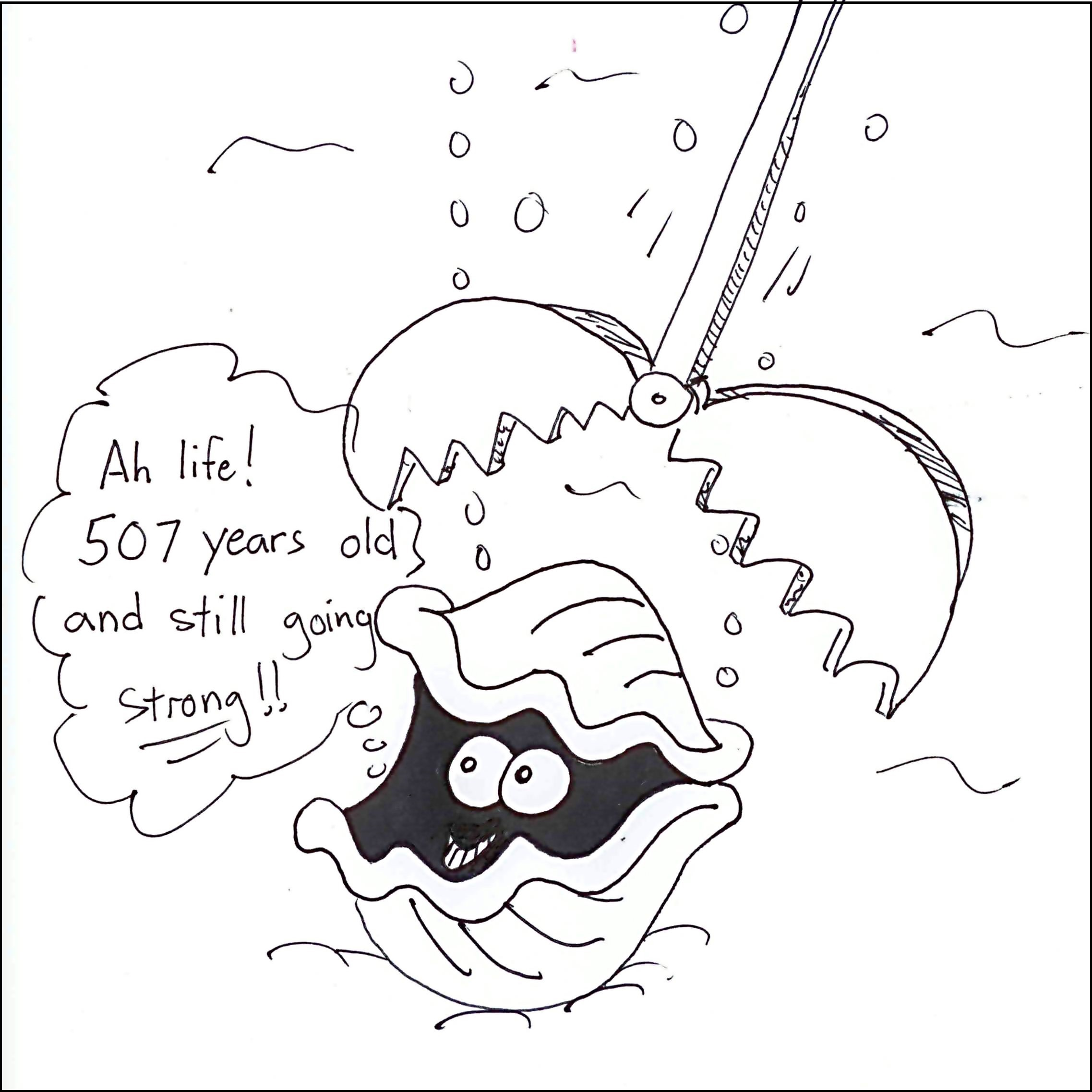
From the "We All Got It Comin'" Files.
In 2006 a group of scientists from Bangor University were dredging the North Atlantic seabed near Iceland as part of a study of climate change when they happened upon a deep sea quahog clam. Unaware of its age, they placed it in a freezer. In 2007 they opened it up to assess its age and discovered it to be the oldest living (individual/non-colonial) creature yet discovered. How old? It was originally estimated to be 405 years old but more recent analysis--which is why this fellow is making news again--of its growth lines, one per season not unlike a tree’s rings, places its birthdate at 1499…two years after Columbus’ famous first voyage to the New World. That made "Ming" the clam (named for the Chinese dynasty in which it first appeared) 507 years old.
And that’s how old good ol’ Ming the mollusk will ever be. In the process of assessing its age, the researchers opened it up and killed it…although I’m not sure why they needed to do that to count its growth lines. Maybe some marine biology majors out there can fill me in.
Find out what's happening in Westfieldfor free with the latest updates from Patch.
It seems such an ignominious end does it not for a creature so noble based on its time on the earth for so long. A half millennium is a long time to evade all sorts of predation and other dangers in the hostile environs of open waters. But Ming endured; it had been present on this planet, quietly going about its harmless business on the cold sea floor, since before the first colony was established in the Americas. The Daily Mail points out that it had lived through the English Civil War, the Enlightenment, the Industrial Revolution and two world wars—only to be killed by accident by scientists who no doubt would very much have wanted to see it live if anything just to see how long it could last.
Find out what's happening in Westfieldfor free with the latest updates from Patch.
Maybe we’ll learn some secrets to longevity from Ming so that its death shall not have been in vain. Although for our size we humans already live a relatively long time. This has more to do with the advance of modern medicine than evolution for our average life-spans have effectively doubled in a matter of two centuries. As a rule of thumb the larger the animal the longer it lives. Galapagos tortoises can live to be almost 200 and some bowhead whales have been found recently with harpoons dating back to the 1790s in their skulls. Orange roughy fish live for well over a century and often end their days not in an old fish home but on someone's dinner plate. The next time you order this fish delicacy at your favorite bistro, consider you may be wolfing down a contemporary of U.S. Grant!
In the case of little Ming, it was probably its slow metabolism that mattered most. That and what I would think was a relatively stress-free life. Nor did Ming smoke or drink, which should be a lesson to us all. In the end, Ming proves that there is a very real correlation between living a low-stress existence and a long life. Perhaps the expression “happy as a clam” has more meaning than we know?
So rest in peace little Ming Methuselah. Old age couldn’t get you, but the modern age could and did. Oh well, you know what they say: "Curiosity killed the clam." (rimshot! Tsss!) Ugh...