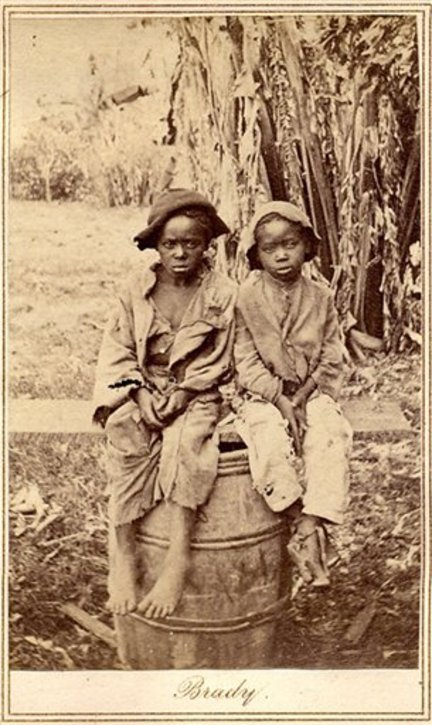

In April of 2010 an undated photo of two slave children was found at a moving sale in Charlotte, North Carolina, accompanied by a document detailing the 1854 purchase of “John” for $1,150. John is presumably one of the children. (The photo was sold to a collector for $30,000). The two forlorn children in this image stare back at us through the chasm of time. They are the ghosts of an ugly national past…the victims of a monstrous injustice that would take the violent deaths of 620,000 Americans to rectify.
Still, as we celebrate the 237th year of American independence, I am struck by the breathtakingly steep arc of moral ascendancy we have seen in this great country since the blood-lettings at Lexington & Concord, Bunker Hill, Saratoga, Monmouth, Cowpens and Yorktown won for us our rightful place among nations. That we have evolved from a country in which African-Americans were once kept as slaves literally in chains and shackles to one that elects a man of African descent to the highest and most powerful office in the land speaks volumes about who we are as a people.
There will be those on the fringe who will predictably use the upcoming Independence Day holiday to highlight the hypocrisy of the Declaration we celebrate. They will mock the document of a slave nation drafted by a slave owner that had the brazenness to announce to the world our vision of a better country founded on the proposition that “all men are created equal.”
But these cynics will miss the point.
The American experiment had to start somewhere. And without that incredibly courageous initial push of the flywheel, the great events that followed which over time would lead to the emancipation of millions from slavery, not just on this continent but throughout the globe where our American presence has been felt, may never have happened. In the late eighteenth century, where tsars and kings ruled Europe, shoguns and emperors the Far East, and slavery was universally practiced across the planet by all races and cultures, our upending of the regal order in favor of popular sovereignty was stunning in its audacity—and quite dangerous to the despots and lords who ruled the world.
Ours was not an uprising of the lows against the highs as was seen in bloody France in the 1790s, but rather it was initiated by the elites of colonial society. Unique in the annals of history, the American Revolution that broke our allegiance to the British Crown was one prosecuted by learned, wealthy men who certainly had the most to lose should their treason be crushed. Indeed, many of these gentlemen revolutionaries would ultimately suffer privation and ruin, and some even death, in the mayhem of a long, drawn-out war even though a final victory was won.
At its heart, the American Revolution was a movement to advance an idea that our basic human rights to life, liberty and the pursuit of happiness originate from a higher power than ourselves: Divine Providence. And since they are God-given, governments are constructed by the people to protect these rights. Thus is it the prerogative, even duty, of free citizens to throw off the yolk of any oppressive regime that seeks to deny us these rights. That governments derive their just powers from the consent of the governed is the essence of the classical American mindset and seems self-evident. It is almost impossible for us to imagine how very radical this notion was at the time.
And so our nation’s inception was as celestial as it was commercial—and that distinctive enlightened quality has been the source of strength behind its durability through many trials and tests over the past 237 years. It also has been the key to our development as a people who can identify a terrible injustice as inconsistent with our founding ideals and rectify it—violently if need be.
As the haunting photograph of the two slave children drives home to us, the Revolution of 1776 was incomplete and fatally flawed in that equality in their day only applied to Whites. For the four million Blacks living in slavery in the United States before the Thirteenth Amendment, it was “all midnight forever.” As an ex-slave once reflected, her elderly voice pressed on a crackly vinyl recording: “You know what I’d do if I ever had to be a slave again? I’d take a gun and end it. ‘Cause you ain’t nothin’ but a dog.”
But that was then. This nation has rolled over and been remade many times since the dark days of the triangle trade. As any visitor to Gettysburg will attest, many Americans paid the ultimate price to wash away our original sin. Today, we citizens of the United States, all 315 million of us, can look back with pride at our Independence Day which relays the story of a new birth of dignity for mankind and the first courageous step taken in the long road to freedom on behalf of generations to come.
I wish more of my countrymen and women could understand just how positive a force the signers of the Declaration of Independence unleashed upon the world. Today, where we must endure an almost fetishized rejection of our core Western values in favor of cultural relativism nonsense at home—not to mention a rabid anti-Americanism abroad—it sometimes takes an outsider to see us as I wish more of us would view ourselves.
Former British P.M Tony Blair once astutely observed:
“I am not surprised by anti-Americanism; but it is a foolish indulgence. For all their faults—and all nations have them—the US are a force for good; they have liberal and democratic traditions of which any nation can be proud. I sometimes think it is a good rule of thumb to ask of a country: are people trying to get into it or out of it? It’s not a bad guide for what sort of country it is.”
In 1776 the US population was less than three million. Today it is over one hundred times that. That says much for the nation the brave delegates to the Second Continental Congress created on our behalf. And even for those not fortunate enough to reside here, hundreds of millions live in liberty in foreign lands as direct beneficiaries of the ideals that our Founding Fathers so confidently and defiantly announced to the world as moral truths…even in the face of a massive flotilla of British warships anchored off Staten Island preparing to crush their impertinent rebellion.
We who dwell in this shining city on a hill on this day in 2013 are the beneficent custodians of the principles handed down to us by extraordinary people from many walks of life and successful in their fields of endeavor in the New World. These were educated and farsighted individuals who at the right place and right time came together to overcome their personal fears and sectional differences to launch a revolution of ideas that continues to inspire the world going on two and a half centuries after the fact: Thomas Jefferson, John Adams, Benjamin Franklin, George Washington and many others whose names are lesser known but no less deserving of our gratitude.
For our parts, we are tasked with carrying a reminder, as seen through the eyes of those two slave children who have long since passed into history of what can still happen to our liberties should we abandon those founding principles that made us the great country we are today.
HAPPY INDEPENDENCE DAY!