Arts & Entertainment
Local Artists Showcased in Barron Arts Center 9/11 Exhibit
"In Memoriam: Creative Responses to September 11," runs through Oct. 2.
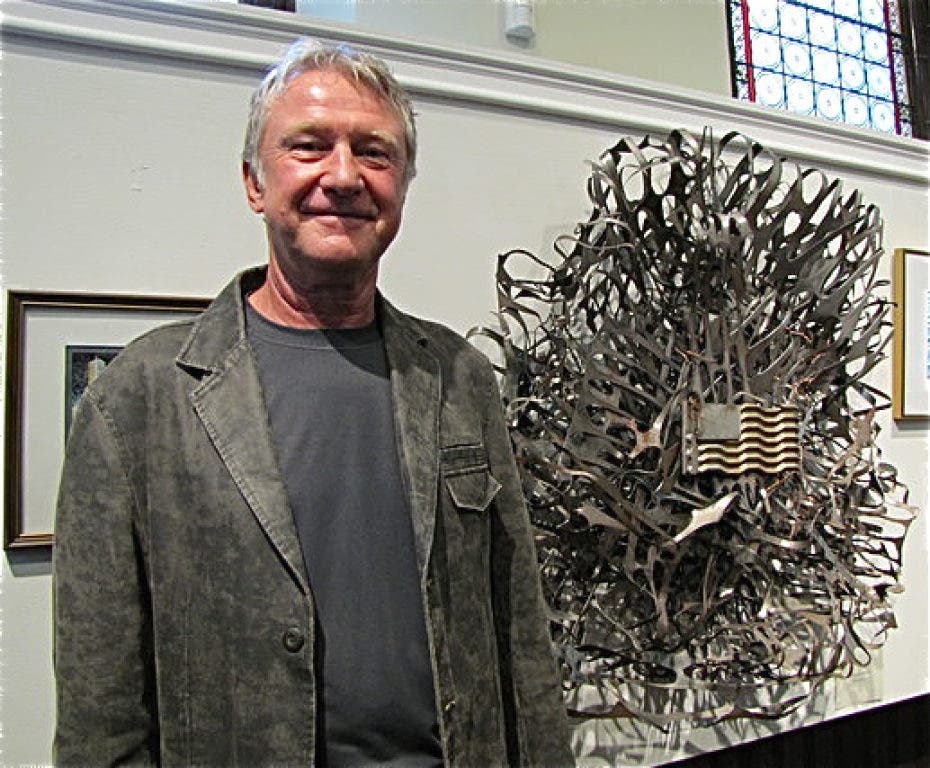


The overflow of human expression continues more than a decade after the tragedy of the World Trade Center attack. On the anniversary of of 9/11, the Barron Arts Center began its exhibit, “In Memoriam: Creative Responses to September 11," commemorating those who lost their lives, as well as those who were forever changed on that fateful day.
The exhibit, which runs through October 2, has a fitting venue in the Barron Arts Center. Originally a library, the Arts Center, with its stained glass windows and Richardsonian Romanesque Revival architecture, looks more like a church. Though brightly lit and cheerful, the interior of the building nonetheless gives off a chilly draft, reminding any visitor of the spirits it’s conjured.
Upon entering the exhibit room, visitors are faced with one of the unfortunate first pieces of 9/11 “artwork” to be created: a piece of steel from the Twin Towers itself. On loan from George Vassillades, president of the Colonia Senior Club, the tiny monolith speaks volumes of its historical roots - like Stonehenge - long after 9/11 is ancient history. For now, on its pedestal, with the stained glass window shining in the background, the piece resembles a podium with no preacher. But its sermon is clear and well known.
Find out what's happening in Woodbridgefor free with the latest updates from Patch.
Behind this living steel is what one would assume to be a companion piece: “A Nation in Shock” by Glenn Murgacz, a metal mash-up with corrugated American flag pressed firmly in the center, is a companion piece in spirit only. Murgacz said it came about quite by accident.
“Using these pieces from a sculpture I had previously made, this was left over. When I piled them together, I recognized there was the possibility of another sculpture.”
Find out what's happening in Woodbridgefor free with the latest updates from Patch.
After a co-worker suggested putting in the American flag, Murgacz said it seemed perfect.
“It’s one of those happy accidents," he said.
Viewed from a few feet away, the metal flag gives off an illusion of red and blue. Even on photo, the ghostly aura of America appears superimposed on the twisted metal body of its legacy.
Immediately to the left is “Untitled 1,” by Marcella Sabo, showing a firefighter sitting down, faced pressed into his (or her) knees, a small sliver of red oozing down the side of the helmet. “Untitled 1” in name as well as presentation tells, in a subtle way, the reaction of rescue workers on 9/11, faced with the unanswerable.
Another simple, subtle, yet in its own way, heartbreaking work is Julius Webber’s “The Evening Before.” A more traditional painting using painting knives rather than brushes, "The Evening Before” is nonetheless a piece of science fiction. It’s a portal back to a time when America was just a little more innocent, one day before the tragedy that would affect America forever. The calm waters, the finger-nailclipping size flicks of paint that become seagulls when viewed from a distance, and the large steamer in the foreground brings as tranquil a scene as is possible in 21st century America. The Twin Towers are mere stubs in the background; their presence, much larger in retrospect.
“I’ve done quite a bit of area paintings,” said Webber, “and this is where the idea came from. I did the bombing of Pearl Harbor a number of years ago when I was younger. That’s what this (9/11) reminds me of, but I’ll take it this way, as it was before.”
Of course no art exhibit would be complete without its overt political statements. While some prefer to bask in the nostalgia of simpler times, or constantly live in the moment, some are pressing forward by any means necessary. “Wake up America” by Danny Scott, a collection of video clips from 9-11 shown on a small 13-inch TV gives us the precise gut reaction we all felt on that day. But the horrors depicted in “Wake up America” serve more as a cautionary tale, not for armed retaliation, but as a reminder that, as Thomas Jefferson put it, “The price of freedom is eternal vigilance.”
The fragility of the nation as shown in “Wake Up America” leads us to an equally fragile representation of the World Trade Center: “Twin Towers,” by Shannon Yaskulka, a scale model of the Towers themselves. Pasted with newspaper clippings, “Twin Towers represents a tenuous relic, empty of life and precarious, as only a model of a legendary building could be. The newspaper clippings, composed of random headlines, gives the impression of a store out of business for good.
The essence lacking in “Twin Towers” is fulfilled in both “9/11,” by Priscilla Smith and “Faded Memories,” by Richard Morris. “9/11,” a potpourri of fragmented buildings, silver badges, and geometric shapes, leaves the impression of a fractured soul. “Faded Memories,” with its simple use of silhouetted Statue of Liberty and large doves, returns that soul to the tranquility of what once was, if not on earth, then perhaps in the next life.
In the end, however, art, much like beauty, is in the eye of the beholder. As much as we may find artistic merit in a tragedy, the true exhibit ultimately comes from the people who view it. The firefighters looking at “Twin Towers at Night,” by Margie DeAngelo, a simple photograph, speaks volumes of our nation’s memory. And the various children’s paintings and envelopes are a naïve, yet touching reminder of our future generations’ inability to completely comprehend this tragedy, while at the same time attempting to carry a very large torch for the next. One is reminded of George Santayana’s famous quote, "Those who cannot remember the past, are condemned to repeat it."
For more information, call the Barron Arts Center at 732-634-0413.