Neighbor News
Fox Lane Physics Grand Prix Encourages Students to Try and Try Again
The annual race is a beloved high school tradition

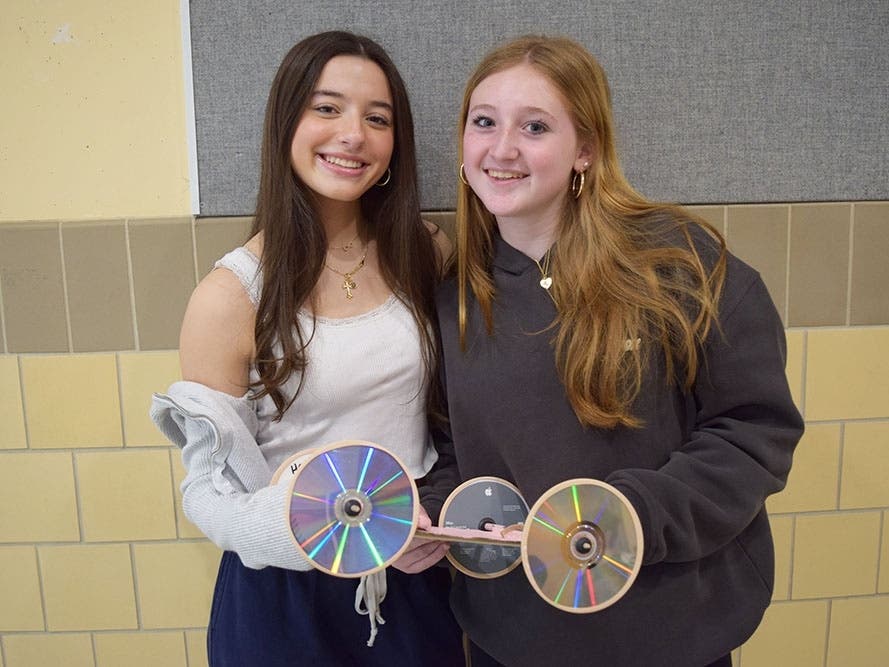

“NASA is going to hire us!” a first-year physics student at Fox Lane High School joked with his friend. He and his partner were about to send a car they designed down the track created in the sunny Broadway hallway for the annual Physics Grand Prix. The goal for each duo was to have their car travel at least 16 meters powered by one #64 rubber band.
The event, which saw roughly 160 participants, involved students from Physics Regents and Physics with AP Science. They each had three attempts to meet the goal.
“As students work through this challenging project, they integrate all of the different parts of the engineering design process, including brainstorming, designing, building, evaluating, and revising to arrive at a solution that meets the goal of the project,” said physics teacher Jerry Ludwig.
Find out what's happening in Bedford-Katonahfor free with the latest updates from Patch.
Students begin the project by looking at the design through a physics lens.
“They make design tradeoffs during the build that consider mass, elastic force, sliding and rolling friction, momentum, and energy,” science teacher Sal Tatto said. “At the onset of the project, students expect their cars to transfer energy efficiently, but they discover through their own analysis that most of the stored energy available in the stretched rubber band is used to overcome the aggregate force of friction and not produce speed.”
Find out what's happening in Bedford-Katonahfor free with the latest updates from Patch.
Kayla King and Kate Vitti considered friction before the race, and it worked in their favor. Their car traveled 24.6 meters, coming in third place for distance.
“We used rubber bands around the tires for friction,” Kayla said.
Other students worked through their difficulties during the race, making adjustments before their second and third tries.
“We had a spoiler, but we took it off and it went further this time,” one group said as they came back from a triumphant third run.
“Ours keeps slowing because the bottom right wheel hits against the cardboard,” another student said to his partner between tries.
“Why does mine keep going to the right?” a frustrated student asked her teacher.
Students watching on the sidelines—as well as Dean Dan Mulvey—cheered participants on and gave them advice after less-than-successful runs.
“You have too much mass,” one onlooker told her peers. “Too much mass isn’t good. You should test it before you go again.”
Just as important as the design, build and performance components of the project is the post-analytical work students do. Students answer the question, “How is the rubber band-powered car connected to physics?” All of their work is then organized into a written report or well-thought-out video.
“In addition to designing, building, testing and analyzing, students work collaboratively; independently set goals, milestones and benchmarks; work through frustrations and setbacks; and realize that success is possible through their own effort,” science teacher Jim Doller said.
Ludwig, Tatto and Doller love the fact that this tradition unites all Fox Lane physics students.
“The event is a bond connecting all of our students together,” Ludwig said. “And it is a day when we get to see all of the students taking physics at Fox Lane. Perhaps just for one day, the three of us are team-teaching all of our students together.”
They also love the excitement that comes when a car performs better than students expected or just makes it across the 16-meter line.
“As with all we do, this is a day when we hope to have the students face a challenge head-on,” Ludwig said. “We want to see them problem solve, design, build, redesign, rebuild and best the challenge. And if there was adversity, we want to see them reflect, learn and do better. That is a good day.”
And now, to celebrate the winners!
Maximum Distance:
- 1st place: Jocelyn Wierzchowski and A.G. Nikprelaj - 27.1 meters
- 2nd place: Zach Stark and Max Lutz - 25.4 meters
- 3rd place: Kayla King and Kate Vitti - 24.6 meters
- 4th place: Saba Shahidi and Ashley Del Cid Romero - 23.8 m
- 4th place: Kevin Schiltz - 23.8 m
Engineering Design (in no particular order):
This achievement award is earned when a car’s engineering design is unique and/or the car is built with extraordinary precision. These cars have transmissions, methods to reduce friction, the ability to steer, parts cut using a laser cutter or made from a 3D printer, etc.
- Nei Lauscher
- Jocelyn Wierzchowski and A.G Nikprelaj
- Raphael Ciriaco and Daniel Gjonmarkaj
- Ashley Hernandez Salazar
- Alex Berisha and Cameron Bahari
Best in Show (in no particular order):
The last category is for cars that have an artful thematic quality. Not only does the car function and meet the minimum level of achievement, but the students also took the time to decorate thematically.
- Lauren Horowitz and Maddy Wills
- Sasha Rapoport and Lily Kimble
- Ashley Ramirez and Karen Lopez
- Sophia Alvarez and Juana Recinos Peralta
- Melanie Perdomo Diaz and Angie Contreras Cruz