Neighbor News
Hands-On Presentation Teaches Students About Nocturnal Animals
West Patent second graders participated in activities to gain understanding


In a darkened classroom at West Patent Elementary School, second graders sat quietly with their hands cupped around their ears so that they were shaped like a deer’s. Patrick Harmon, a naturalist with the Center for Environmental Education at Putnam | Northern Westchester BOCES, played them audio clips and asked them to try and name different animal sounds. Later, students reached into a bag and sorted through rocks to find fake bugs, simulating how raccoons hunt for food in the dark. These engaging sensory activities were part of the “Nocturnal World of New York” program that taught students about the special adaptations of nocturnal animals.
“What adaptations help animals survive at night?” Harmon asked the students as a video of a deer in a dark forest played on the screen behind him.
“When their ears are big, they can hear if a predator is coming!” one student said. “And they twitch so they can hear everything.”
Find out what's happening in Bedford-Katonahfor free with the latest updates from Patch.
This led to a discussion about how hearing adaptations help some animals, while things like opposable thumbs, night vision and a strong sense of smell help others.
“Bears' noses are long, and they can move them around to help them smell,” Harmon told students. “They sometimes open their mouths too because their taste buds are connected to their sense of smell.”
Find out what's happening in Bedford-Katonahfor free with the latest updates from Patch.
He then showed them a bear skull — carefully explaining that all of his artifacts were from animals who died of natural causes — and pointed out how large the nose hole was.
“Is that a real skull?!” one student called out, excited to examine it up close.
Students were also able to inspect a river otter pelt after learning that they have a thick, double layer of fur that helps keep them dry.
They spoke about owls, with one student explaining to her peers “They can turn their heads to the very back, but they can’t turn their eyes!”
Harmon added to her description, showing students photos of owls.
“Their eyes are so big they’re half the size of their skull,” he said.
“Oh my!” one student called out.
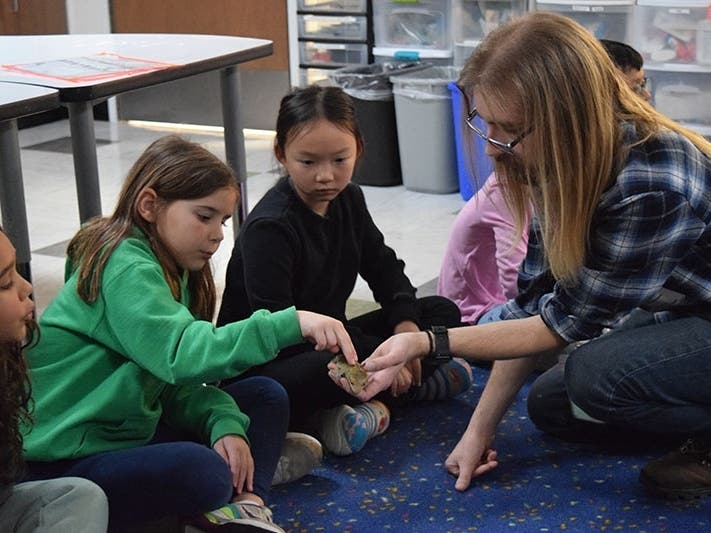
At the end of the presentation, Harmon brought out a very special guest: Louise, a 10 to 14-year-old crested gecko.
“Woah, she’s like a teenager!” a student said, leaning in closer to get a better look. They all had a chance to pet Louise, being careful to do it gently so as not to alarm her.
“Her toes are so sticky!” a student said with a giggle. Harmon explained that sticky toes are another adaptation.
Through sensory activities, examining artifacts and meeting an animal ambassador, students got an in-depth look at nocturnal animals and gained an unforgettable understanding of how specialized senses and adaptations help them survive at night.