Business & Tech
Verizon Strike Update: Day 23, Workers Mobilize, Company Cuts Health Benefits
Catch up on the latest news about one of the largest worker strikes in recent American history.


Editor's Note: This article is part of a series. Catch up on the latest news update here.
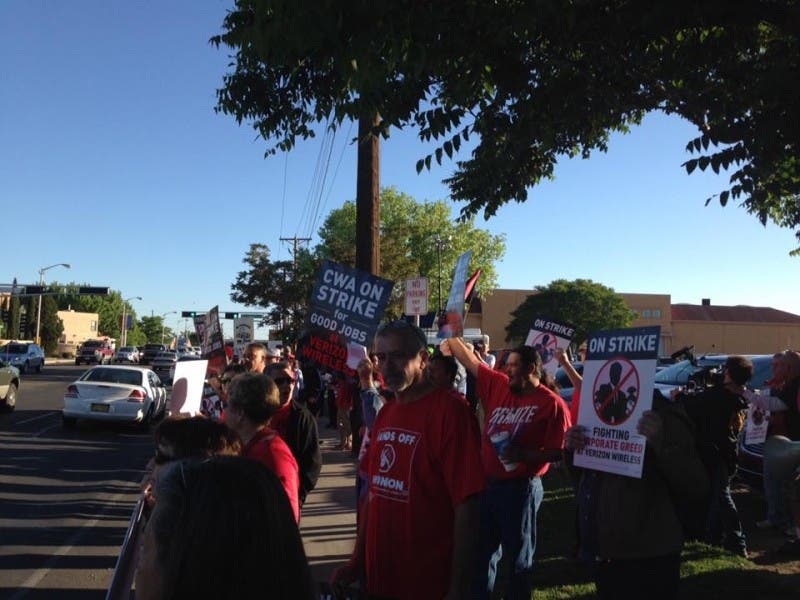
May 5, 2016 – As the Verizon labor stoppage of 2016 entered Day 23, almost 40,000 striking workers with the communications giant called for a national “Day of Action” on May 5.
Union leaders organized a protest outside a Verizon shareholder meeting in Albuquerque on Thursday morning.
According to a union news release, 250 supporters protested outside the meeting and 15 people were arrested – including union members and community supporters – after the group dropped a 70-foot banner reading “Verizon: Good Jobs, No Greed” across the busy Rio Grande Boulevard and then laid down on the banner to block traffic.
About 400 protests are planned to take place on Thursday nationwide today in support of striking workers, union leaders said.
A list of planned protest sites and times can be seen here.
Union members with the International Brotherhood of Electrical Workers (IBEW) and the Communications Workers of America (CWA) have been on strike since April 13.
Meanwhile, union members marked their 5th day without company medical coverage after Verizon officially cancelled health benefits for striking employees on May 1.
Both the CWA and IBEW informed their members about what to do about benefits while they strike in addition to signing up for COBRA coverage, which can include premiums that reach thousands of dollars per month.
“Members may have the ability to enroll in their spouse’s coverage under a ‘life event,’” IBEW representatives stated. “Loss of coverage under an employer is considered a qualifying event.”
In addition, the Affordable Care Act allows members to sign up for insurance through a special enrollment, which includes loss of coverage under an employer, IBEW representatives wrote.
CWA leaders took their pledge to help members with healthcare coverage a step further.
According to a union statement:
“CWA has pledged that no striking member or family member will go without medically necessary health care during the strike. CWA will pay for all necessary medical/hospital expenses incurred on May 1, 2016, or later… In limited cases the CWA Fund Director for District 1 will authorize payment of COBRA premiums on behalf of strikers and their families.”
“Strikers who can obtain healthcare coverage through a spouse or parent during the strike should do so,” CWA leaders added.
Dennis G. Trainor, Vice President, CWA District One and Ed Mooney, Vice President, CWA District 2-13 issued the following scathing statement in response to Verizon’s decision to pull health coverage:
“It is unconscionable for a company that made more than $4 billion dollars in profits in the first quarter of 2016 alone to cut off health care benefits for the workers who created those profits. This heartless move by Verizon shows why the strike is so important.”
Photo: Stand Up To Verizon, Facebook
HISTORY OF THE STRIKE
Contract talks between Verizon and members of the International Brotherhood of Electrical Workers (IBEW) and the Communications Workers of America (CWA) began in June of 2015.
The workers’ last contract expired on August 1, 2015.
Employees in nine Northeast and Mid-Atlantic states plus Washington, D.C. began striking on April 13.
- See related article: Verizon Workers Prep For Massive East Coast Strike
- See related article: Massive Verizon Strike Begins
Since then, strike activities have taken place up and down the Eastern Seaboard.
- See related article: Verizon Striker Says Union Won't Fold, Picketing Will Continue
- See related article: Striking Verizon Workers March on Boylston Street
- See related article: Brooklyn Verizon Worker Challenges CEO to Climb a Telephone Pole
Bargaining efforts between Verizon and the unions remained mostly stagnant through the first weeks of the strike.
- See related article: Verizon Strike: Bargaining Not Going Well, Union Reps Say
On April 21, Verizon released a statement that claimed the company has been the victim of 24 recent “suspected incidents of sabotage” in five states.
- See related article: Verizon Strike 2016 Update: Alleged Industrial Sabotage, Service Issues
As the strike reached week three, union leaders and workers released photos and videos that alleged the company’s replacement workers weren’t up to the task and were creating safety issues.
- See related article: Verizon Strike Update: Replacement Workers Unsafe, Unions Allege
Complications resulting from the strike have reportedly caused lengthy service delays for the company's 140 million customers who use Verizon for cable television or Internet connections and even longer waits for new subscribers wanting Verizon's FIOS and mobile services.
- See related article: Verizon On Strike: Internet, Cable Outages Could Take Weeks To Repair
On April 28, 2016, Verizon's Chief Administrative Officer Marc Reed announced that the company has put its “last, best and final offer” on the table.
Verizon presented each of the striking workers’ bargaining units – the New England, Mid-Atlantic and New York IBEW and the New York/New England and Mid-Atlantic CWA – with separate contract offers, which can be seen here.
“Unfortunately, their ‘last and best’ was little more than the same old [expletive]," union leaders with the CWA District 1 bargaining team wrote after the April 28 meeting.
“We will continue bargaining and striking until we get the contract that you deserve,” union leaders concluded.
- See related article: Verizon Strike 2016 Update: Unions Decline Company's 'Final Offer'
Verizon officially cancelled health benefits for striking employees on May 1.
Reed reported an unfruitful bargaining meeting with the Mid-Atlantic unions on April 29, and an equally unsuccessful meeting with the New York/New England units on May 2.
“We met with the New York/New England unions and they made a proposal that was not constructive,” Reed stated. “We rejected the unions’ proposal and reiterated that they have our last, best, final offer.”
Union leaders reported that they made some “compromise proposals” in several areas during the May 2 meeting, designed to “kick-start the bargaining process.”
“The company completely dismissed our proposals without even asking clarifying questions,” CWA leaders reported.
Striking Verizon workers – acting under the banner of the “Stand Up To Verizon” coalition – launched a national “Day of Action” on May 5.
- See related article: Verizon Strike: Workers Mobilize, Company Cuts Health Benefits
THE ISSUES
Union representatives are alleging that even though Verizon made $39 billion in profits over the last three years, the company wants to “gut job security protections, contract out more work and send jobs overseas, and require technicians to work away from home for as long as two months without seeing their families.”
Verizon summarized its April 28 contract offer in a series of online videos that were immediately criticized by union leaders.
WAGE INCREASE
Verizon has stated that the striking employees have a wage and benefit package that averages more than $130,000 a year.
However, union leaders have asserted that the average salary of the striking Verizon workers is closer to $74,000 a year.
“Customer service reps average about $69,000 a year, and highly skilled technicians, who install or service FiOS and have five or more years of experience, top out at $84,600 in New York and about $76,000 elsewhere.”
According to Verizon, workers would receive a 7.5 percent salary increase over the term of the proposed contract, up from a previous offer of 6.5 percent.
However, union leaders have stated that the increase was made to trick workers into glossing over the rest of the company’s offer.
“If you [look further], you will find that the 7.5 percent will be eaten up by paying more for prescriptions, co-pays, deductibles and premiums,” union representatives stated. “Your gas cost will also increase due to travel above your current commute.”
JOB SECURITY
According to Verizon, if the unions agree to certain “workforce flexibility proposals,” job security for currently classified workers will continue for the term of the contract.
But union representatives counter that the proposal is a “path to eliminate all of us.”
Union leaders charged that the “workforce flexibility proposals” will mean:
- “We agree to sell out our members hired prior to August of 2003 and allow them to be transferred an additional 50 miles from the commute they have now”
- “We agree to close 11 offices and force 123 members to drive up to an additional 70 miles one-way”
- “[We agree to] a ‘special incentive offer’ for jobs [Verizon] contracts out with no guarantees of backfilling those jobs with internal or external hires”
PENSION
Verizon stated that under the proposed contract, workers who currently participate in the company pension will continue to earn service credit up to a maximum of 30 years, in addition to three, 1 percent annual increases.
“If you already have 30 or more years of service, you will keep everything you’ve already earned and you will receive the pension increases (assuming you are on payroll as of the date of each increase) but you will not earn any additional service credit,” Verizon stated.
In addition, the company match for employees’ 401K plan will continue, according to Verizon.
Union leaders claim that in layman’s terms, the company is attempting to “freeze the pension plan for eligible associates at 30 years.”
“They are also proposing to modify the cash out option,” union leaders stated. “The calculation method proposed will significantly reduce your lump sum cash out if you elect that option upon retirement. The 1 percent annual increase will effectively be negated by this new calculation.”
HEALTHCARE
Workers’ contributions towards their healthcare coverage will increase under the proposed contract, Verizon stated.
For example, employees with single coverage will have a $4.85 increase per paycheck in the first year of the contract, a $2.77 increase the second year and a $3.23 increase the third year, Verizon stated.
The proposed contract also has changes to employees’ deductibles and copays, as well as prescription drug coverage due to “escalating drug costs,” Verizon stated.
“The wage increases you will receive will be greater than the average increase in healthcare expense over the life of the contract,” Verizon asserted in its offer.
Union representatives countered that workers will see cost increases to their healthcare that include:
- A $325 increase to the managed care network deductible by 2018
- A $650 increase to “out of pocket” expenses by 2018
- A $1,128 increase to annual contributions for a family and a $564 increase for individuals
- A $1.60 increase to generic prescription drugs (retail) by 2018
“Today we have an open formulary, meaning the plan covers medications your doctors deem necessary,” union leaders stated. “[Verizon] proposes a closed formulary, meaning the plan will only provide medications the insurance company deems necessary based on costs for any particular condition.”
WORK ASSIGNMENTS
“Our earlier proposals could have allowed for assignment of technicians over great distances,” Verizon stated.
“We are focused on minimizing force imbalances in nearby states,” Verizon added. “We have narrowed this proposal so that you could not be temporarily involuntarily assigned to a location in another state outside New England if it would require an overnight stay (board and lodging). If you are a technician, you could be assigned to another state outside New England for up to 60 days in a year, but only to a distance that you could commute from at the end of the shift without staying overnight. We have offered to withdraw this proposal altogether if we reach a ratified agreement by May 20.”
Union representatives had this to say:
“This [stipulation] will be withdrawn if CBA is ratified by May 20, so it must not be critical to the company… This type of proposal should not be part of bargaining at this late stage.”
Editor's Note: Patch will update this article as new information develops; check back here for the latest news on the Verizon worker strike.
Send news tips to eric.kiefer@patch.com
Get more local news delivered straight to your inbox. Sign up for free Patch newsletters and alerts.