Politics & Government
Bronxville's Mayor Blasts State's 'Unrealistic' Tax Cap Legislation
In her latest column, Mayor Marvin says there are better, more fair ways for New York to generate revenue.


By Bronxville Mayor Mary Marvin
The New York State Comptroller’s Office recently announced that beginning with the June 2016 budget cycle, the 2 percent tax cap law will translate into only a .12 percent tax ceiling for villages to be in compliance.
This unrealistic limit is the result of the wording of the law, a signature piece of legislation for the Governor, which limits spending growth to 2 percent or the rate of inflation, whichever is lower.
Find out what's happening in Bronxville-Eastchesterfor free with the latest updates from Patch.
In contrast, state spending is not limited in this way nor are the projected increases in the over 200 unfunded mandates delivered to Villages from Albany yearly.
As is evident, the tax cap operates in a politically expedient vacuum devoid of economic realities.
Find out what's happening in Bronxville-Eastchesterfor free with the latest updates from Patch.
Though rhetorically brilliant, the long term detriment of the tax cap cannot be overestimated.
As illustration, if Bronxville were to come in under the cap in this budget cycle, we would have to forfeit $5 million plus in FEMA flood mitigation monies as our 12.5 percent matching share would exceed the cap limit.
Unlike the exception for school districts, capital improvements and infrastructure repairs undertaken by a municipality are not exempt from the tax cap spending calculation. This prohibition creates the most powerful disincentive for communities to repair what is one of the Nation’s most aging infrastructures.
In an effort to counter the unrealistic .12 percent spending increase ceiling, many of our neighboring Villages including Tuckahoe, Irvington, Dobbs Ferry, Ardsley and Hastings petitioned for a 3 percent hotel tax on each rented room – the logic being that the revenue would be a user tax, not a property tax, and the increased funds would keep local services at least flat.
Even though the Governor signed an almost identical bill allowing the City of Yonkers to generate this revenue, he vetoed it for local Villages over the objection of most of Westchester’s elected officials as well as the bipartisan Westchester Municipal Officials Association.
Why the disproportionate burdens on Villages - be it the unrealistic .12 percent tax cap, the lack of an exemption for capital/infrastructure repairs and the continuation of the Metro North tax for municipalities only? (costing our Village a half percent tax point yearly)
As a close follower of the current Governor’s statements, I have concluded that the tax cap legislation and the recent veto are rooted in the Governor’s overarching goal of municipal consolidations.
When he was our Attorney General, Mr. Cuomo’s office submitted a bill allowing any citizen of New York State to start the process of the dissolution of a Village, regardless of whether he or she lived in that village, by garnering the support of just 10 percent of the residents who voted in their last Mayoral election. To put the Governor’s bill in context, a non-resident would need to find only eight Bronxville residents to force a Village-wide referendum or vote on dissolution. The incredibly flawed bill was amended several times but the new bill that was passed has provisions that require communities to vote on their own dissolution before a consolidation plan and financial impact statement are produced. The Village of Seneca Falls went this route and is now mired in years of litigation as to cost sharing and financial obligations with its merged town.
On the subject of consolidation, Governor Cuomo states that there are 10,500 government units in New York State, far too many in his estimation. Refuting this, the State Comptroller’s Office sets the number at 4,200. Included in both calculations are all of the Off Track Betting operations and Industrial Development Authorities which have no taxing authority so both numbers are misnomers.
In his stump speeches, the Governor states, “I support consolidations. I think if you said to the taxpayers of most districts in this state, I know you like to have your name and identity. Is it worth $2,000 a year, (the supposed, though undocumented, savings from consolidation) to have your name and identity, they would say, change my name.”
The statistics don’t bare this out. Since the most recent revision of the Consolidation Law was enacted in 2007, thanks to the Governor’s efforts as Attorney General, one community in the state, Altmar population 407, has consolidated with their neighbor.
Based on the federal census of local governments per capita, there is also no correlation between the number of governmental layers and a person’s relative tax burden.
Two of the most intensely governed states are New Hampshire and Oklahoma, yet they are two of the least taxed.
New York and New Jersey are near the bottom in governmental units, yet near the top in tax burden. This is the result of New York’s “trickle down” policy of making local governments shoulder tax burdens shifted from Albany.
In Westchester County alone, $225 million collected annually at the local level is remitted to Albany for the State Medicaid program. Westchester County taxpayers could see this $225 million in local tax relief immediately if the Governor and the State Legislature would only do what 49 other states have done already and fund Medicaid at the State level.
The consolidation theme mirrors the tax cap mantra in its political appeal and simplicity of message, but again does not address the true underlying issues. Eliminating a few positions in a Police or Public Works Department does nothing to ameliorate the underlying unsustainable pension system. Rather, consolidation puts an added distance between the tax payer and their government. I would also argue that elected officials closest to the impact of their decisions and personally sharing the financial consequences thereof, make the more efficient decisions and are directly answerable to their constituents be it at Village Hall or in the aisles of Value Drugs.
Consolidation decisions should be made on factors unrelated to the vicissitudes of the current Albany agenda, rather on the benefits to the most important special interest group, the New York State taxpayers.
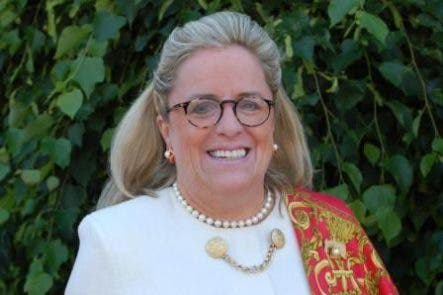
Photo: Bronxville Mayor Mary Marvin. Photo credit: Contributed
Get more local news delivered straight to your inbox. Sign up for free Patch newsletters and alerts.