Politics & Government
Mayor Marvin: Connecticut Should Pay Fair Share of Metro-North Maintenance
Bronxville's top official is calling on residents to urge the MTA to correct the imbalance in what Westchester and Connecticut residents pay


By Bronxville Mayor Mary Marvin
My continued sojourns to Brooklyn have prompted me to become more interested in our train station and railroad system as well as the nearby environs.
The current station is actually the third permutation of a rail station in our Village. The first was a wooden house built in 1844 on the Village’s eastside at the time the tracks were laid when Bronxville was known as Underhill’s Crossing. Its architectural distinction was separate waiting rooms for men and women. Starting in 1852, it also served as our first post office replete with 14 mail slots for local deliveries.
Find out what's happening in Bronxville-Eastchesterfor free with the latest updates from Patch.
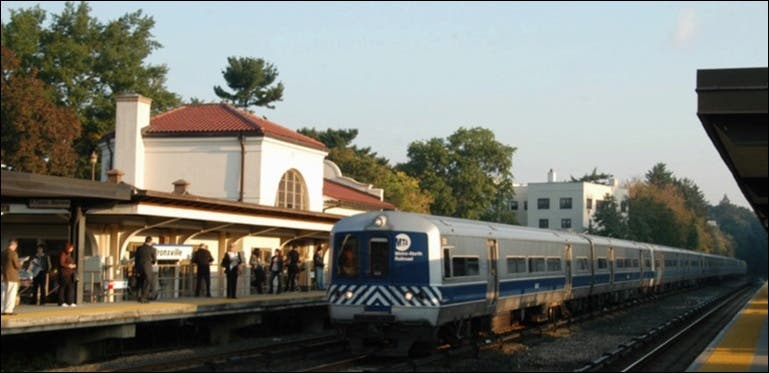
In 1893, again on the east side only, a stone and wood structure was built to emulate a country home. During the period of 1904 to 1914, seven people died at the crossing to the west side but only after much controversy was the underpass constructed and a second west side station built in 1916. Designed in a Spanish Mission revival style to mirror the nearby Gramatan Hotel, our current station had a baggage room and rows of church pews in the nave like main room.
The last restoration was in 1998 coinciding with the Village’s 100th Birthday Celebration.
Find out what's happening in Bronxville-Eastchesterfor free with the latest updates from Patch.
The current Metro North rail system, under the umbrella of the Metropolitan Transportation Authority, resulted from the early mergers of the New York Central and Pennsylvania Railroads. The larger entity was created by Governor Nelson Rockefeller as a public benefit corporation in 1965 as a way to purchase and operate what was a bankrupt LIRR system.
The MTA has the distinction of being the largest regional public transportation provider in the Western Hemisphere with a catchment area of 5000 square miles and 14.6 million people.
The system operates in 12 New York State counties as well as two in Connecticut. Eleven million people travel the rails daily with 800,000 passengers using the seven bridges and two tunnels in the system on a daily basis.
The Bronxville commute is traditionally on 12 car trains traversing the 15.3 miles in 36 to 42 minutes. (When the system first started the same trip took 62 minutes and when I moved here 20+ years ago, it was only a 28 minute ride). The Metro North rail fleet is significantly older than the LIRR equipment and travels 24% fewer miles before breaking down.
It currently takes 65,000 employees to operate the system, with a budget of $14 billion dollars, two-thirds of which goes to the employees. Due to some comparatively generous labor agreements, 40% of the aggregate labor costs fund healthcare, pension benefits, retiree health care and other fringe benefits.
Actual train ticket costs cover only 40% of the yearly operating costs and tolls only covering 12% of bridge and tunnel expenses.
The balance is made up by seven separate taxes paid by the State, New York City and the adjacent New York State counties. The balance/fairness of payment obligations is a current source of tension between Governor Cuomo and Mayor Di Blasio. Currently, the state contribution is only 4% of the yearly obligation.
What came as a complete surprise to me and most of my elected colleagues is a “platform maintenance tax” imbedded in our County tax bill.
Westchester County and its property tax payers contribute $28 million yearly to the MTA under this obligation. The Town of Eastchester pays $1.3 million of this total with the Bronxville Village share $406,000 annually.
Residents from Connecticut pay $0 toward the platform maintenance tax despite heavy rail usage and the presence of multiple stations while residents of Pound Ridge pay $372,000 and they don’t even have a platform to maintain. One only has to look at our station to know nothing close to $400,000 annually is dedicated to station maintenance. As a point of interest, the Village has often offered to paint fences, clean up garbage, repair benches on Metro North property but the MTA has turned down our offers due to liability/insurance issues.
Riders from Connecticut provide $156 million less in subsidies than the yearly MTA services they consume with New Jersey riders contributing $56 million less than their proportional share.
Adding inequality to inequality, New York State businesses, including Village government, also pay a payroll tax directly to the MTA to offset the deficit. In the Village’s case it is $30,000 plus per year or almost a ½% tax obligation in our budget.
The entire system is governed by a 19 member board with seats earned through political appointment rather than expertise in the transportation delivery system. The Governor appoints five members, the New York City Mayor four and the County Executives of Nassau, Suffolk and Westchester each one.
The County Executives of Rockland, Dutchess, Orange and Putnam Counties each get an appointment, though their representatives only account for a one quarter vote each. The remaining seats are filled by members of organized labor and a citizens’ advisory committee.
The Westchester Municipal Officials Association, which represents all 45 Westchester Communities, has joined the argument against the inequitable platform tax as an additional burden on Westchester property tax payers vs Connecticut residents who are a significant percentage of the MTA New Haven ridership but are exempt from the tax.
Net-net, Connecticut residents who take advantage of the rail system daily are having their costs subsidized by Westchester residents, many of whom who do not use the train service.
I urge you to reach out to our legislators to redress the imbalance. Unfortunately, this is just another reason why New Yorkers are often reluctantly leaving the area because of our high cost of living.
Photo: Bronxville Train Station. Photo credit: NYCSubway.org
Get more local news delivered straight to your inbox. Sign up for free Patch newsletters and alerts.