Neighbor News
The Green-Wood Cemetery Announces 2024 Research Fellows
New Partnership with Perfect Earth Project Enables Two Research Teams to Use Green-Wood as Their Field Lab


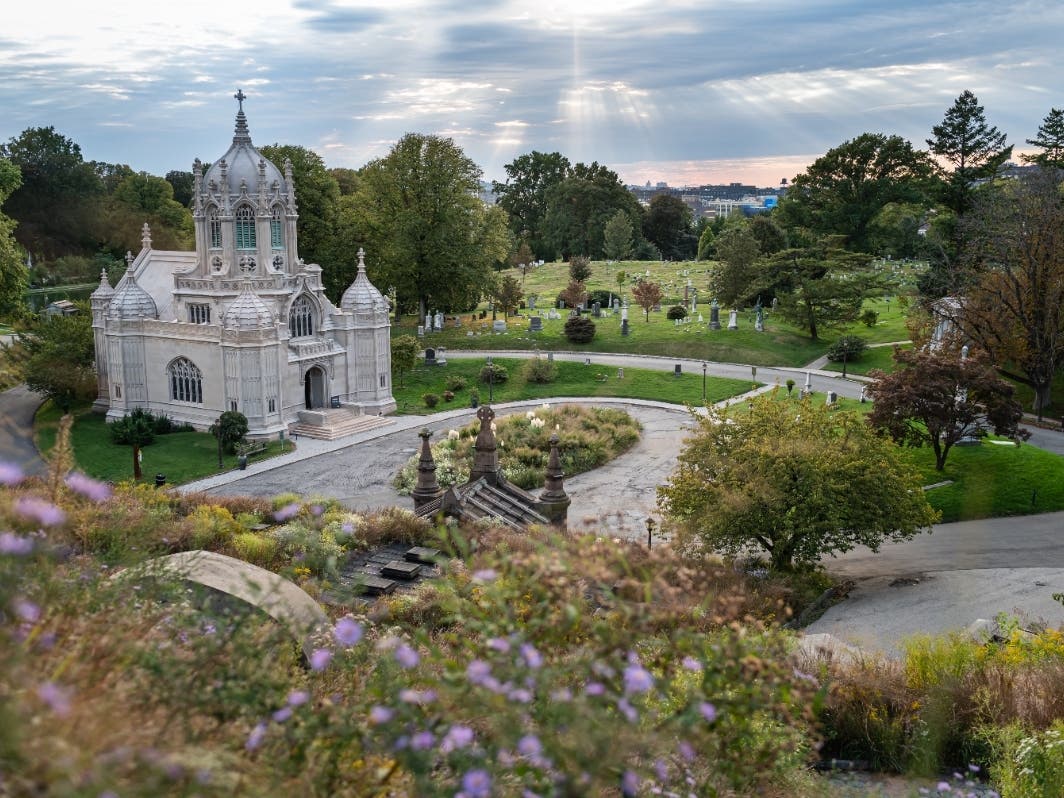
The Green-Wood Cemetery today announced the recipients of its 2024 Research Fellowship in Urban Environmental Science, where fellows employ the Cemetery’s natural resources to conduct original research. One team will investigate the viability of planting southwestern oaks and hybridized oak trees in urban conditions and the other will compare the biodiversity of other species that thrive on native versus non-native trees.
This is the third year of research fellowships offered by Green-Wood, which presents an extraordinary opportunity to advance the study of urban ecology and climate resilience in the Cemetery’s Level III arboretum, which features a dynamic living collection comprised of about 8,600 specimens representing over 800 unique species and cultivars.
“Green-Wood includes a variety of dynamic ecosystems that allow us to explore and promote environmental stewardship,” said Joseph Charap, Green-Wood’s Vice President of Horticulture. “These fellowships illustrate our dedication to ensure our vast assets are available to those who wish to advance the fields of urban ecology and climate resilience.”
Find out what's happening in Brooklynfor free with the latest updates from Patch.
The grants are funded in part by Perfect Earth Project, a nonprofit dedicated to toxic-free, nature-based, and climate-responsible landscaping practices necessary for a healthier and more sustainable environment.
“Perfect Earth Project is thrilled to support Green-Wood’s environmental research fellowships, which should provide important data to advance long-term resiliency goals in our landscapes, and improve our understanding of the habitat value of native flora,” said Toshi Yano, Director of Perfect Earth Project.
Find out what's happening in Brooklynfor free with the latest updates from Patch.
The first research project—“Trialing of Climate-Adaptive Oaks for Urban Landscapes at Green-Wood”—will be led by Dr. Nina Bassuk, Emeritus Professor, Cornell Urban Horticulture Institute (UHI), and Florae Collaborative LLC (dba Phytacell).
The team already has been trialing hybrid oaks at Cornell University and at sites across New York State, including Green-Wood, which has the largest collection of the oaks bred by UHI. Researchers will continue to assess these trees (many over a decade old) at Green-Wood and plant additional oak trees for trialing, with the aim of breeding trees that are better at tolerating urban conditions.
“We’re excited to expand our work with hybrid oak trees at Green-Wood in the next year,” said Nina Bassuk, Professor Emeritus, Urban Horticulture Institute in the School of Integrative Plant Science at Cornell University. “Green-Wood is home to about 20 unique hybrid oaks produced at Cornell University, and we will continue to evaluate these genotypes for growth, form, pest resistance, and urban stress and the best individuals will be selected for micropropagation.”
In the second project—“Biodiversity on Native and Non-native Tree Leaves”—Dr. Emily Herstoff, Assistant Professor of Biology at St. Francis College, and Dr. Michael Tessler, Assistant Professor of Biology at Medgar Evers College, both based in Brooklyn, will examine organisms living on and in leaves of closely related native and non-native trees to assess impacts on biodiversity.
“Comparing the tiny organisms on trees helps us understand how to maintain tree health and even fight climate change,” Dr. Herstoff said. Added Dr. Tessler, “So many organisms—from microbes to insects—rely on urban tree leaves, and Green-Wood is an ideal place to study this.”
The Research Fellowship in Urban Environmental Science program is now in its third year. One past project supported research on mesocarnivores (particularly raccoons) in urban greenspaces, focusing on how human-created factors influence their population dynamics. Another examined the impacts of landscape management on the diversity of microorganisms in urban soils. The latest projects concluded earlier this year; one aimed to characterize the community of bacteria that live around the root systems of trees and plants throughout Green-Wood. The other studied the cold hardiness and dormancy of woody perennial plants at Green-Wood.
All research fellows have access to the landscape; plant records and archived wildlife data; Esri GIS software and mobile app tools; Green-Wood GIS data; support staff who can operate digging machines and electricians to assist with monitoring and other devices; storage space for equipment; freezers and refrigerators to store samples temporarily; and office space with desktops.
Each research team receives $5,000 in funding and has access to Green-Wood’s 478-acre accredited arboretum, home to more than 8,000 trees and shrubs, a diverse array of wildlife, and glacial ponds; plus the Cemetery’s institutional records.
Established in 1838, The Green-Wood Cemetery, a National Historic Landmark, is recognized as one of the world’s most beautiful cemeteries. As the permanent residence of over 570,000 individuals, Green-Wood’s magnificent grounds, grand architecture, and world-class statuary have made it a destination for half a million visitors annually, including national and international tourists, New Yorkers, and Brooklynites. At the same time, Green-Wood is also an outdoor museum, an arboretum, and a repository of history. Throughout the year, it offers innovative programs in arts and culture, nature and the environment, education, workforce development, restoration, and research, as well as bold initiatives in climate resiliency and sustainability. For more information, please visit www.green-wood.com.
Founded in 2013 by Edwina von Gal, the Perfect Earth Project is a nonprofit organization dedicated to educating, engaging, and inspiring individuals, land care professionals, and decision-makers to adopt toxic-free, nature-based, and climate-responsible landscaping practices necessary for a healthier, more sustainable—and beautiful—environment for all. Learn more at perfectearthproject.org.