Community Corner
Son Remembers Hero FDNY Chief Killed On 9/11: 'It Still Hurts'
FDNY Asst. Chief of Department and Citywide Commander Donald Burns was 2 weeks from retiring. "Every day, a little bit of hope was lost."


EASTPORT, NY — The deceptively blue morning of 9/11 might have dawned 20 years ago, but for Michael Burns, of Eastport, the memories are still vivid. Burns lost his father, FDNY Asst. Chief of Department and Citywide Commander Donald J. Burns, in the attacks — and 20 years later, the terror and grief of those dark days are still a heartbeat away.
Burns, born in Smithtown, said his parents later moved to Nissequogue, to their dream home on the beach. Burns, now a retired Southampton Town Police sergeant, was at his home in Eastport on the morning of 9/11, sitting on his couch, drinking coffee and watching the news.
"It began as a beautiful, cool, relaxing day," Burns said. Burns saw the reports of the first plane hitting the North Tower and knew his father had worked the night tour, and was waiting around for a meeting regarding his retirement, which was just two short weeks away.
Find out what's happening in Center Moriches-Eastportfor free with the latest updates from Patch.
At first, there seemed to be no reason for worry.
Burns and his mother Elizabeth tried calling him, but the calls went to voicemail. Still, there wasn't any reason for concern. Not yet. His father normally didn't answer calls while fighting a fire, he said.
Find out what's happening in Center Moriches-Eastportfor free with the latest updates from Patch.
His father, who was 61, Burns said, had also been at the first World Trade Center bombing in 1993, the commander at Tower 1, and had written reports about that rescue — including the problems first responders had encountered with communications. He also documented and reported the logistics on how to get firemen to the upper floors of high rises to battle the fire and evacuate people, Burns said.
When he heard about the crash, Burns knew his father was uniquely armed with the experience and passion for his position to help.
"Eighteen minutes later when the second plane hit the South Tower, the situation became so much more serious. This was not an accident," Burns said. "This was an attack on America."
A plane crashed into the Pentagon about 15 minutes later, then the South Tower went down —and five minutes later a plane crashed in Shanksville, Pennsylvania. Then, 25 minutes later the North Tower collapsed, Burns said. "The attack lasted about one hour and 45 minutes. The
United States of America was being attacked. And we were being attacked on our own soil," Burns said.
As the world watched in collective horror, for Burns, his mother, his sister Lori and his brother Patrick— who was also a firefighter — what was unfolding on the screen was deeply personal.
"When the first tower collapsed, instantly my concern turned to fear. All of a sudden, you thought, 'Oh, no.' Now you know hundreds of people died. I knew my father was there, and possibly my brother, too. I called my mom again to see if she had any information. We knew that Dad was at the twin towers," he said.
His family started asking anyone they could reach if Asst. Chief Burns had been heard on the radio. "People were just saying, 'I have not heard him since the building collapsed.' That was the first inkling," Burns said.
His father, Burns added, was one of five assistant chiefs who served under the citywide tour commander, one of five serving in the number-two spot. He also served his hometown fire department on Long Island.
"If he had been on the radio they would have known. So when people were saying they hadn’t heard him, we knew that was pretty bad. At first, it was mostly disbelief that this was actually happening. You always think, somehow, 'It’s not going to be my dad.'"
Burns went outside to wash his car. "I felt helpless," he said.
At noon, Burns called his mother to find out if there had been any news. After a few hours of unanswered pages, calls to his father, and pleas to others if they heard anything, anything at all, there was nothing, Burns said. They knew that if he had been able, their beloved husband and father would have called to ease their fears.
Terror began to mount in their hearts and minds, a steady drumbeat of fear.
Burns called out from work that afternoon, picked up the kids from school, and headed to his parents' house. "Mom was frantic on the phone, calling other wives and contacts in the fire department. Nobody had heard from my father."
The good news was that his brother had survived; he had been fighting a fire in Brooklyn that morning.
His children, who were young at the time, tried to comfort his mom, Burns said. "They promised her that we would stay until Grandpa came home. During the evening, my kids were getting tired and asked, 'Grandma, when is Grandpa coming home?' That ripped her heart out."
His father's best friend Lawrence Stack had also not been heard from since the towers collapsed, Burns said. His mother called Stack's wife, trying to joke in the face of a nightmare, saying maybe they'd escaped and were safe in a bar sharing a beer.
"It was a doubtful glimmer of hope," Burns said. "Trying to avoid the inevitable truth that they had both died in the collapse earlier that morning."
The phone calls were frequent and continued late into the night, but they became shorter, usually ending with: "I haven't heard anything. I have no new information," Burns said.
That night, Burns slept at his parents' house; the next morning he woke up suddenly. "The house was quiet; I knew it was bad," he said.
September 12 was long, an empty expanse of hours with no good news. "Nobody being pulled from the rubble was found alive," Burns said.
Just 20 people survived the towers' collapse. A total of 2,996 people were killed, including the hijackers.
The news reported that hospital emergency rooms were waiting but nobody was arriving, Burns said.
"Evening came and hope of my father being found alive was fading," Burns said.
Burns drove his children Victoria and Tyler to school; a soccer coach, Burns wanted to provide some sense of normalcy for them.
As he drove down the Long Island Expressway heading to soccer practice Burns saw all the fire trucks and emergency response vehicles heading toward the city; they had the HOV lane dedicated to them, he said.
"This was the first time I was alone after the towers collapsed and I began to cry," he said
The next day, there was still no word, Burns said. "Just the slow, continuous fading hope of finding my father or anyone else alive. Every day, a little bit of hope was lost," he said.
Eventually, Burns said the rescue efforts at the World Trade Center turned from a rescue effort to a recovery effort. "It was now almost impossible," he said.
On the fifth day after the towers collapsed, his family was gathered in the living room at his parents' house, Burns said.
"The prospect of my father still being alive was now almost certainly not possible — but nobody wanted to say it out loud. My mother was sitting quietly on the couch on the far side of the room. Then she got up and said, 'I guess it's time to have a memorial,'" Burns said, his voice breaking. "Having not found his body, we started planning a service to honor his life."
Later, his family learned that Burns responded to the World Trade Center and died in the collapse of the South Tower.
When the first plane hit, Burns said, all the chiefs went to the North Tower and set up a command post there. When the second plane hit, his father was told to set up a command center in the South Tower. "That was the second one to get hit and the first to collapse," Burns said.
His family later learned that his father had sent someone to move the chief's car. He remembered, from the '93 bombing, that there had been so many fire trucks, his car got stuck behind them and he couldn’t leave until 12 hours later, Burns said.
"So he told this guy, 'Take the car and move the car back four blocks. When all this is over we don’t get stuck here behind fire trucks,'" Burns said.
The man went to the chief's car, was putting something in the trunk, and then, in a moment of horror, saw the tower collapse.
"He told us, 'Your father telling me to move that car saved my life.' He told us when he'd left, my father was standing at the command post, right there in the corner. And when they recovered his body months later, that's where he was," Burns said.
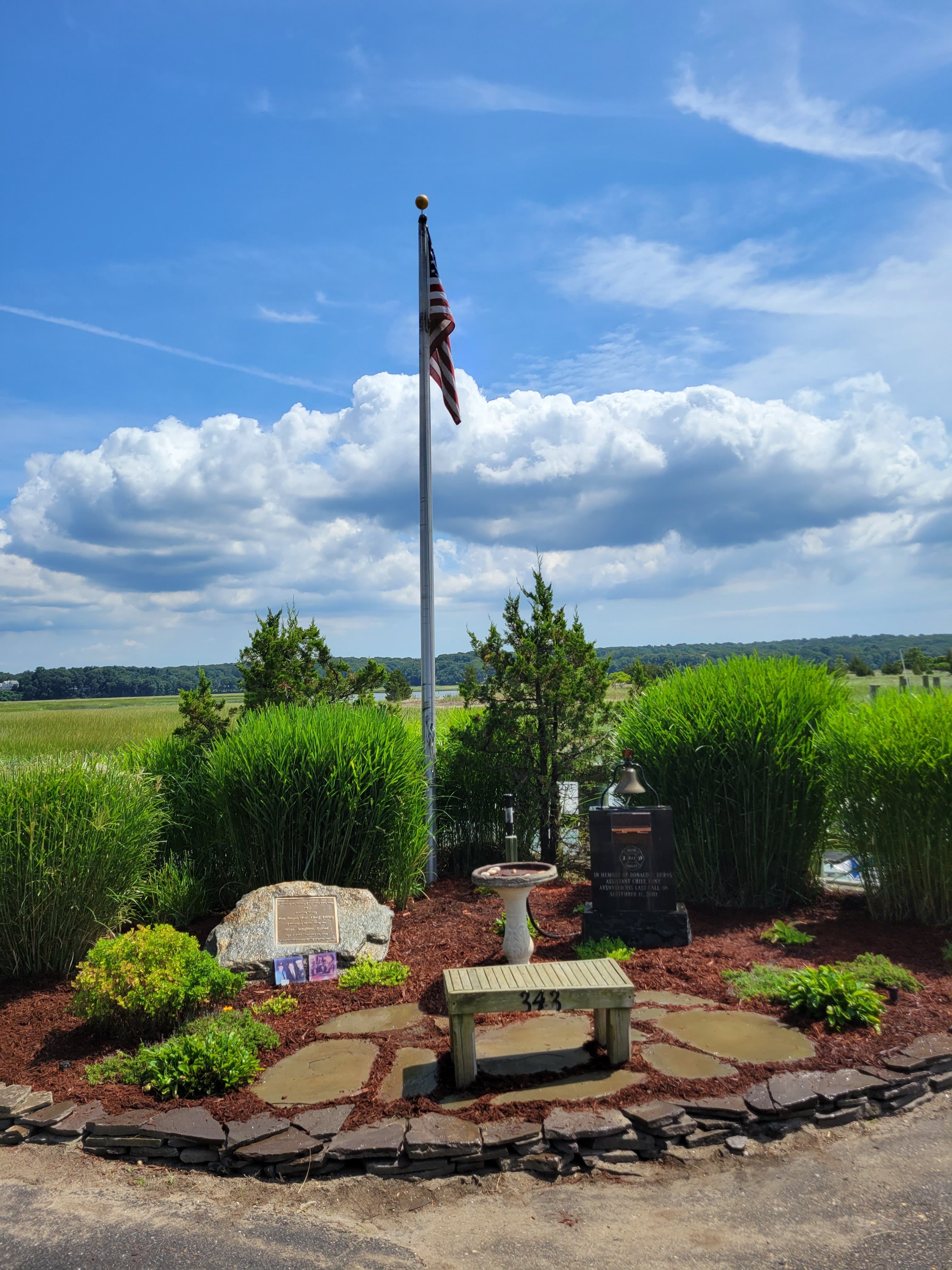
In the years since, a memorial garden to honor Burns was created at the Smithtown Marina Nissequogue. The Nissequogue Fire Department will host a memorial to Burns at 10 a.m. on 9/11.
Assistant Chief Burns, according to Firefighterhero.org, was known as a "walking encyclopedia" because of his incredible knowledge of New York City’s streets and subway system.
"My father loved the city, and he loved the fire department," Burns said. In fact, he loved the World Trade Center, taking Michael into New York one day to see them shortly after the towers were finished, proud to share the beauty of the incredible structures.
While he was lauded for his 39 years of service to the fire department, Michael Burns said his father also left a lasting legacy in his deep love for his family.
"He was a great father. He loved the family," he said. His father coached his own soccer team; he remembers going on long bike rides to the lake and then, for ice cream.
His parents, Burns said, had been married 40 years and were ready to live their dream retirement. His father had bought a boat and fishing rods and was ready to go surfcasting. They were planning to buy an apartment in the city.
Plans were also made to take the whole family to Disney World the following weekend, Burns said. "He was going to call out sick that last week. And so, because he worked midnights, and it was two days on, three days off, he probably was only supposed to show up at work maybe two or three more times."
His father was born with a deep love of firefighting, Burns said. "That's why he did it for so long, 39 years." His father used to visit his grandfather at the firehouse; there are photos of him on a tricycle by a firetruck, he said.
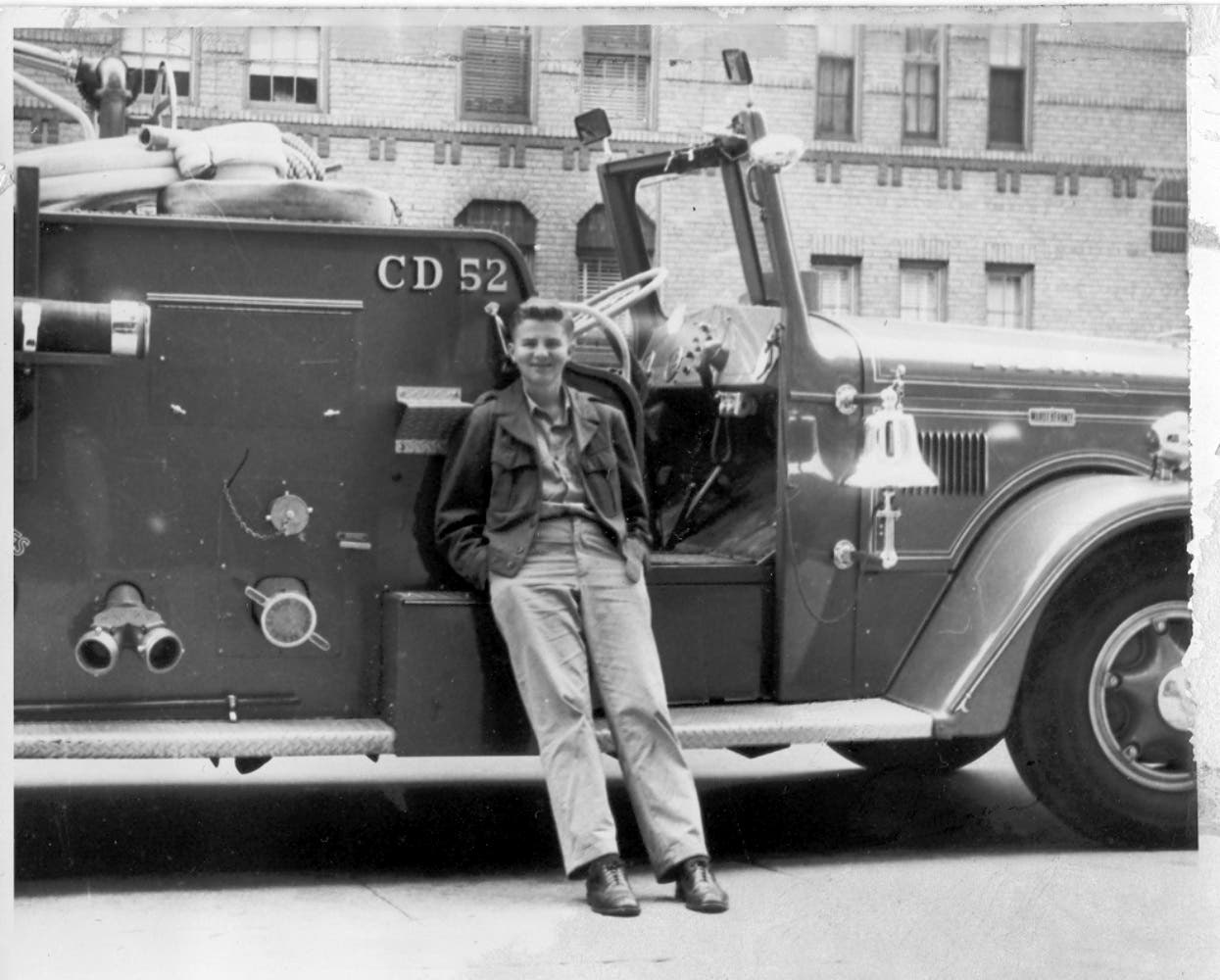
"My grandmother used to tell us that when he was in school, a teacher told her that while he did well and paid attention in class, 'If you hear a firetruck go down the street, he looks out the window and you know you’ve just lost him for the next five minutes.'"
And that's why it makes perfect sense to Burns that his father, who was off-duty at FDNY headquarters in Brooklyn waiting for his retirement meeting, raced to Ground Zero when he heard about the attacks. "He would have been anywhere else. He was a hero. He was there to the very end. Even if he had been at home fishing, he would have gotten into his car and driven to the city."
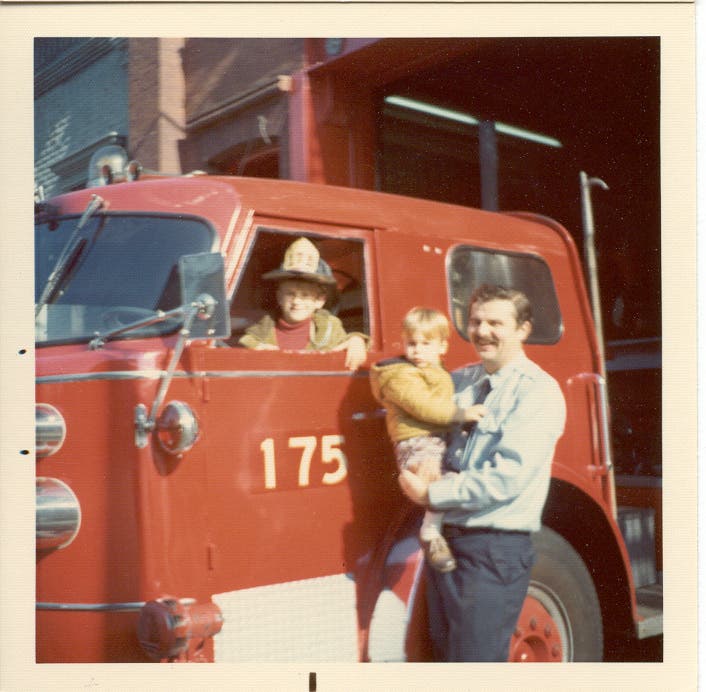
He was also known for his humor, Burns said, recounting a story he'd heard about 9/11 many months later. "When they'd heard that the planes had hit, the chiefs were all getting into an elevator, and as it was going down, one man was putting on a tie. He asked him, 'What are going to, a freaking wedding?'" he said, laughing.
Today, Burns said there are enlarged photos of his grandfather, his father, and his brother, all in their uniforms, dotting their homes. His mother visits the memorial garden, which is close to her home, to tend the shrubbery and mulch.
The lessons he learned from his father resonate today and have, throughout his life, Burns said: "Be good. Be honest. Get an education. Enjoy what you do for a living," he said.
Today, Burns hears his father's voice in his own head as he raises his children. His father showed his family that dedication to community, service to the people who depended on them for their very lives, was more than just a job. It was his life's calling.
"One year during Thanksgiving dinner we were all at my parents' house and my father got a call that there was a fire; a fireman had gotten hurt and was in the hospital," he said.
His father knew he had to go and asked Burns to go with him in the chief's car. "I'll never forget that, seeing my father in action," he said.
Even today, memories of his father aren't easy to share. "I don't bring it up very much. It still hurts," Burns said.
Every time someone mentions 9/11, Burns said saying the words, "My father died on 9/11" still cuts deep.
And, too, there is anger. After 9/11, in 2010, 33 miners who had been trapped underground in Chile were saved after 69 days.
"I remember thinking, 'Oh, my God. They saved all these miners, but that couldn't save one person in the World Trade Center?'"
And he wasn't alone: Burns said he went to a party soon after and met others who'd lost loved ones on 9/11, who shared the same outrage and pain.

Holidays still haunt, Burns said. The New Year's Eve after 9/11, when everyone was cheering and toasting, all he could think was, "I'm so glad last year is over. It was the worst year of my life."
If he could see his father again, Burns would tell him so many stories, about how life has gone one. How his daughter now has her own child, a little boy named Graham. How his children went to college and how his brother has two daughters.
His mother donated a stained glass window at St. Patrick's Church in Smithtown in memory of her husband. "She always sits by that window," he said. "She says, 'Donald is still watching out for me and taking care of me.'"
And, Burn said, if he could speak to his father just one more time, he knows just what he would say, the words he would have said, if only they'd had that one last phone call, to say good-bye.
"I would tell him not to worry, that I'm taking care of Mom," Burns said, his voice heavy with tears. "I would thank him for giving me a lot of life lessons. I'd thank him for being a great dad."
Get more local news delivered straight to your inbox. Sign up for free Patch newsletters and alerts.