Politics & Government
Conifer Seeks Zoning Change
Proposed change to workforce housing law would allow town board to grant zoning waivers, use different requirements than the site's underlying zone has.


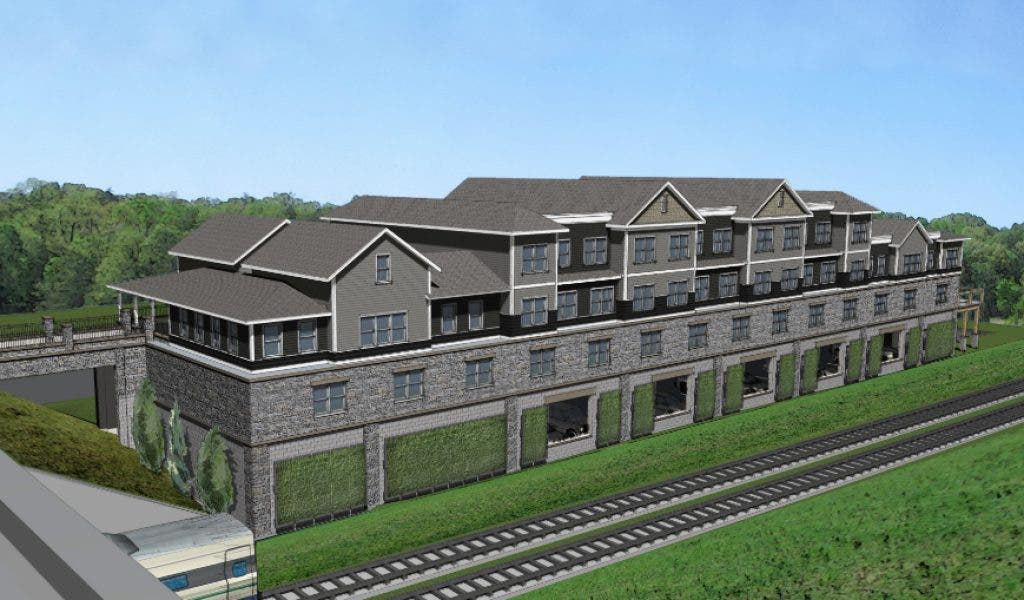


Conifer Realty is seeking to change zoning provisions of New Castle's workforce housing law, which governs the process for getting a special permit needed for its Chappaqua Station affordable housing plan.
The developer's proposed changes include allowing for the lot, dimensional and bulk requirements of any site that is covered by the law to be treated according to special standards in the legislation and limts from the Retail Business (B-R) zone. However, if there is a conflict between the two, then the special standards would apply.
The site of Conifer's proposed apartment building, which is 28 units and 3-4 stories tall, is located at 54 Hunts Place and falls under the town's General Industrial (I-G) zone. The B-R zone is more lenient than I-G. For example, under the town code, B-R has no maximum building coverage for a lot and allows buildings of up to 35 feet (three stories) in height. In contrast, I-G states that a building's total floor space can't be more than 40 percent of a lot's area, and has height limits of 30 feet (two stories).
Find out what's happening in Chappaqua-Mount Kiscofor free with the latest updates from Patch.
Conifer is also seeking to allow for the town board to grant waivers of zoning requirements in the law, with criteria for doing so including hardship to an applicant, benefit to the town outweighing a detriment and that if compliance is made then it is “not requisite to public health, safety and general welfare.”
The existing workforce housing law was approved by the town board in 2010. It allows for such housing to be built with special permits that are issued by the board on a series of downtown Chappaqua sites that are in proximity to the train station.
Find out what's happening in Chappaqua-Mount Kiscofor free with the latest updates from Patch.
Alfred DelBello, Conifer's attorney, told Patch that the intent behind the changes is to “give the town board more discretion on their approval.” He explained that there were restrictions in the law that would've led Conifer to go to the zoning board of appeals. It was the belief of town officials that the code would require Conifer, which is seeking a special permit from the town board, to seek variances from the ZBA in order for its building to deviate from the limits for the I-G zone.
Conifer had its own opinion on the matter, believing that I-G was not the guiding zone. Talking to reporters after an April 16 meeting in which the current version of its plan was unveiled – previous iterations called for 36 units – Conifer principal Andrew Bodewes explained that the company's opinion was that the building, under the special permit process, would comply with zoning because the process supersedes the I-G.
The town board, which will take up the matter tonight at a work session, will also have a modified version of the proposal, which was drafted by its law firm, Wormser, Kiely, Galef & Jacobs LLP. The changes would have the same outcome, according to New Castle Town Attorney Clinton Smith, who works for the law firm. However, the modified language is different. It also states that if the town board were to deny a waiver request, then an applicant can make one before the ZBA, which Smith explained clarifies the that board's role. Smith cautioned that the modified draft does not equate to an endorsement of Conifer's request, but the idea is that if they are being considered then the more recent proposed changes are meant to be better.
The version of the waiver system crafted by the town's law firm also has explicit language allowing for the board to impose conditions while also granting a change, while the characteristics of a specific site in question can also be considered.
The nature of I-G and how it relates to the special permit process has been considered by the town board. During a February work session, board members expressed concerns over the consistency between the process and the zone. At that meeting, Councilman Robin Stout, described the connections as “logically inconsistent,” while Supervisor Susan Carpenter questioned whether affordable housing was viable for the I-G zone.
Opponents of the Conifer plan blasted the proposed changes. In a letter, residents under the label of Chappaqua for Responsible Affordable Housing, argued that the measure will just be a way for the town board to approve the housing plan.
“They would then use this self-granted authority to, as quickly as possible, approve Conifer’s project as proposed, while ignoring the huge environmental, safety, quality-of-life and aesthetic deficiencies of this project, including that it will isolate and stigmatize the very residents that it is intending to serve,” the letter states.
The town board's work session starts tonight at 7:45 p.m., at town hall in Chappaqua. The board, at the meeting, will consider a resolution that would refer the matter to the town's planning board and Westchester County's planning board for advisory input.
A copy of the town board's packet for its work session is attached to this story as a PDF, with the portion related to Conifer on pages 2 to 25.
Get more local news delivered straight to your inbox. Sign up for free Patch newsletters and alerts.