Community Corner
NY One of States Most Able to Handle Infectious Disease Outbreaks
A new study finds the nation unready to handle new threats.


BY LANNING TALIAFERRO
A new report finds that New York is among the states most able to prevent, detect, diagnose and respond to infectious disease outbreaks.
The report, from Trust for America’s Health and the Robert Wood Johnson Foundation, concluded that the United States must redouble efforts to better protect the country from new infectious disease threats, such as MERS- CoV and antibiotic-resistant superbugs, and resurging illnesses like whooping cough, tuberculosis and gonorrhea.
Find out what's happening in Deer Park-North Babylonfor free with the latest updates from Patch.
More than half of states scored a five or lower out of 10 key indicators. Tied for the lowest score at three out of 10 were Idaho, Kansas, Michigan, Ohio, Oklahoma, Oregon and Utah.
Five states—Delaware, Kentucky, Maine, New York and Virginia—tied for the top score, achieving eight out of 10 indicators.
Find out what's happening in Deer Park-North Babylonfor free with the latest updates from Patch.
“The overuse of antibiotics and underuse of vaccinations along with unstable and insufficient funding have left major gaps in our country’s ability to prepare for infectious disease threats,” said Jeffrey Levi, PhD, executive director of TFAH. “We cannot afford to continue to be complacent. Infectious diseases – which are largely preventable – disrupt the lives of millions of Americans and contribute to billions of dollars in unnecessary healthcare costs each year.”
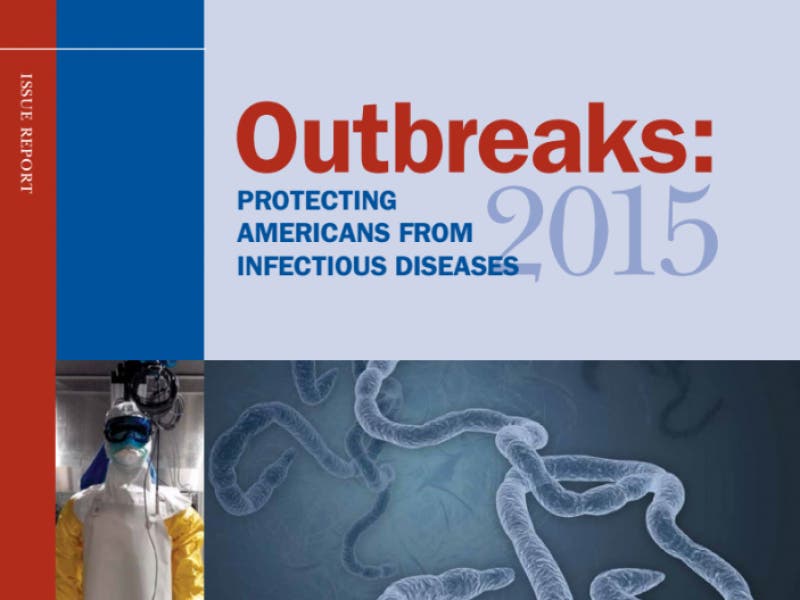
Some key findings from the Outbreaks: Protecting Americans from Infectious Diseases report include:
- Health care-associated Infections: Around one out of every 25 people who are hospitalized each year contracts a healthcare-associated infection, leading to some 75,000 deaths a year.
- Superbugs: More than two million Americans contract antibiotic-resistant infections each year, leading in excess of 23,000 deaths, $20 billion in direct medical costs and more than $35 billion in lost productivity.
- Childhood Vaccinations: In 2014, there were more than 600 cases of measles and nearly 33,000 cases of whooping cough reported. While more than 90 percent of all U.S. kindergarteners receive all recommended vaccinations, rates are lower in a number of communities and states. More than 28 percent of preschoolers do not receive all recommended vaccinations.
- Food Safety: Around 48 million Americans get sick from a foodborne illness each year.
- Hepatitis C and HIV/AIDS: Of the more than 1.2 million Americans living with HIV, almost one in eight do not know they are infected. Hepatitis C infections—related to a rise in heroin and injection drug use from people transitioning from prescription painkillers—increased more than 150 percent from 2010 to 2013.
- Preparing for Emerging Threats: Significant advances have been made in preparing for public health emergencies, including potential bioterror or natural disease outbreaks, since the September 11, 2001 and anthrax attacks. Gaps remain, however, and have been exacerbated as resources have been cut.
New York was one of only 9 states that reduced the infection rate for Central Line-Associated Bloodstream Infections -- which people get while they’re getting health care -- between 2012 and 2013, the report said.
It is among 15 states that has completed a plan for handling adaptation in infectious diseases related to climate change.
And it is among only 16 states that explicitly authorize syringe exchange programs. According to the report, Hepatitis C infections—related to a rise in heroin and injection drug use from people transitioning from prescription painkillers—increased by more than 150 percent nationally from 2010 to 2013.
Get more local news delivered straight to your inbox. Sign up for free Patch newsletters and alerts.