Community Corner
678 Dead Geese Found In East Hampton's Georgica Pond; Geese Found In Jamesport Positive For Avian Flu: DEC
After more than 670 dead geese were found dead in East Hampton, residents worried they weren't being properly buried; DEC assures they were.


LONG ISLAND, NY — As the number of dead geese found across the East End continues to mount, some residents in East Hampton have voiced concerns that those found around Georgica Pond were not disposed of properly — but officials assure that they were.
And, those geese found in Jamesport last month have tested positive for avian flu, according to the New York State Department of Environmental Conservation.
According to the DEC, preliminary test results have been received regarding possible avian influenza in goose specimens collected in Jamesport in February.
Find out what's happening in East Hamptonfor free with the latest updates from Patch.
Test results suggest the geese were infected with Highly Pathogenic Avian Influenza (HPAI), with a “non-negative” finding, the DEC said.
Confirmatory testing at the United States Department of Agriculture’s National Veterinary Services Laboratory is underway, the DEC said.
Find out what's happening in East Hamptonfor free with the latest updates from Patch.
Last week, the DEC said they have received reports of deceased waterfowl throughout Long Island including reports of more than 100 dead geese in the East Hampton area.
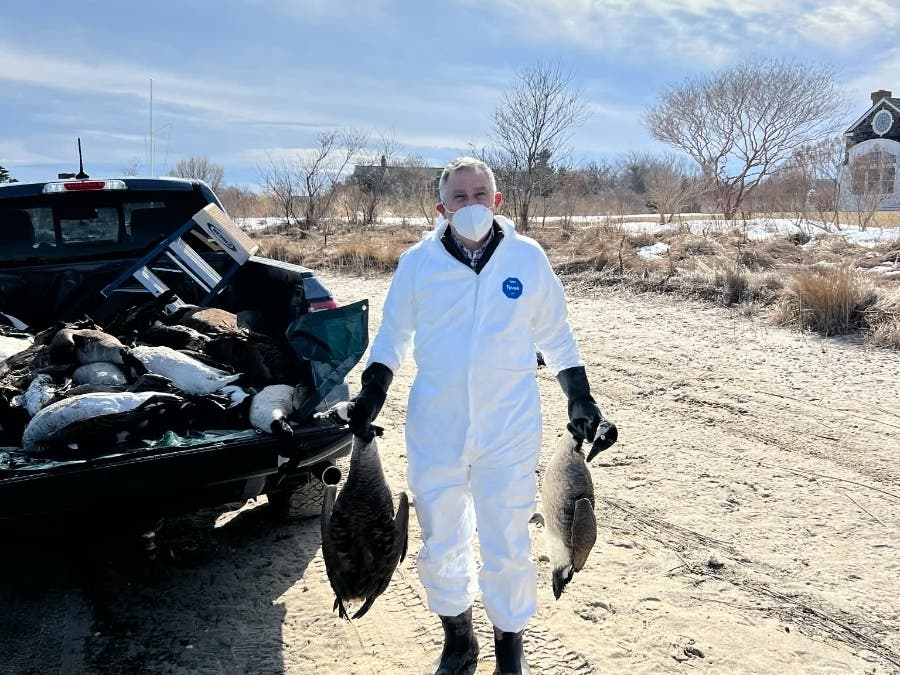
This week, East Hampton Town Trustee Jim Grimes confirmed that 678 dead geese have been found at Georgica Pond in East Hampton.
On March 13, East Hampton Town trustees responded, in a statement, to the "mass waterfowl die-off at Georgica Pond."
The trustees said they were first alerted to the matter on February 27, when Chief Harbor Master Tim Treadwell reported a large number of deceased birds along Georgica beaches.
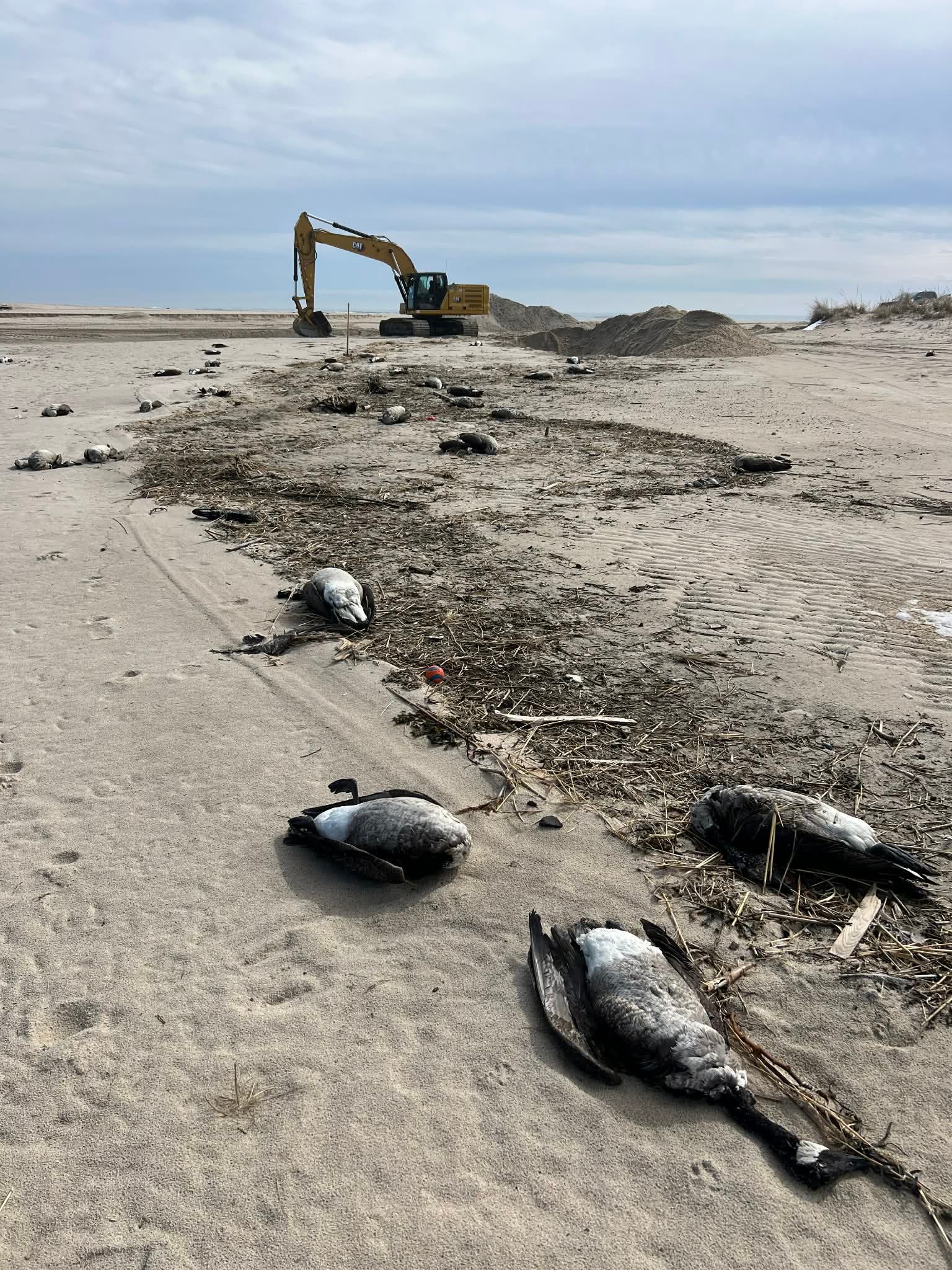
(Courtesy East Hampton Town Trustees)
Officer Treadwell initially sought assistance from the Town of East Hampton to hire a contractor for cleanup, but within 30 minutes, he informed the trustees that the Town of East Hampton had declined, citing that the affected areas fell under trustee jurisdiction and the private shoreline of the Georgica Association, trustees said.
Officer Treadwell forwarded New York State Department of Environmental Conservation guidance on carcass handling along with photos from the site, trustees said.
Following the notification, Deputy Trustee Clerk Grimes visited the area to document conditions and assess the scope of the die‑off, officials said.
Trustee Clerk Francis Bock contacted East Hampton Town Supervisor Kathee Burke-Gonzalez’s office for clarification regarding jurisdiction, the trustees said.
A representative for the supervisor sent Patch a statement: "The town did not decline to help with the cleanup. The trustees never asked for our help with the cleanup on lands within their jurisdiction. There was discussion that if they needed help they would reach out, but they never did."
Deputy Town Supervisor David Lys confirmed that, based on photographs provided, the die‑off appeared confined to trustee and Georgica Association properties, and that the Town of East Hampton would not assist in the matter, the trustees said.
Lys also reiterated the NYSDEC guidance previously provided, trustees continued.
Trustee Jim Grimes then conducted a survey of the affected area and took a rough count of the deceased birds. While doing so, he collected and buried some of the carcasses in place to prevent further exposure, trustees said.
The NYSDEC was then contacted for potential site review and avian flu testing. Due to overwhelming number of reports, the agency declined to visit and referred the trustees again to its general disposal guidelines, which includes burial in place, trustees said.
To safeguard public health, trustees said they ordered permanent warning signs and, due to delays in delivery, immediately produced temporary signage through a local business, they said.
Those were posted at all Georgica Pond access points and at Beach Lane, trustees said.
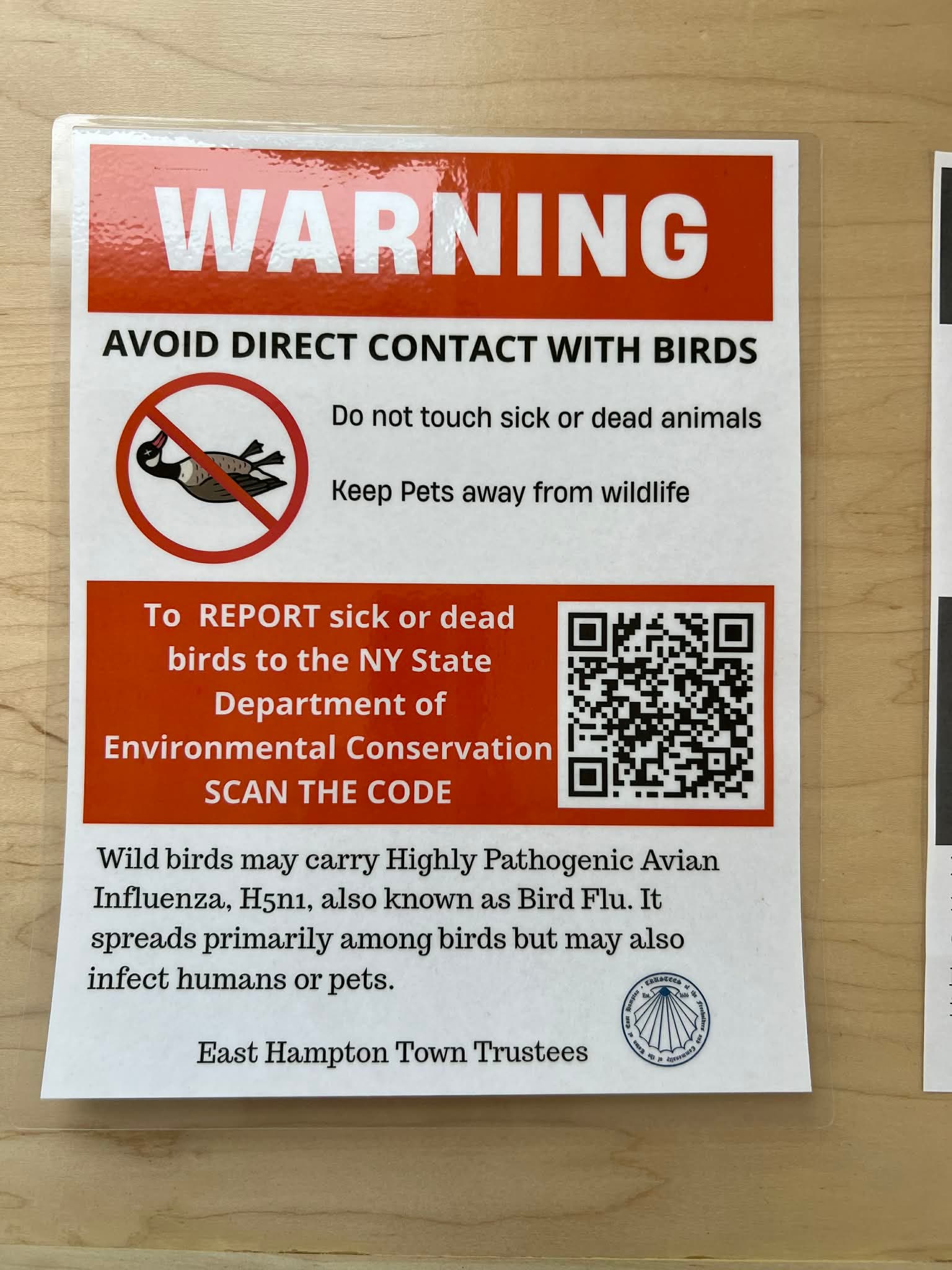
(Courtesy East Hampton Town Trustees)
Additional signs were posted at Louse Point following confirmation that a Snowy owl found there had died of avian influenza, trustees said.
Warming temperatures raised concern amongst the trustees that rotting geese carcasses with potential avian flu could create an increased hazardous risk to humans and animals and, therefore, time was of the essence to address the immediate public health hazard, they said.
The trustees said they determined that "quick and decisive action" was required to prevent further environmental and public impacts, and as such, approved Jim Grimes’ landscaping company, who had already begun clean-up on a voluntary basis, to complete cleanup operations.
Carcasses were disposed of according to the provided NYSDEC guidelines, with some buried onsite and a majority taken to upland areas for burial, trustees said.
Burial on the beach was done on the first day of removal, when an upland area had not yet been made available to the trustees, officials said.
Burial was outside the tidal zone at a depth of approximately 3 feet, with an additional 3 feet of locally sourced and compatible sand placed on top, trustees said.
A total of 6 feet of coverage was provided, trustees said.
Workers were provided with appropriate protective equipment and all equipment used in the effort was sterilized, trustees said.
At the conclusion of the clean-up effort, the NYSDEC confirmed that all work was done within their guidelines, trustees said.
At no time did the Georgica Association request assistance from the trustees regarding the incident, trustees said.
The trustees said they "have been made aware of inappropriate comments and misinformation shared by a trustee staff member in response to public inquiries. The trustees take this matter very seriously, and it is being addressed internally in cooperation with the human resources department and under established civil service protocols. The East Hampton Town Trustees remain committed to protecting public health, safeguarding the environment of Georgica Pond and Georgica beaches, and providing transparent communication as more information becomes available."
The DEC said they had corresponded with the East Hampton Trustees regarding the removal and burial of a large amount of deceased Canada geese in the Georgica Pond area.
Burial of birds with suspected Highly Pathogenic Avian Influenza (HPAI) can be a proper method of disposal if suitably located and an appropriate depth, the DEC said.
The DEC said that they confirmed with the trustees that the geese were buried at an appropriate depth of over 3 feet and were placed outside of tidal wetland areas.
DEC also said they were informed that final burial depths were deeper than initial depths circulated online, with a significant amount of sand placed over the area. The trustees also confirmed that signage was posted in the area advising residents to avoid contact with sick or dead birds based on DEC guidance, the DEC said.
DEC said it expects bird flu cases to lessen as the area heads into spring. During the warmer weather, birds no longer gather in large flocks and break off into breeding pairs. Smaller flocks or groupings of birds lessen the chance of transmission of bird flu within a flock, the DEC said.
Grimes told Patch that things "seemed to have calmed down" this week at Georgica Pond. "We picked up 10 birds this week — a big difference from a week and a half ago."
Of the outcry that resulted over disposal of the geese, he said there was "a lot of innuendo, misconceptions, half truths and outright lies out there," sparked largely by social media, he added.
The number of geese found at Georgica Pond "was a community problem," he said, assuring that all geese were buried with about 6 to 7 feet of sand; he added that East Hampton Village officials were "helpful" and offered a disposal site at the highway barn for the remainder of the geese.
"Everything got buried properly," Grimes said, adding that the DEC confirmed that all burial was done "according to DEC guidelines. We had no issues."
In a sight that's broken hearts around the East End and beyond, residents have reported seeing hundreds of dead geese littering the shorelines, and even floating out on the ice in the Peconic Bay
Maria Orlando Pietromonaco of South Jamesport wrote on Facebook last month: "Yet another neighbor reported counting 106 dead geese on the beach today."
Pietromonaco said she'd heard hundreds of Canadian geese honking overhead during the night, "some waddling through the streets, others perched all alone in various places. At least 15 dead, others look very sick."
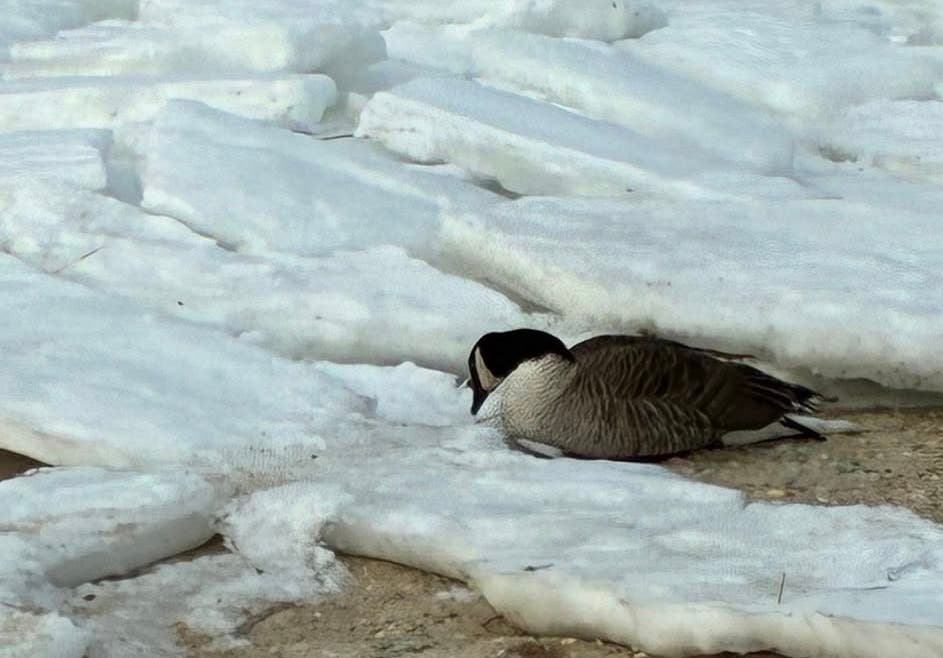
Pietromonaco and others speculated whether the geese were dying of starvation — with all food and water sources encased in ice — or from avian influenza.
Amanda Devaux said she had been walking on the South Jamesport Beach at Miamogue Point and seen two deceased and three "ill-looking" Canadian geese. "It's sad to see," she said.
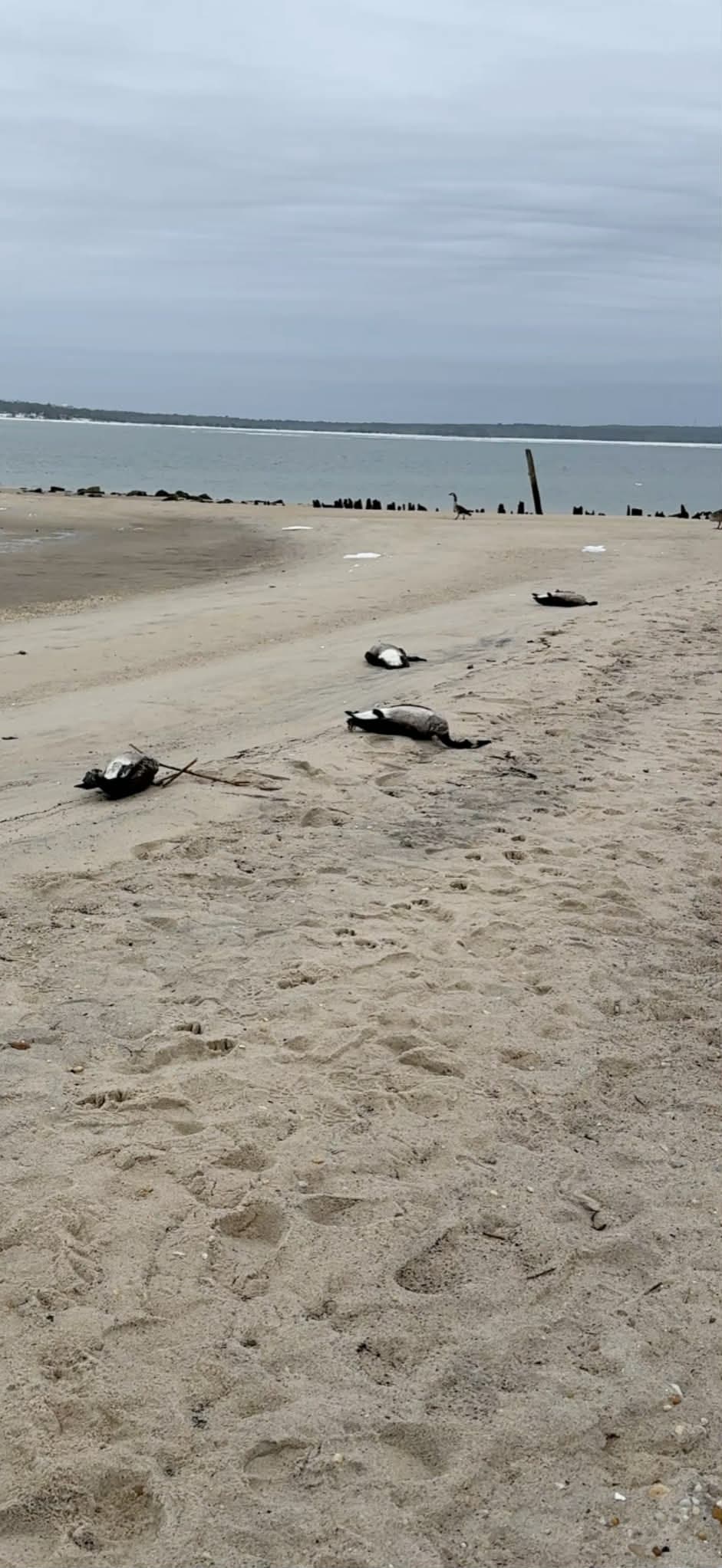
(Courtesy Amanda Devaux)
Devaux said she believed the large die-out of geese must be related to the avian flu. "Just too many sick one day and dead the next. We actually saw one flying and then just flew into the beach and was dead within minutes. The ones still alive on the beach seem disoriented and stumble. Some don’t even move when we walk by.," she said.
The DEC said it has had reports of more than 100 geese or ducks in the Jamesport area along the Peconic Bay, in addition to numerous reports of dead or sick waterfowl throughout Nassau and Suffolk counties.
The DEC said targets larger die-offs — 20-plus geese — or interesting species. The public should strongly consider that groups of birds found deceased are HPAI positive and should follow CDC safety protocols to reduce contact, the DEC said.
The DEC advised the public to avoid any contact with sick or dead birds and mammals that may be infected with HPAI.
HPAI continues to infect birds and mammals across the U.S. and Canada, including New York State, the DEC said.
HPAI is carried by free-flying waterfowl and other waterbirds, such as ducks, geese, and shorebirds, but can also infect domestic poultry, raptors, corvids, and mammals, the DEC said.
The DEC’s wildlife health program is monitoring the spread and impact of HPAI throughout the state and has an online reporting tool the public can use to report suspected HPAI mortalities:
Updates on HPAI can be found on the Cornell Wildlife Health Lab website.
There is no way to contain HPAI infection in wild birds, the DEC said, adding that the clinical signs for HPAI infection in wildlife are nonspecific and may be similar to other diseases or injuries.
Waterfowl, waterbirds, raptors, and scavenging birds are at higher risk of infection, but any species could potentially be infected, including mammals, the DEC said.
HPAI-infected birds may be asymptomatic or may exhibit signs of respiratory distress (sneezing or nasal discharge), lethargy, neurologic malfunction (ataxia, stargazing, or seizures), diarrhea, weakness, or sudden death, the DEC said.
Once a report is received, DEC’s field response is guided by the report’s details, including the number of sick or dead birds, bird species, and observations from new areas where HPAI has not yet been documented, the DEC said.
Of particular interest are reports of suspected outbreaks in all species of waterfowl, raptors, crows, shorebirds, and other waterbirds such as gulls, loons, and herons.
HPAI is widespread in wild birds and mammals, so not all reports will result in the DEC retrieving the animals for testing and/or disposal, the DEC said.
The public can help minimize risk and limit disease spread by preventing contact between domestic animals and wild birds, the DEC said.
In cases where DEC field staff are not responding to collect samples or carcasses from the landscape, the public should limit contact with dead wildlife and keep domestic animals away, the DEC said.
If removal of carcasses is deemed necessary, the public is reminded to wear disposable gloves, a mask, and eye protection — and to avoid direct contact with the carcass or carcass fluids by using a shovel and washing hands and clothing immediately after with soap and hot water. Carcasses should be triple bagged (garbage or contractor bags) and placed in an outdoor trash receptacle, the DEC said.
With reports of dead geese and birds reported across the East End in recent weeks, East Hampton town sent out a safety advisory for residents.
As of the last week of February — before the Jamesport testing results were in — DEC confirmed 11 birds with results suggestive of being infected with Highly Pathogenic Avian Influenza (HPAI) with a "non-negative" finding across Long Island.
The public should strongly consider that groups of birds found deceased are HPAI positive and should follow CDC safety protocols to reduce contact.
To report any suspected cases of avian influenza, contact the DEC:
- By phone, call 631-444-0310.
- To report online, click here.
- The East Hampton Town marine patrol is also accepting reports of suspected avian influenza cases on public land. Call the department at 631-537-7575 to make a report.
Get more local news delivered straight to your inbox. Sign up for free Patch newsletters and alerts.