Community Corner
'Equality Matters In The Hamptons': Talk On Racism, Civil Rights
Guild Hall was packed Wednesday night for a lecture on "Equality Matters in the Hamptons" with Sherrilyn Ifill of the NAACP LDF.


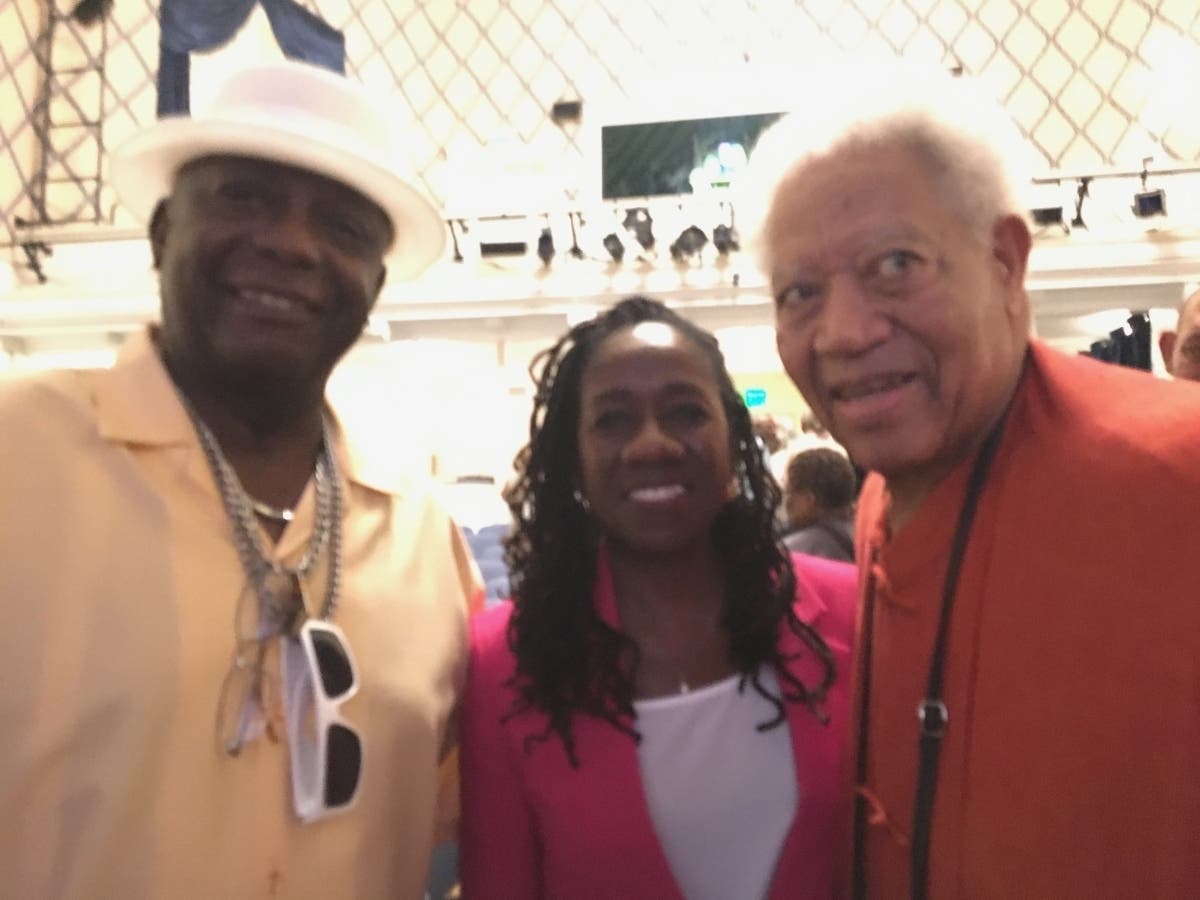

EAST HAMPTON, NY — In a country torn asunder by acrimony and divided by anger and the specter of racism, a large group turned out Wednesday night at the John Drew Theater at Guild Hall in East Hampton to listen to a lecture, "Equality Matter in the Hamptons."
The fourth installment in the "Thinking Forward Lecture Series," the event was presented by the Bridgehampton Child Care & Recreational Center in partnership with Guild Hall and featured Sherrilyn Ifill, president and director, counsel for the The National Association for the Advancement of Colored People's Legal Defense & Educational Fund.
An ardent "warrior" for civil rights issues, according to moderator Ken Miller, a financier, civil rights advocate and advisory board member at the Center, Ifill, in her work at the LDF, works to "increase the viability and engagement of the organization in cutting edge and urgent civil rights issues, while maintaining the organization's decades-long leadership fighting voter suppression, inequity in education, and racial discrimination in application of the death penalty," according to event organizers.
Find out what's happening in East Hamptonfor free with the latest updates from Patch.
The LDF, organizers added, was founded by Thurgood Marshall in 1940 and became a separate entity in 1957; Ifill is the second woman to take the helm of the organization.
Ifill began by discussing her book, "On the Courthouse Lawn," which discusses the nearly 5,000 black Americans who were lynched between 1890 and 1960.
Find out what's happening in East Hamptonfor free with the latest updates from Patch.
Born in Queens, NY, Ifill said she grew up hearing about lynchings, deep in the woods with the KKK, but not in plain sight, in front of the courthouse for all to witness — acts without shame, committed with impunity and with a sense that the perpetrators could "control the justice system."
Those "lynching pogroms," Ifill said, instilled terror; families of those lynched were afraid to come and collect the bodies.
Ifill discussed efforts to keep a statue of Frederick Douglass off a courthouse lawn in Talbot County, based on the assertion that the ground was hallowed and only to allow monuments dedicated to veterans who had given their lives for their country; in her work, she has sought to challenge the notion of the courthouse lawn as hallowed ground.
The issue of the public good, Ifill said, lies at the core of the issues that divide. "We have lost sight of the public good and lionized it with what is private," she said, adding that all too often, "what is public is racialized," including public schools and public transportation, while what is private is "exalted," including schools.
Standing on the subway, "cheek by jowl," Ifill said, is an equalizer, spotlighting the need to "make it work for all of us." She spoke of her own childhood, when a 35-cent subway token took her from Queens to her summer job in Harlem and allowed her the chance to avail herself of a public school education in the 1970s.
On the issue of voter suppression, Ifill said that after the election, President Donald Trump "had trouble accepting that he lost the popular vote" and created the Presidential Advisory Commission on Election Integrity, which many said fostered voter suppression. "It was the worst," she said; the NAACP challenged the creation of the commission. "We sued the President of the United States," as well as Vice President Mike Pence, chair of the commission, and commission vice chair Kris KobachIfill, on the basis that the group "engaged in intentional discrimination" against African-Amerian and Latino voters. "It was a big deal," she said. "What they did with language was so frightening, calling it election integrity — but it was the opposite," Ifill said.
The LDF also filed suits against Cabinet members, U.S. Secretary of Education Betsy DeVos, and the head of Homeland Security, she said. "It was unheard of in history," Ifill said.
Trump ultimately disbanded the commission.
Also discussed at the lecture was a discussion on Senate Majority Leader Mitch McConnell's refusal to allow a vote on an election reform bill that would address "foreign hacking and influence," Ifill said.
Another critical issue, she said, is the appointment of judges to the federal bench, who will have powers for years to come, "judges who are beyond conservative," including Jeffrey Rosen, Trump's deputy general. Rosen refused to affirm the landmark Supreme CourtBrown v. Board of Ed, which deemed segregated schools unconstitutional, according to a Newsweek post. Other judges are virulently "anti-LGBTQ," she said.
Ifill questioned judicial nominee Matthew Peterson, who she said struggled with basic questions.
On the issue of reparations, Miller and Ifill reminded that many of the first presidents of the United States were slave owners, that former President Ronald Regan was charged with making racist remarks to Richard Nixon; President Abraham Lincoln's Vice President Andrew Johnson was also accused of being racist, she said.
Discussing Trump, Ifill and Miller discussed that possibility that he has "removed the shame around racism."
The 14th Amendment, she said, is critical because it assures that every person born or naturalized in the United States is a citizen and protected within the nation' s borders.
Deeply embedded racism has long existed in the housing arena, Ifill said, including during the 1970s when she alleged some applications for apartments were marked with the letter "C" for "colored."
"That kind of explicit racism exists and is on the rise," she said. Ifill also discussed the development of Levittown, where tax breaks, she said, were given based on racial segregation, loans were given for mortgages based on racial segregation and loans were given by the federal government only if individuals were seeking to live in areas or neighborhoods populated by their own race or color.
The Fair Housing Act, Ifill said, "was passed in shame by one vote" after the assassination of Martin Luther King.
Addressing the audience, Ifill said: "You may say, 'I'm a good person,' but you are the inheritor of policies and practices" that came before.
Ifill said she preferred not to focus on compensation for slavery but instead to focus on eradicating and dismantling structural racism — in voting rights, the criminal justice system and in the education system. "Racism is hiding in plain sight," she said.
The focus, she said, should be on the creation of, and investment in, new policy. "There has been a massive underinvestment to make up for the wrong," she said.
Racism, Ifill said, is used to divide and conquer. Although the African American community and poor white communities might share similar challenges, there is a "psychological wage of superiority." Some who support Trump, Ifill said, may believe that, as lower income white individuals, their dignity has been challenged, leading them to support policies that might not, in fact, benefit them economically.
Other issues discussed included the issue of felons released from prison in Florida who now, under Amendment 4, can have their right to vote restored — but now face hefty fines and penalties that must be paid first; the LDF has challenged that issue, she said.
As the meeting drew to a close, one woman discussed a bench in East Hampton dedicated to Rosa Parks, who refused to give up her seat to a white person on the bus. Every time she waits there, the woman said she is "sitting with Rosa" and uses the experience to uplift and educate.
Get more local news delivered straight to your inbox. Sign up for free Patch newsletters and alerts.