Politics & Government
Town, SCWA Apply For Grant Funding To Address Contaminated Wells
"We must be vigilant in protecting our sole-source aquifer from contamination by reducing chemical use." Supervisor Peter Van Scoyoc.


WAINSCOTT, NY — It's good news for Wainscott residents after contaminants were detected in private wells: The Suffolk County Water Authority and the Town of East Hampton jointly applied for grant funding recently under New York State’s Clean Water Infrastructure Act of 2017 for a "massive project" designed to bring safe public water to more than 500 residents of Wainscott impacted by the detection of perfluorinated compounds.
If secured, the grant would fund a substantial portion of the project cost, estimated to be more than $24 million, town officials said.
East Hampton Town has established a water supply district in the impacted area and will fund the project through the issuance of bonds, with any grant funds subsequently awarded used for reimbursement. The project area is located south of East Hampton Airport, stretching to the Atlantic Ocean.
Find out what's happening in East Hamptonfor free with the latest updates from Patch.
East Hampton Town Supervisor Peter Van Scoyoc initiated discussions about the water main extension project in early 2018, shortly after taking office; it has since been a high priority for both the supervisor and SCWA to begin work as quickly as possible, he said.
In total, approximately 45,000 feet of water main between six inches and 16 inches in diameter will be installed in the impacted area.
Find out what's happening in East Hamptonfor free with the latest updates from Patch.
The project will also involve the installation of copper and HDPE service lines between the water main and each impacted home and the installation of meters and meter vaults, as well as the installation of fire hydrants throughout the project area, Van Scoyoc said in a release.
The project has been slated to begin in early August.
“East Hampton Town has moved to address water contamination in Wainscott by providing bottled water deliveries, offering a rebate for water treatment systems, and establishing the Wainscott water supply district to secure safe water for residents,” Van Scoyoc said. “However, we must be vigilant in protecting our sole-source aquifer from contamination by reducing chemical use, and properly disposing of such products.”
“We’re very happy to be able to help residents of Wainscott secure a drinking water supply that is safe and constantly tested for the presence of nearly of 400 chemicals, far more than we are required to test for,” said SCWA Chief Executive Officer Jeffrey W. Szabo. “Additionally, Wainscott residents should know that our internal standards for water quality are more rigorous than regulations require.”
The Suffolk County Department of Health Services confirmed the presence of pefluorooctane sulfonate, or PFOS, and perfluorooctanoic acid, or PFOA, in more than 100 private wells in the impacted area, with a small number showing detections over the health advisory level of 70 parts per trillion.
Existing private wells will be disconnected from the internal plumbing of homes in the project area to prevent the possibility of cross-contamination with the public water system, officials said.
The New York State Department of Health recommends that residents not use their private wells for irrigation purposes, a release from Van Scoyoc's office added.
The Clean Water Infrastructure Act provided $2.5 billion for drinking water infrastructure projects and water quality protection across New York State. As part of the act, the New York State Intermunicipal Water Infrastructure Grants Program authorized the New York State Environmental Facilities Corporation to provide at least $150 million in grants to help municipalities fund water quality infrastructure projects.
In January, Suffolk County announced that it has expanded its private well survey in Wainscott after contaminants were detected in private wells.
The Suffolk County Department of Health Services announced the expansion, in the vicinity of the East Hampton Airport, following the detection of PFOS and PFOA in 63 private wells, a release said.
Though PFCs are currently unregulated, the United States Environmental Protection Agency has identified both PFOA and PFOS as "contaminants of emerging concern," the release said.
The agency has issued a lifetime health advisory level of 0.07 parts per billion in order to protect the most sensitive populations, including fetuses during pregnancy and breastfed babies, against potential adverse health effects.
PFCs have been used in a number of industrial and commercial products such firefighting foam, as well as coatings that repel water, oil, stains and grease, the release added. Individuals can become exposed to PFOS and PFOA through air, water, or soil from industrial sources and from consumer products.
Due to the potential for PFCs to cause environmental contamination, the New York State Department of Environmental Conservation conducted a survey of facilities across New York State that may have used products containing PFOS and PFOA, the county said.
East Hampton Airport "indicated that it had used or stored products that may have contained PFOS and PFOA, and the state requested that the Suffolk County Department of Health Services sample drinking water supplies near the airport," a release said.
To assess the drinking water quality of properties belonging to homeowners served with private wells, the Suffolk County Department of Health Services initiated a private well survey in the vicinity of the airport property in August, 2017.
PFOS and PFOA have been detected in some of the private wells that have been tested so far, the SCDHS said. Of the 138 private well test results received by January, 63 had detections of PFOS and PFOA, three of which had detections above the USEPA lifetime health advisory level of 0.07 parts per billion, the county said. PFOS and PFOA were not detected in 75 of the 138 private well samples.
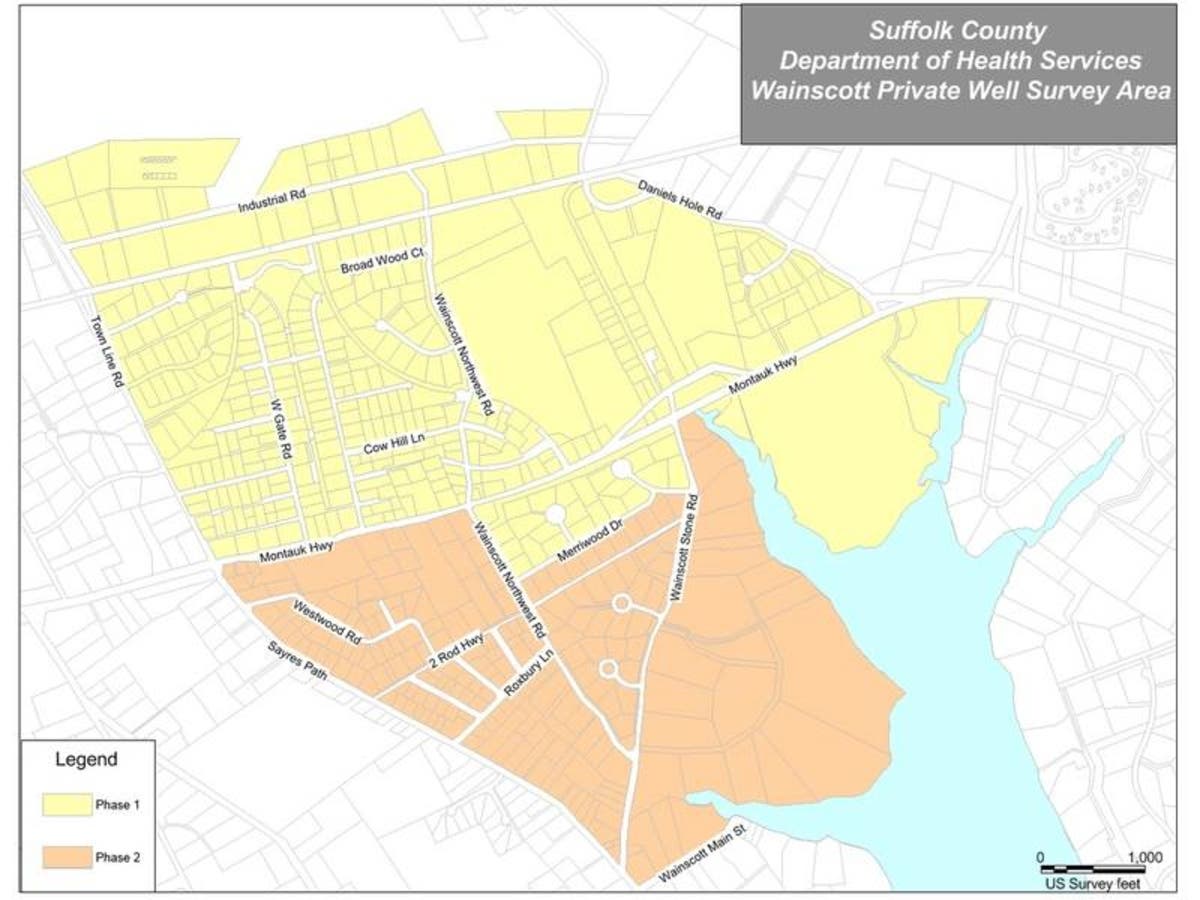
Based upon the contaminants found, the Suffolk County Department of Health Services, along with the New York State Department of Health and the New York State Department of Environmental Conservation expanded the private well survey in the vicinity of the East Hampton Airport as follows:
the area bounded on the north by the East Hampton Airport, on the west by Town Line Road to Montauk Highway and then Sayres Path to Wainscott Main Street, on the south by Wainscott Main Street, and to the east by Georgica Pond and Daniels Hole Road.
The expanded survey boundaries were determined based on the current understanding of groundwater flow as depicted in the U.S. Geological Survey groundwater elevation maps as well as the location of known detections above the health advisory level in three private wells, the county said.
The Suffolk County Department of Health Services said then that it planned to install groundwater monitoring wells in the area to confirm the local groundwater flow.
Residents who use a private well for drinking water and live in the survey area you can contact the Town of East Hampton's purchasing department at 631-324-4183 or email jcarroza@ehamponny.gov to receive bottled water.
Homes connected to a public water supply do not need to have their water tested as those supplies are routinely tested. PFOS and PFOA have not been detected in the public drinking water supply wells serving that area, the county said.
Residents with general questions about health effects of perfluorinated compounds are advised to call the New York State Water Quality Hotline at 1-800-801-8092, Monday through Friday, from 8 a.m. to 4 p.m. Residents who are unsure if they are served by public water may call the Suffolk County Water Authority at 631-698-9500.
Residents with private wells who have questions about private well water in Suffolk County or who want to have their wells tested can contact the Suffolk County Department of Health Services Office of Water Resources at 631-852-5810.
For additional information about PFCs, click here.
For more information on perfluorinated compounds, click here.
Patch courtesy photo.
Get more local news delivered straight to your inbox. Sign up for free Patch newsletters and alerts.