Community Corner
'I Think About It Every Day': Retired LI FDNY Lieutenant Trapped In Stairwell Recalls 9/11
"Firemen will die today." Matt Komorowski heard those words from his captain before spending four hours trapped in the North Tower.


MASSAPEQUA PARK, NY — Eight thousand. That's roughly the amount of days Matt Komorowski has thought about 9/11 in the 22 years since the terrorist attacks that rocked New York and the nation as a whole.
"I think about it every day," Komorowski told Patch.
Komorowski, 60, was one of six FDNY firemen trapped under Stairwell B for four hours in what was left of the North Tower. And he wasn't even supposed to be in New York City that day.
Find out what's happening in Farmingdalefor free with the latest updates from Patch.
Komorowski, a member of Ladder 6 in Chinatown, was finishing a 15-hour night tour. Normally, he would get relieved at 8 a.m. after a night tour and leave within the hour. The firefighter was preparing to head to his Massapequa Park home when he heard the ladder company was short men on Sept. 11, 2001. A firefighter was called from home, so Komorowski had to wait for him to come in before he could leave.
Komorowski was having a cup of coffee outside of the firehouse and watching the Chinatown passerby on what he called "such a beautiful day."
Find out what's happening in Farmingdalefor free with the latest updates from Patch.
"And all of a sudden I saw a plane," he said. "It was flying over Manhattan. And the first thing I thought was that it was flying very low for a commercial airline. And then I heard the pilot throttle it up to go faster."
He lost sight of the plane as it flew behind Confucius Plaza. And then he saw the explosion and fireballs erupting from both sides.
"There, I knew we were going to respond right away."
The dispatcher called for all lower Manhattan companies to respond to the World Trade Center.
"I've never heard a dispatcher say 'all companies,' so that was very odd," Komorowski said.
The firemen got in the truck and drove to the fully engulfed North Tower. They got to the tower, where they saw a woman with burn marks leave. They entered the lobby, awaiting orders. As the ladder company's captain, John Jonas, was getting their assignment, the South Tower was hit.
Jonas returned and told them, "Firemen will die today."
That statement was "very difficult" to hear, Komorowski said.
"However, when you're there with a bunch of other guys, and your officer, you know, you have a job to do," he said. "So whatever that entails, you just have to do it. And that's what being a New York City fireman is. We just have to do things that a lot of other people just don't do."
Ladder 6 was told to go up to the 85th floor and assist in the evacuation. None of the elevators were working, so they had to find a viable staircase. It could only fit two people side by side, which was "interesting" for such a large building, Komorowski noted.
A line of people were descending the stairs. Some were burned, some had broken limbs and some complained of chest pains.
"It was very difficult for us to move past these people without giving them some sort of assistance," Komorowski said. "But we knew we had to get up to the higher floors."
Jonas made it a point to have his team stop every 10 floors for a break, as the firemen had bulky gear they had to carry through swarms of people heading the opposite way. At the 30th floor, the firemen took their periodical rest when Jonas wanted to check the outside conditions at a window.
He watched the South Tower fall.
But only Jonas knew at the time since his squad was by the staircase. He returned to his team and told them, "Time to go, guys. I'm pulling the plug."
Komorowski recalls the glances the firefighters exchanged knowing they had another 50 or more floors to climb. They still didn't know the neighboring Twin Tower crumbled. But when it did, the North Tower began shaking and swaying. The stench of jet fuel filled the air as it began cascading down the elevator shaft.
The company followed Jonas's command and started heading back downstairs.
"I've been to plenty of high rise fires in my career and buildings just don't come down," Komorowski said. "It just doesn't happen. Sure, there are collapses, but these high rise buildings for businesses do not collapse."
The crew got to the 12th floor when they encountered a woman named Josephine Harris. She was in her early 60s and worked as a secretary for Port Authority. She was having trouble at the last 12 floors.
At about the fifth floor or so, the firefighters decided to carry Harris down the rest of the way. Komorowski, bringing up the rear, heard an "incredible rumbling" above his head that only got louder and louder. The floors above him were collapsing. He screamed at everyone in front of him to move.
Komorowski was thrown down the five remaining flights of stairs to the first floor, flying right past his fellow firefighters.
The North Tower had fallen.
Komorowski never experienced a tornado, but he imagines it was like what happened to him when he got thrown.
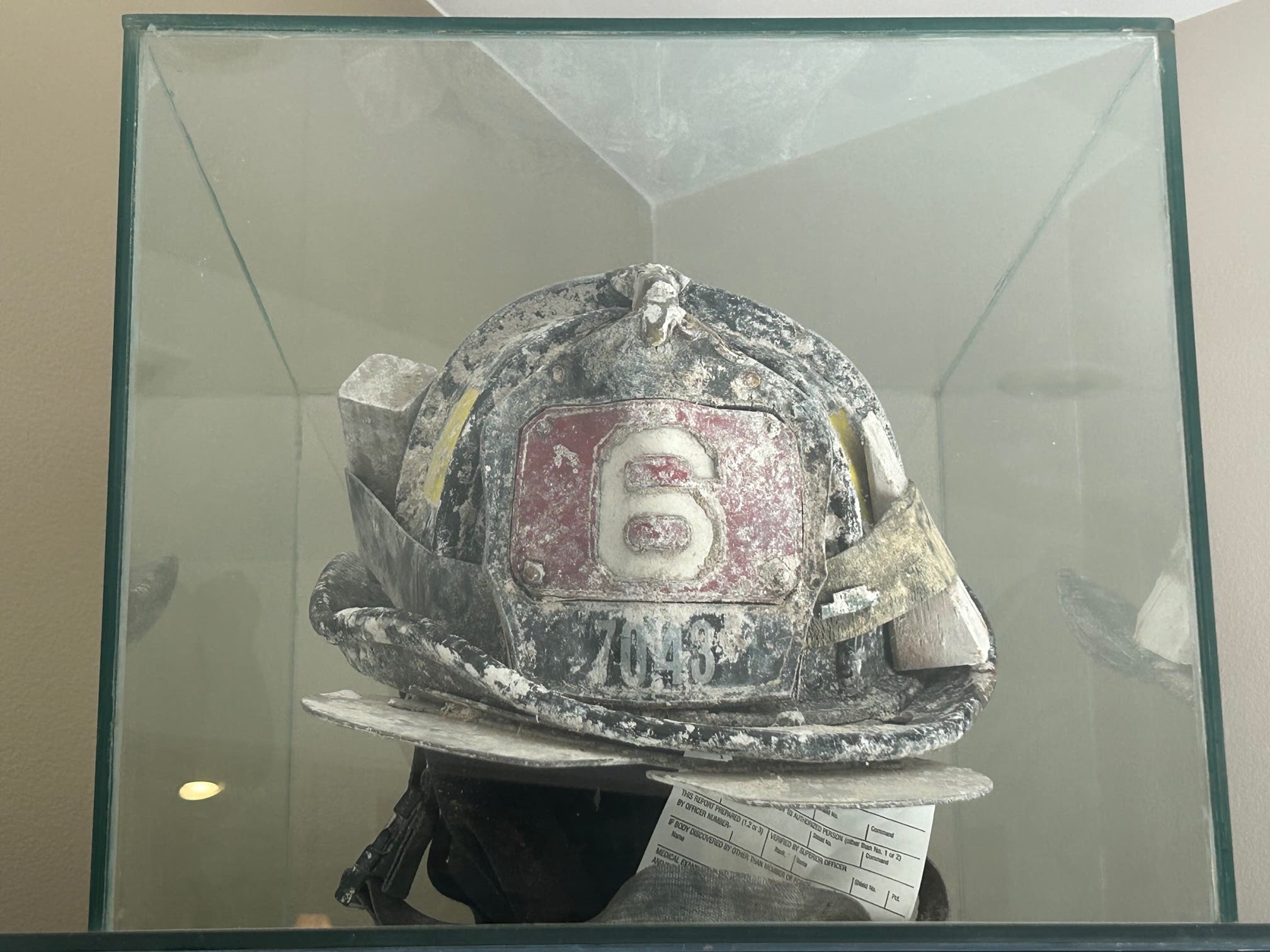
"It's like, you're getting pushed down by the pancake collapse air," he explained. "But then the air has to go someplace once it reaches the lobby level, or the lower level, and then it goes up. So you're getting pushed down and pushed up at the same time, which was a wild feeling. And that's when my helmet got blown off of my head."
Komorowski's helmet was found a month later. He could have cleaned it up and began using it again, but he chose to display it in a glass case instead.
"I think it would be better for it to serve like a memorial in my living room."
Komorowski and Ladder 6 were trapped in the five floors that remained of Stairwell B. There, they spent four hours.
"It was scary," Komorowski said. "But having other people in the staircase made it bearable. I could not imagine being trapped alone. When you're trapped alone, that's a whole different ballgame."
Komorowski was on the ground floor. He had to wiggle out of pulverized sheetrock and cement up to his waist. The rest of the men and Harris were scattered across the third, fourth and fifth floors, but they could all yell to each other.
The other firefighters, Komorowski said, were making sure Harris was safe and telling her they would get her out of the remains of the tower.
Jonas ordered everyone but one member of the crew to turn off their lights and radios to conserve batteries.
Komorowski meanwhile forced a door open that led to a sprinkler machinery room. Jonas said the firefighters could live off the water in the pipes if they were going to be there for days.
Jonas made contact with people outside and tried to direct them to where they were trapped, but since the tower had fallen, there were no landmarks guiding search crews to Ladder 6. Rescuers did not know where the North Tower was.
"And that was a shock to us inside," Komorowski said. "Because from our perspective, how could you not see the North Tower? But they had mounds of debris and rubble out there, so they had no clue with where to go to get us."
As the debris and smoke began to clear, the firemen saw sunlight above the stairs. Komorowski climbed five stories' worth of railings since there were no stairs left. Searchers found the firemen, who had to shimmy across an I-beam without falling two or three stories into rock.
When the firefighters got out of the staircase, they found themselves in a debris field of crushed cement, I-beams, and rebar. They made a "very dangerous trek" back to West Street, Komorowski said, but they eventually got there. Rescuers couldn't believe Ladder 6 had escaped, as they had been looking for the six firefighters for hours.
Komorowski called his wife, Jennifer, at a local business to let her know he was OK. Then the line got disconnected.
The crew was separated and taken to different hospitals.
Komorowski called his wife again in the ambulance, letting her know he was being taken to a hospital. The line got cut off again.
"When I got to the hospital, that was an eerie feeling, because there were so many nurses and doctors waiting with their gurneys to take in all the people who were injured," Komorowski said. "And there was nobody coming in. So it was very hard for me to see that."
Komorowski was X-rayed, tested for dehydration and treated for exposure. He was released from the hospital.
"That was the longest ride home in my life."
He made it home at 7 p.m. Sept. 11, 2001.
Komorowski embraced Jennifer.
"Because out of all the horrific stuff I went through that day, she was what I needed at the moment. She was so comforting. She was hugging me. She really didn’t know what was going on that day until she got a phone call from my family. My brother-in-law actually called her and said 'Do you know what’s going on in New York?' She had no idea because she didn’t have the TV on. From that point on, I can’t imagine what she was going through not hearing from me until around 4 in the afternoon."
Komorowski can't say making it home that night was a relief.
"Because there is no relief from that. But I definitely needed my family in that moment."
Jennifer and the couple's daughter, Hannah, had prepared a little dance recital they planned to put on for Komorowski when he was supposed to have returned home that morning from his night shift. He never did get the dance recital, but he got to watch Hannah grow up.
Matt and Jennifer had another daughter, Julia, in 2002.
Komorowski still deals with PTSD and is currently on medication.
"I don't have a problem telling people," he said. "I think it really helped me to get therapy early, where I know a lot of firemen didn't do that. And they might not be faring as well as I am. But I'm still dealing with it after 22 years."
He "definitely" experiences survivor's guilt, as well.
"It's a weird feeling to be so happy that you're alive. But then the happiness quickly goes away because of all the death that was around that day. And all the firemen, policemen, all the workers that perished. It's a very difficult, emotional thing to think about. But it's now a part of me and I have to learn how to deal with it."
Komorowski still keeps in touch with the five other firemen he was trapped with that day — just not as often as he once did. They made it a routine to get together for dinner at least once a year with Harris, but that faded away when she died of a heart attack in 2011.
Harris was the "guardian angel" of FDNY Ladder 6, Komorowski said. They would have all died if they hadn't stopped to help her, he said.
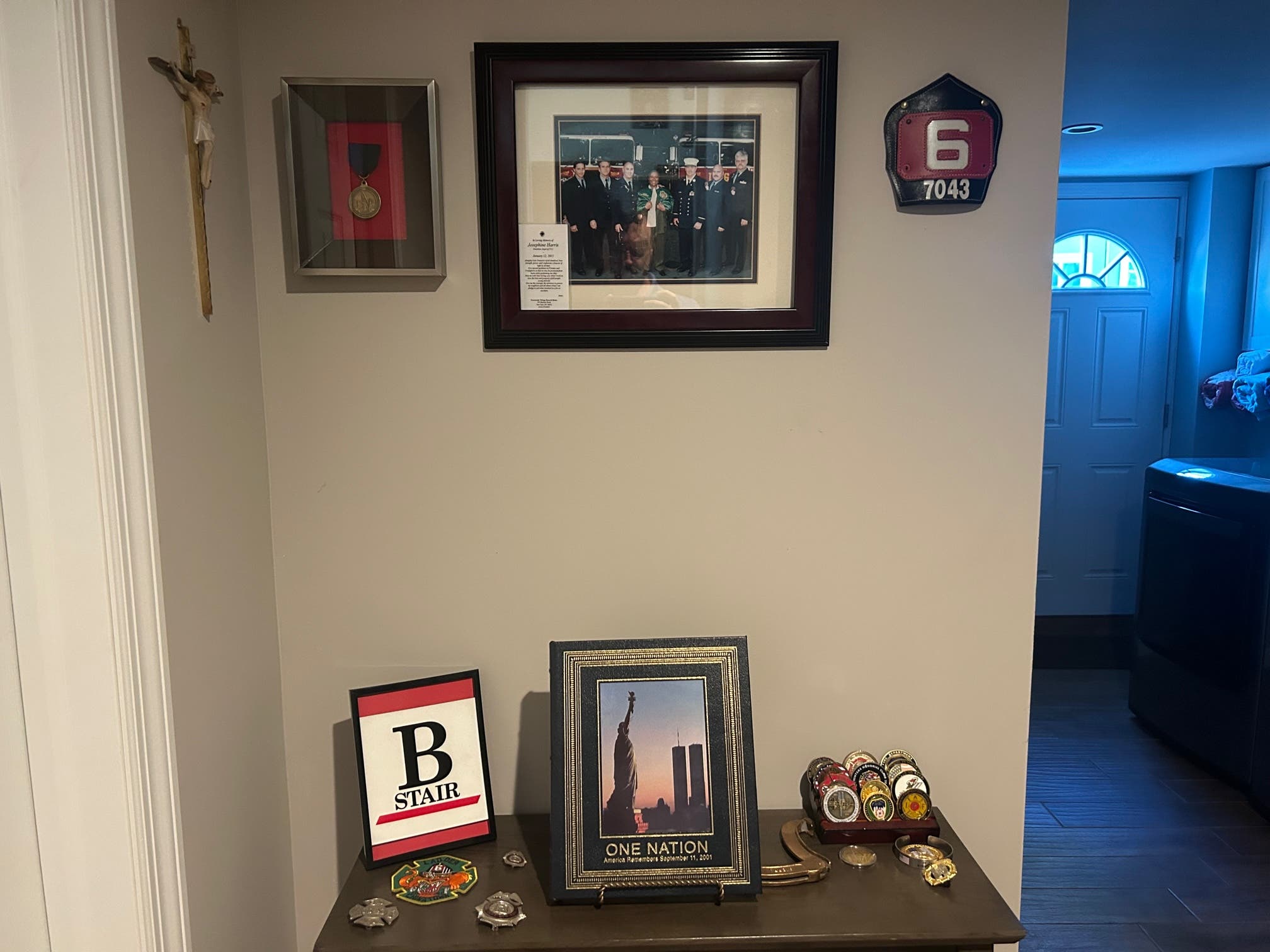
Komorowski's FDNY career began in 1990. He was in Engine 9 in Chinatown for six years. He transferred to a different company in the same firehouse: Ladder 6.
He was promoted to lieutenant in 2002 and re-assigned to Williamsburg, Brooklyn, where he served for 18 years.
Komorowski retired in 2019 after 29-and-a-half years in the FDNY.
"I like to say 30, though," he said with a smile.
When Komorowski isn't spending time with his family, he enjoys running, watching his New York Yankees, cooking, gardening, household projects, and playing second base in the Over the Hill Gang Softball League.
Get more local news delivered straight to your inbox. Sign up for free Patch newsletters and alerts.