Politics & Government
Frustrations Run High Over 9/11 Fund
At town hall meeting in Melville responders and survivors upset that cancer is excluded from aid package.


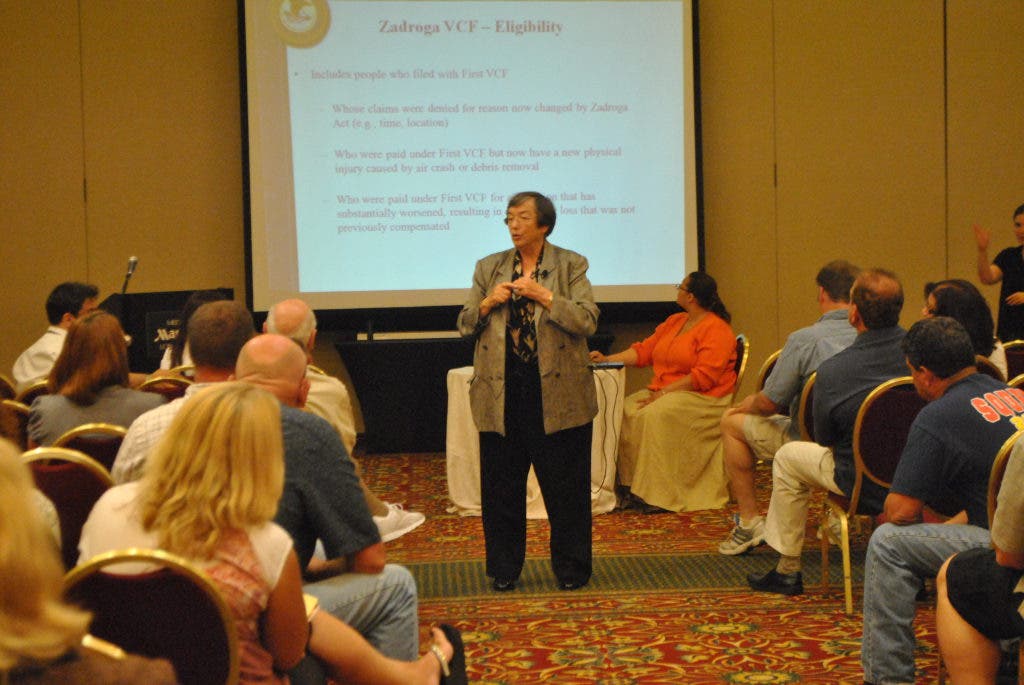

The head of a fund for people injured in the Sept. 11 attacks visited the Tuesday night to discuss details of what the health plan will cover.
On the minds of responders in the room however, was the item the fund does not include: cancer treatment.
The town hall meeting, led by Sheila Birnbaum, Special Master for the Department of Justice Sept. 11 Victims Compensation Fund, came a week after Dr. John Howard, the doctor in charge of deciding which injuries and illnesses are included on the list, declared that a federal review to warrant adding the illness to the list of conditions covered.
Birnbaum shared the frustration of firefighters and workers sitting in the room suffering with cancer. She asked that anyone with medical evidence from their doctors linking the illness to Sept. 11 to bring it to the department so that more information is documented when a new review is conducted next year.
“I know that is not sufficient for those who have cancer now and are wondering why you’re not covered, but that is the state of things as of now,” she said. “(The list of) injuries can be expanded with scientific evidence. We’re going to read every study that comes out.”
Another difficulty of the plan is that it is a limited fund of $2.78 billion to be used within the next five years. How much each person receives will depend on how many individuals apply for compensation. That amount must also cover all administrative costs of running the program.
Birnbaum stated that she is giving up one month of her salary because she does not want to take away from the victims. “I want to set an example,” she said.
While the department has yet to gather a sufficient scientific link between cancer and Sept. 11, for responders such as John Gallagher, a New York City firefighter from Deer Park, the connection could not be more clear. Gallagher uses a breathing tube because of his pulmonary fibrosis, which he was diagnosed with after Sept. 11.
“They keep saying they don’t have the numbers and quite frankly, I don’t know how they cannot have the numbers because every time I bump into another fireman, he’ll tell me somebody else came down with cancer,” he said. “We look at people that we know with cancer and there’s no doubt in anybody’s mind what the cause was because the one thing they all have in common is the World Trade Center. That’s the one common denominator in all of them."
One of those individuals is 42-year-old NYFD Anthony Conti who was diagnosed with a rare bladder cancer last June.
“Here I am, a first responder with cancer. I’m here just to put another nail in the coffin so to speak to say that there definitely is a connection, he said. “In June of 2010, I was 40 years old. I never smoked and this is not the type of cancer someone gets who doesn’t smoke...I’m not an expert, I’m not a scientist, but I think this is crazy.”
Illnesses that will be covered under the act include chronic cough, asthma, sinusitis and gastroesophageal reflux disorder (GERD), mental health problems, such as post-traumatic stress disorder and depression and other health problems, such as lower back pain and carpal tunnel syndrome and other conditions which research suggests may be related to WTC exposure. Mental illnesses such as post-traumatic stress disorder will also be covered.
Survivors and responders can begin to apply for compensation and/or treatment starting October 1.
Get more local news delivered straight to your inbox. Sign up for free Patch newsletters and alerts.