Community Corner
World's Fair "House of Tomorrow"
The original development was set up in Bradley Hills, within Dix Hills, during the 1940s.
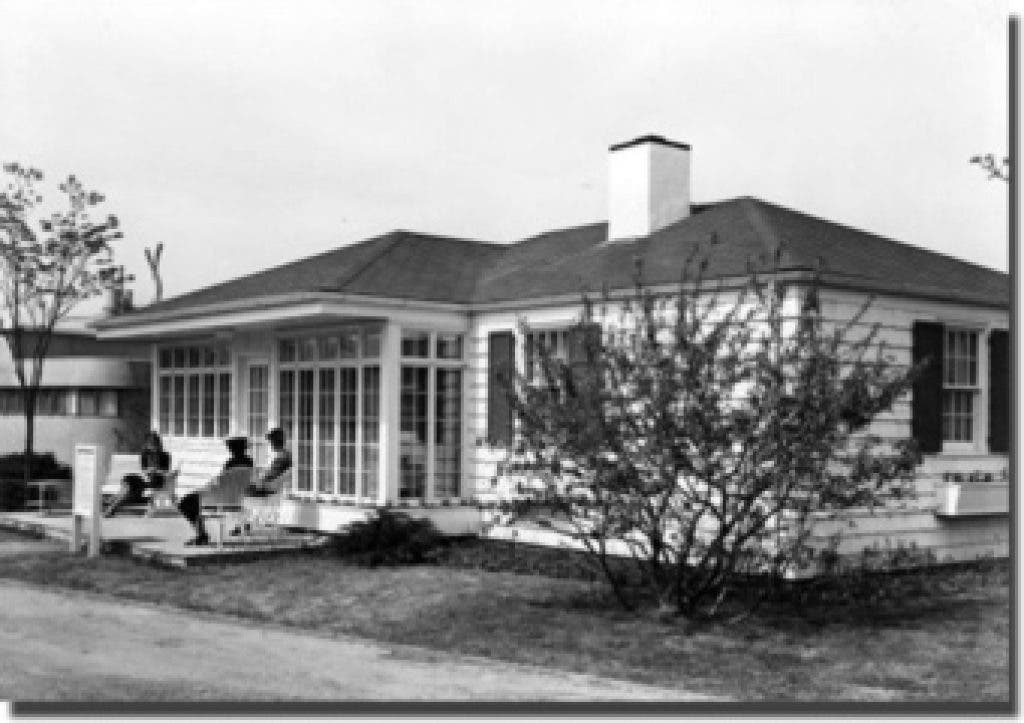


On August 28, 1941 the Long-Islander proudly announced that, “The original World’s Fair House of Tomorrow has been set up in the new development known as Bradley Hills in the Dix Hills section of Huntington.”
The 1939-1940 World’s Fair was the home to the “Town of Tomorrow.” Described by James Mauro in his book, "Twilight at the World of Tomorrow," as “an attractive, orderly cluster of fifteen ‘Demonstration Homes’… [where] the Board of Design had attempted to create truly low-cost housing by utilizing pre-fabricated material.”
The homes were built, furnished, and sponsored by material manufacturers and major department stores. According to www.1939nyworldsfair.com, “The 1939 World's Fair guide books listed the average home price of around $20,000 while the 1940 Guide Book gave a price range from $3,000 to $35,000.”
Find out what's happening in Half Hollow Hillsfor free with the latest updates from Patch.
"House No. 1," as it was called, was the “Dual Duty House." It was designed so that every room in the house, including the garage, would have more than one purpose. The architect of the house was Harry S. Churchill, and Bloomingdale Brothers, Inc furnished it. The cost of the house was about $5,000.
The living room of the home was designed to function as a living room, a library, a music room, and because of the wall-high windows at one end, a solarium. The “L” shape of the room also provides a dining alcove, which can be used as a study the rest of the time. The master bedroom “contains a compact convenience wall which serves to provide an ultra-modern sewing room and domestic office.” A second bedroom, called “a scientifically developed nursery,” was adjacent to the master bedroom, as was the bathroom.
Find out what's happening in Half Hollow Hillsfor free with the latest updates from Patch.
As a small house, it had no cellar, but had a complete utility room that provided space for heating equipment and laundry room instead. The garage was heated, its walls and floors attractively finished, and as such could house a work bench. The home also contained a streamlined kitchen, designed for ease of housekeeping, and a paved terrace with overhanging roof which served as a porch. (All information on the interior of the home found at www.1939nyworldsfair.com)
On November 28, 1938, the Long-Islander announced, “Syosset Contractor Buys Deer Park Property.” John Franklin Bradley was a landscape architect from Syosset who purchase 28 acres of woodland in Dix Hills. The property fronted on three major roads; Jericho Turnpike (1/4 mile), Deer Park Avenue (1/3 mile), and Old Country Road (800 feet). The article reported that he intended to build a nursery on the property.
Then on August 28, 1941 when the Long-Islander announced that the World’s Fair House of Tomorrow had been purchased by Bradley and moved to Dix Hills, they also discussed his plans to develop the 28 acres. They referenced “Bradley Hills” and said that it would contain one-are plots, and that the acreage was formerly part of the Carll property. (See my former article on the Carll- Doscher Homestead.)
The New York Times also reported the moving of the house to Dix Hills on August 31, 1941. It is from this account that we learn that the house was Number One Town of Tomorrow. The article also explains that, “Mr. Bradley purchased the house when the Fair closed from the World’s Fair Corporation. When it was taken down he had all the parts numbered so that it might be accurately rebuilt on the new site. The cost of removal, and reconstruction, he states, represented close to $2000. The house is being opened this week for general inspection and it will serve as the model home for the projected development, [Bradley Hills].”
I am not quite sure what happened, but Bradley Hills—the development never made it off the ground. On March 20, 1958 the Long-Islander announced that John Franklin Bradley had been made President of the Huntington Station Rotary Club. In the same article, they reported that he lived in the World’s Fair House of Tomorrow that he had moved from the 1940 World’s Fair. Whether or not it ever served as a model home for a development is unclear, but the development was never built. (Just an interesting tidbit: the article also states that John F. Bradley was a, “descendent of Sir John Franklin, famous Arctic explorer and discoverer of the North West Passage.”)
Instead of a housing development, John Franklin Bradley’s original plan for the site, Bradley Nurseries, operated for several years at that location. Advertisements for it can be found in the Long-Islander from the mid- 1940s through the 1960s. The nursery was so good that on November 19, 1953, the Long-Islander reported that John Franklin Bradley complained to the police that several of his finest azaleas and rhododendrons had been stolen over several weekends. He suspected it was another horticulturalist as they only stole the finest of each.
In addition to a nursery, John Bradley went into the split rail fence business. On June 28, 1951 the Long Islander reported that he had purchased the lumber rights to a 600-acre tract of land in West Virginia in order to enable him to keep up with the demand for split rail fencing.
John Bradley died on November 12, 1971 at Huntington Hospital. His obituary in the Long-Islander, published on November 19, 1971, identified him as an active member of the Huntington Historical Society, and a charter member of the Huntington Station Rotary Club, as well as a member of the National Audubon Society’s Huntington branch. His memorial services were presided over by the Reverend Joseph MacGinnis of St. John’s Episcopal Church, and he was buried in Mount Hope Cemetery in Hastings-on-Hudson, NY. The article also stated that he had resided at 684 Old Country Road.
Armed with an address, I set out to discover if the World’s Fair House of Tomorrow was still standing in Dix Hills, and perhaps no one knew it’s great history. With a little help from some friends at the Town of Huntington, I learned that unfortunately, the house is gone.
There is a house there now which was built in 1972, one year after John Franklin Bradley passed away. After he died, the property was probably sold and the house demolished. If you take all of the land in between Deer Park Avenue and Jericho Turnpike, from Old Country Road and the Pathmark Shopping Center on the west to the Greenlawn Water District Tower on the east, you have approximately 25.4 acres, with ~800 feet of frontage on Old Country Road and a quarter mile of frontage on the other two roads. It appears therefore that this was formerly the home of Bradley Nurseries. Interestingly, the 1972 house burned down in 1978, and has yet to be rebuilt. In this fire, any evidence of the original house would have been lost.