Politics & Government
Mayor's Desk: Water, Water, Everywhere — Or is it?
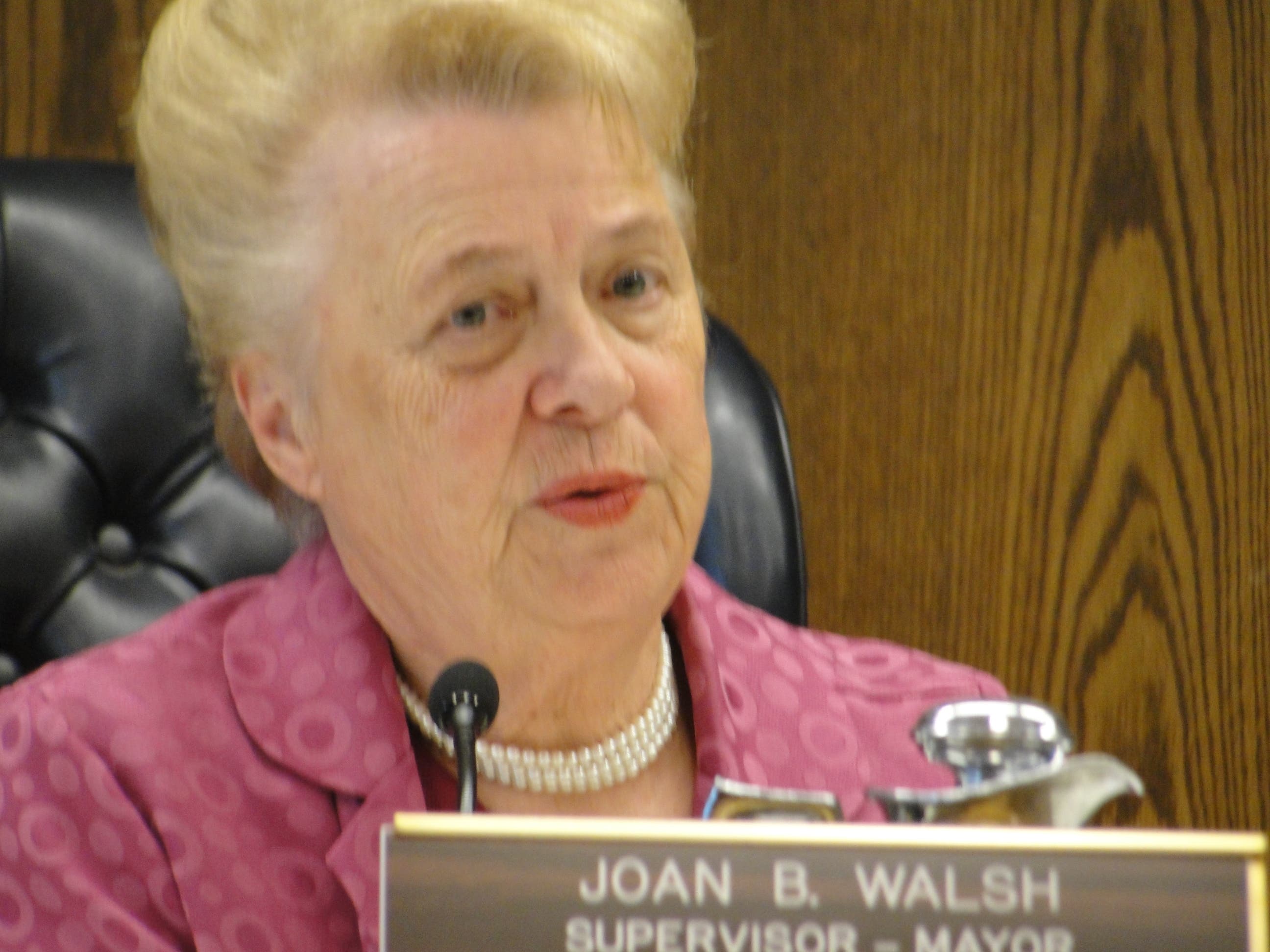
Harrison Mayor/Supervisor Joan Walsh discusses local issues in her weekly column.
We are getting just a taste of warmer weather, so naturally, for some of us, our thoughts turn to grass, and landscaping and irrigation systems. So my discussion today is about those irrigation systems and the cost of water to keep our grass so green.
Most people know that we get our water from the . Not too many know that the Water Works is owned and operated by three municipalities: Harrison, the Village of Mamaroneck and the Town of Mamaroneck.
And, are you aware that the WJWW buys our water from New York City? We don’t have wells or our own reservoirs so we must buy the water and pay whatever they decide to charge.
Find out what's happening in Harrisonfor free with the latest updates from Patch.
All three municipalities share the cost of the daily operations and of those capital projects that serve all of us: IE: upgrades of the machinery that treats the water or changes to the booster pump stations that are required to keep the water flowing at the right pressure. When a project serves only one municipality, that municipality pays the cost. An example of a municipal cost would be the replacement of a water pipe on a local street, or, as now, replacement of house meters in each municipality so that when the entire system has been replaced in all three municipalities meters can be read from the home office and not require an employee to drive by your home or, in the case of really old meters, actually go into your home to read the meter.
History
Find out what's happening in Harrisonfor free with the latest updates from Patch.
New York City has the most marvelous system of aqueducts and tunnels. However, they leak, some say up to 36 million gallons a day. Repairs are being made, but it is complicated as the tunnels cannot be shut down completely.
The water comes from watershed property in upstate New York, flowing by gravity down to the Croton Reservoir here in Westchester, mainly through the Catskill and Delaware aqueducts. Then, two very old tunnels carry the water into NYC: #1, completed in 1927, and #2, completed in 1935. Construction on a new, larger and greatly improved tunnel, #3, was started in 1970, will be more than 60 miles long, and is not expected to be completed until about 2020. It is said to be the most expensive capital project undertaken by New York City.
What has this to do with us? We buy our water from New York City, so we pay part of the cost of the entire system, including the new tunnel. Every year their costs go up, just as everyone’s does. There is a new UV plant under construction in Eastview, the UV plant under construction in Van Cortland Park, the cost of chemicals, buying land to preserve the watershed, and on and on.
How does that affect you? Every year, in late spring, the New York City Water Board decides how much to charge (increase) in the coming months for the water they sell to various entities such as the WJWW. Last year, that increase was 25 percent. We are now paying $1,149.72 for each unit of water – per million gallons. In addition, because there was very little rain, heavier than normal use of irrigation systems pushed water consumption levels above the per capita water use limits established by New York City, resulting in additional charges from New York City for excess consumption at a rate of $2,794.13 (this rate was increased by 9 percent from the prior year) applied to each incremental unit of water – per million gallons -- above the threshold.
The increase in the New York City basic rate, higher New York City excess charges and the hot and dry weather conditions, resulted in some of our residents with irrigation systems getting high water bills.
Cost Increase For 2011
WJWW is expecting that there will be another substantial increase this spring, with the amount not yet known. There was a statement in the Wall Street Journal that for New York City residents it might be 7.5 percent. For customers like us, we have been told it might be 13 percent, but we think it will be higher. This is not a cost we can control.
Reasons for increases? See above. Also, as part of the construction process for the new tunnel, NYC is working on repairs for a portion of one of the old tunnels. This will decrease the flow of water for a period of time. Farmers in Ulster County are being told that shortly they will no longer be able to buy water from the Delaware Aqueduct as they do now, to irrigate their crops, as the system needs a certain sustainable volume of water each day, and continuing to service these farms would put in jeopardy the volume that is now required for New York City and customers like the WJWW.
That volume is in the neighborhood of 1.5 billion gallons per day. Those farmers are looking into a solar system to filter ground water ponds in their area to bring it to USDA standards but it is extremely expensive, and would take time to design and install. Other factors contributing to the New York City rate increases are the UV facilities being constructed at Eastview and Van Courtland Park by New York City; the extensive protections required for the New York City watershed in upstate New York; as well as other programs related to filtration avoidance, water quality and homeland security.
It behooves all of us to be vigilant in our consumption of water. It is not inexhaustible, nor is it free or inexpensive.
What About High Water Bills
We can all take some very simple cost-effective steps right now:
-
Check for leaks. Turn off all faucets. Stand next to the pipe that brings water into the house, and listen. If you hear water running, you need to find that leak. Once fixed, repeat the process.
-
Check your sprinkler system. If it is old, it may be leaking through a pipe or through a connection. There are good systems, and there are poor systems. Until installers are tested and licensed, anyone can install a system, and you will never know if it is done properly or not – until you get that water bill. Listen for leaks. Install a separate meter for the system as well as a back-flow value (which is required for these systems.)
Decide how green you want your lawn to be. Most lawns need no more than one-inch of water per week. Get a rain sensor and connect it to your timer. Test various ideas and see how your lawn responds. Water at dawn, or at dusk. Once a day or every third day, 20 minutes or half an hour. You can measure how much water your system uses by reading the meter before and after it runs, (read the numbers from the left (IE: 0421 start number, then at the end it might read 0433. Subtract 0421 from 0433, and you have used 12 (100 cubic feet) of water) Find the cost by multiplying that number (12) by the per 100 cubic foot cost of abut $4.26 to get your theoretical cost of $51.12. Costs vary according to how much water you use, but for this trial, use $4.26 per hundred cubic feet. Do it now for the current cost, and in June/July for the cost after we have to told you what the new rate is, to accommodate the New York City increase. Then decide how much you want to spend, how green you want your lawn to be.
Also look at your appliances. For example: if you buy a new clothes washer, a front loader high efficiency washing machine uses about 15 gallons of water, vs 65 gals for a top loading machine. These machines are expensive, but save water and electricity. Again, this is the five-minute version of a very complicated issue. There are various sources for more information, starting with Google and also the .
P.S. — This column contains advice – something that I generally don’t offer. However, there were so many people concerned about their water bills after last summer, many of whom called me, that I thought it might be helpful at this time. I just don’t want you to be surprised by this summer’s water bills.