Schools
Purchase Professor Tackles the Philosophy of Happiness
Casey Haskins encourages students to look at the notion of happiness as multi-faceted and more spiritual than material in nature.
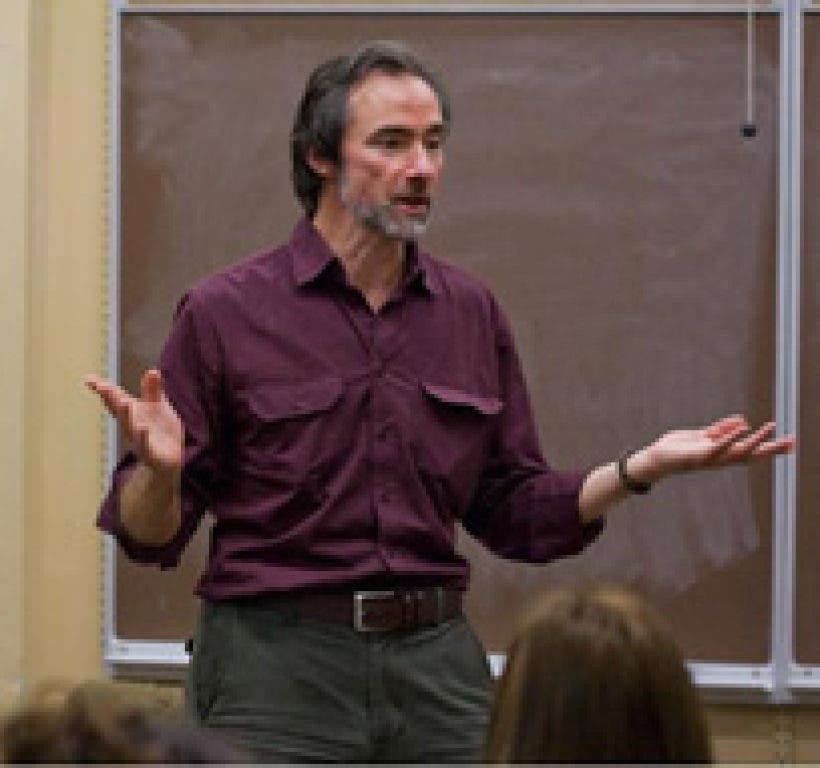
The subject of happiness is one that's intrigued philosophers for millennia. What does it mean to be happy? How can we be happy in the face of hardship? Can material possessions bring people true happiness?
These are some questions asked in courses taught by Casey Haskins, an associate professor of philosophy at Purchase College.
Haskins, who's focused on the philosophy of art, religion and aesthetics at Purchase since 1987, said that teaching a course on happiness facilitates a complex interdisciplinary dialogue for his students that's often lacking in traditional studies.
"Students are likely to be more aware today than at any time in academic history of there being different kinds of knowledge being represented in different disciplines," explained Haskins.
"They're more inclined to think of the world as being complicated, but what does it mean to say we have these different siloughs of expertise that look at different aspects of the world? They're not neatly divided at all," he said.
In Haskins' course on happiness, he approaches the topic by offering students readings in literature, psychology and film.
Find out what's happening in Harrisonfor free with the latest updates from Patch.
Last semester, students read Leo Tolstoy's novella "Family Happiness", Gary Shteyngart's novel Super Sad True Love Story and Jonathan Haidt's The Happiness Hypothesis. They also watched films such as "Waking Life", "Wings of Desire", "It Happened One Night" and "XXY".
"My approach to this subject isn't to tell people what happiness is definitively, or that it can be achieved without tragedy. They're both very interconnected," said Haskins. "The less considered part of the psychology of literature might say that happiness is something we can all apply as a self-help program."
The course starts out by looking at how happiness is portrayed in modern society.
"Happiness is a very traditional philosophical subject and I think it's interesting for a lot of students," he said. "You find explorations of it in Plato, Aristotle and other ancient thinkers and it's a flourishing topic that gets taken up more and more as Western intellectual history goes forward."
Haskins notes Aristotle saying that "happiness is a condition of life flourishing," rather than a singular life event or attainment of social status.
"To be happy is kind of misleading," he explained. "It's not a singular experience; it's a good life. In this view, happiness isn't defined by a particular moment, but a whole pattern when you can look back on your life and say, 'This is a person I'm happy to be'."
But the modern view of happiness in our society, Haskins says, is often associated with "first world" material consumerism.
"We're all individuals and to be an individual is to have desires and satisfy them," he said. "We get more stuff and assess our amount of stuff without thinking too much about the individuals' relationships to other people. That kind of view raises some problems about a healthy society, especially at a time where people are getting into debt while others explore their own economic benefits at the harm of others."
Haskins asks students, "What are the best, healthy ways of conceptualizing what it is that we all think is most important in our lives, given the types of problems that people have gotten themselves into?"
The ideal notion of happiness for Haskins seems to strike a balance: It's continual, resilient to life's hardships and spiritual, rather than material, in nature. Just as he seeks to engage students in an interconnected dialogue on happiness, he says good students have a sense of curiosity for how ideas transcend disciplinary boundaries.
"The best students at Purchase College tend to achieve some kind of balance between traditional disciplinary focus and a larger sense of connectedness," he said.