Politics & Government
Walsh Talks Town Finances in Final Column
Comparing spending levels of now to 10 year ago doesn't paint a pretty picture, according to Mayor/Supervisor Joan Walsh.
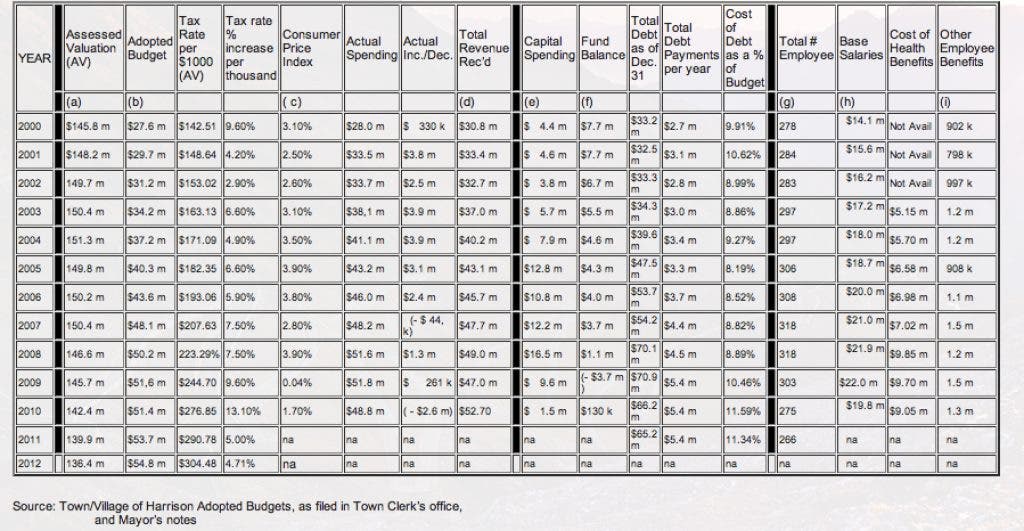


For the past few weeks, I have been working with a good friend, an expert in measuring the fiscal health of corporations, to prepare a financial picture of Harrison as it would look to someone who would be preparing to buy stock in the corporation that is the Town of Harrison .
The attached chart shows our finances as they exist today, and the changes that have occurred since 2000. I used the numbers from the graphs that I presented at the Town Hall Budget discussions, and published in columns here. Please read it carefully. It is not a very pretty picture.
I will highlight only four of the columns, contrasting Year 2000 with Year 2010.
Find out what's happening in Harrisonfor free with the latest updates from Patch.
Consumer Price Index: In only six of those years was it over 3%, and in the other years it ranged from 0.3 percent to 2.8 percent.
Why am I stressing this information? Because four years ago, I was elected to stop the spending that had been the hallmark of our town from 2002 through 2007. In some areas I was successful, in other areas it was not possible. There were, and are, built-in obstacles that the new administration will also face. It takes time to reverse momentum, but that process has begun. Let’s hope it continues.
Find out what's happening in Harrisonfor free with the latest updates from Patch.
To define a couple of terms:
- Operating Budget: In a household, that is the money you use for everyday expenses: heat, electricity, food, gas, minor purchases such as a new chair, a sweater or shoes, etc. The town uses those funds for many of those same expenses.
- Capital Budget: In a household it is money you use for major purchases: a down payment on a new house, if you buy a car, or a bedroom set, for an addition to your home or major landscaping. The town uses the capital budget for its major costs: a new garbage truck ( $225,000) repaving a road (about $87 per foot) etc.
- Fund Balance: The town’s savings account, to be used for emergencies and used by the financial rating agencies such as Standard and Poor’s as a measure of our fiscal health. We were downgraded as that balance kept dropping.
The major success during my administration was in reducing spending so that it stayed almost within the adopted budget, what you elected me to do. It was difficult to re-educate people that asking for more money did not mean an automatic increase. By 2010, we actually had a surplus due to constant use of the word “NO” and the cooperation of the department heads in controlling their costs, including overtime.
We used those funds to pay off the deficit in the operating budget, and in restoring some funds to our savings account, known in financial circles as the fund balance. It had dropped from $7.7 million in 2000, to a deficit of $3.7 million in 2009, even while our bonded debt grew from $33 million to $70 million in 2009. (In the 2012 Budget, 10 percent or $5.2 million goes to repay that debt.) Our savings account—the fund balance—money needed for emergencies such as major snow storms or major building repairs, has grown to a very modest $30 thousand in 2010, increasing again in 2011.
There was some success in controlling capital budget costs. By 2010, we had reduced that expense to $1.5 million. Were some customary projects not done? Yes, IE: filling potholes rather than repaving those streets, repairing major equipment rather than buying new. Was the reduction necessary? Yes. Our residents have a difficult time paying today’s taxes without the town adding even more to these costs.
The major cost in a town is in personnel, in salaries and benefits. For many years, going back decades, it was easier for administrations to give a benefit rather than a salary increase. As the unions got involved, those benefits increased.
Two major areas are pensions and healthcare costs. We are assessed a percentage of salaries to be sent to Albany to cover pension costs, and that percentage is set by Albany—we have no choice but to pay it. The current cost is $1.3 million. Our only control is in the number of employees, and in the last four years, that number has dropped by 53, to 261. Currently we have 53 in the Civil Service union (office and library staff), 96 in Teamsters (DPW), 14 in the Firemen’s Union (downtown Fire District) and 59 in the Police Union.
Healthcare costs: That is a major expense. We all know how medical expenses have soared in recent years. Unfortunately, the town is locked into contract provisions that were standard in the 70s and 80s, but terribly outdated in 2011.
The clause that is causing the most problems states that the health plan cannot be replaced unless it is “equal to or better than” the provisions of the 1988 health plan. Now, there was either a very clever negotiator for the unions in 1988 or the town negotiator was very careless, because discussions with other municipalities reveal a major difference.
They too have an “equal to or better than” clause, but equates it to the current Empire Health Plan in effect for New York State government at the time of the current negotiations, rather than the 1988 NYS Empire Plan. A major, major difference. The town is self-insured, and the amount budgeted for health care in the 2012 Budget is $10.2 million. The town has been negotiating with the unions for changes in the health plan since summer of 2010. There is a basic agreement on most changes, but with one important hold-out clause: that there never again be any changes to the health plan.
Never. No responsible administration can agree to such a demand, so we have stalemate. The next administration has a new leader, but four members who have been around for a while. Perhaps, working together, they can resolve this issue. It is crucial to the town’s finances in future years.
As mayor, I have been given advice by a wide variety of people. I have listened to all of it, examined it by the reality of what government can and can’t do, particularly with the constraints of civil service rules and regulations and by union contracts, and then applied the best of it when making decisions.
I want to thank those people, particularly the leader of the “7 a.m. train crew” who sends me several e-mails a week and has given me a wider understanding of finance, to the economist who takes a macro view of town government and urges that we reduce our services to only the ones that are necessary for health and safety, to the people who looked at a particular town function, then made recommendations as to how to improve it, both in services and in cost savings. I also want to thank the many, many people who have come into my office, or stopped me on the street, or sent e-mails sharing their concerns, offering advice, telling me of their support. I truly, truly appreciate all of you.
After 27 years of working for the town as an employee, and perhaps 15 more years as an activist, I go into retirement with a smile. For me, it is good. Do I worry about what will happen to the town now? Of course. However, it is no longer my responsibility. Residents have chosen a new mayor and returned a big spender as councilman. I wish Ron Belmont the best of times, that he gets the best advice, and makes the best decisions.
May Harrison prosper in the coming years.