Community Corner
Huntington's Independence Day History
Word of the signing of the declaration didn't reach Huntington until July 23, 1776.



The Fourth of July is more than just barbecues and fireworks.
As most are aware, it commemorates the day in 1776 that the 13 original colonies signed the Declaration of Independence from Great Britain during the American Revolution.
Although the declaration was signed on July 4 in Philadelphia—New York was represented by Lewis Morris, Philip Livingston, Francis Lewis and William Floyd—the news didn't reach Huntington until later in the month. July 22 or 23, to be sort of exact.
On that day in 1776, a crowd was assembled on the Village Green located at the intersection of East Main Street and Park Avenue. The document arrived and was read to a large crowd. The reaction was mixed. Those loyal to the King George III were upset, but those in support of the patriotic cause of independence rejoiced.
The flag flying at the time in Huntington was probably the British Red Ensign, a red flag with the King's Colors—pre-1812 Union Jack— in the upper left hand comer. In the year of Huntington's Declaration of Rights, 1774, the word "liberty" was added to the front of this flag and George III to the back.
Upon the reading of the Declaration of Independence, the patriots lowered the flag from the pole on the Village Green and the King's Colors and the word George III were ripped off the fabric. This left a red flag with only the word liberty left.
An effigy of George III was constructed by patriots, which was stuffed with those parts of the flag that had been removed. The effigy was run up a gallows and blown up with a gunpowder. (Note: These events will be recreated by the Huntington Militia on July 11 on the Village Green.)
The euphoria patriots felt on July 23, 1776 was short-lived. Following the defeat of the rebel forces at the Battle of Long Island on August 27, 1776 Long Island was occupied by the British Army. Residents were required to take oaths of allegiance to the British crown.
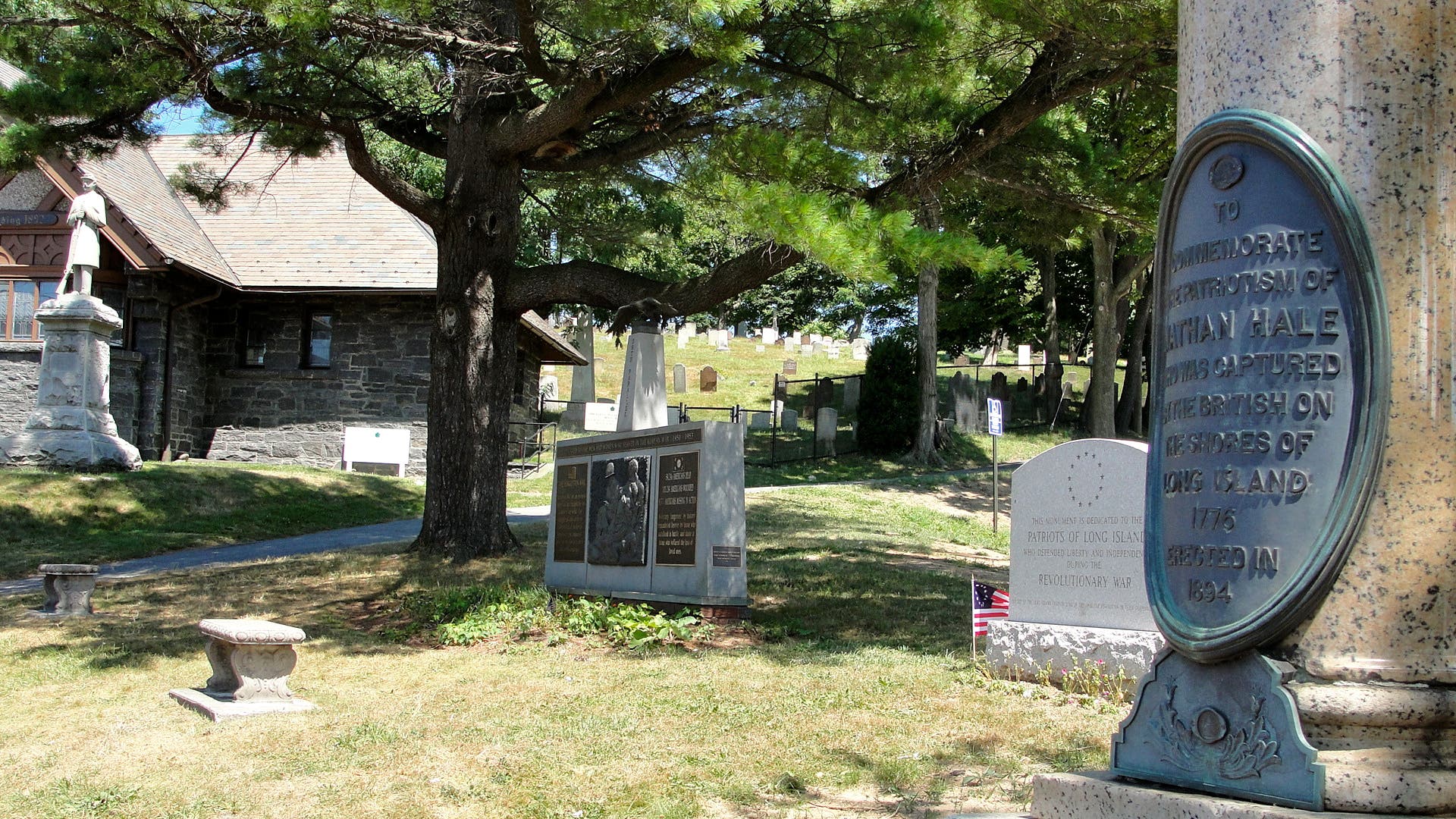
If a man refused to take the oath, he and his family could be turned off their property, losing everything. In 1782 the occupying army established an encampment in Huntington's Old Burial Ground located behind the Soldiers and Sailors Building. Located on Main Street, it was the final resting place of many ascendants of names still familiar today, such as Sammis and Conklin.
In preparing the foundation for their fort, the British razed 100 tombstones. The townspeople were outraged, waging guerilla warfare until the war was over and the British left in 1783.
Huntington was also the site of American spy Nathan Hale's landing on Long Island. Hale crossed Long Island Sound from Norwalk on the armed sloop Schuyler, landing on the shore of Huntington Bay, probably near Bay Road. Although unconfirmed, local legend tells that he spent the night at Mother Chick's Inn, also known as Widow Chichester's or Mother Chidd's Inn before continuing on his spy mission disguised as an unemployed school teacher. The inn is now a private residence on Bay Road,
Find out what's happening in Huntingtonfor free with the latest updates from Patch.
Not long after arriving in New York, Hale was discovered and captured by the British in Manhattan. The 21-year-old was hanged at what is 66th Street and Third Avenue in Manhattan on September 22, 1776.
The Huntington hamlet Halesite is named for him and there is a memorial plaque set into a large boulder on Mill Dam Road, which was removed from the beach nearby where Hale is thought to have landed on his fateful mission.
Hale is probably best remembered best for a speech supposedly gave before being hanged following the Battle of Long Island, in which he said, "I only regret that I have but one life to lose for my country."
To learn even more about Huntington history during the Revolutionary War, contact the Huntington Historical Society or visit the Town Clerk's Archives. Items from the Revolutionary War collection include receipts for supplies and books, oaths of loyalty and town accounting records.
The Archives is located in Town Hall and is open on weekdays, except holidays, from 9a.m.- 4p.m. For additional information, call (631) 351-3035 or e-mail Town Archivist Antonia S. Mattheo at amattheou@town.huntington.ny.us.
Town Clerk Jo-Ann Raia is the records management officer for the Archives and Stacy H. Colamussi is the records administrator.
Get more local news delivered straight to your inbox. Sign up for free Patch newsletters and alerts.