Community Corner
No. 86: The Old Burying Ground
The cemetery at the top of 'town hill' dates from when the village was first settled.
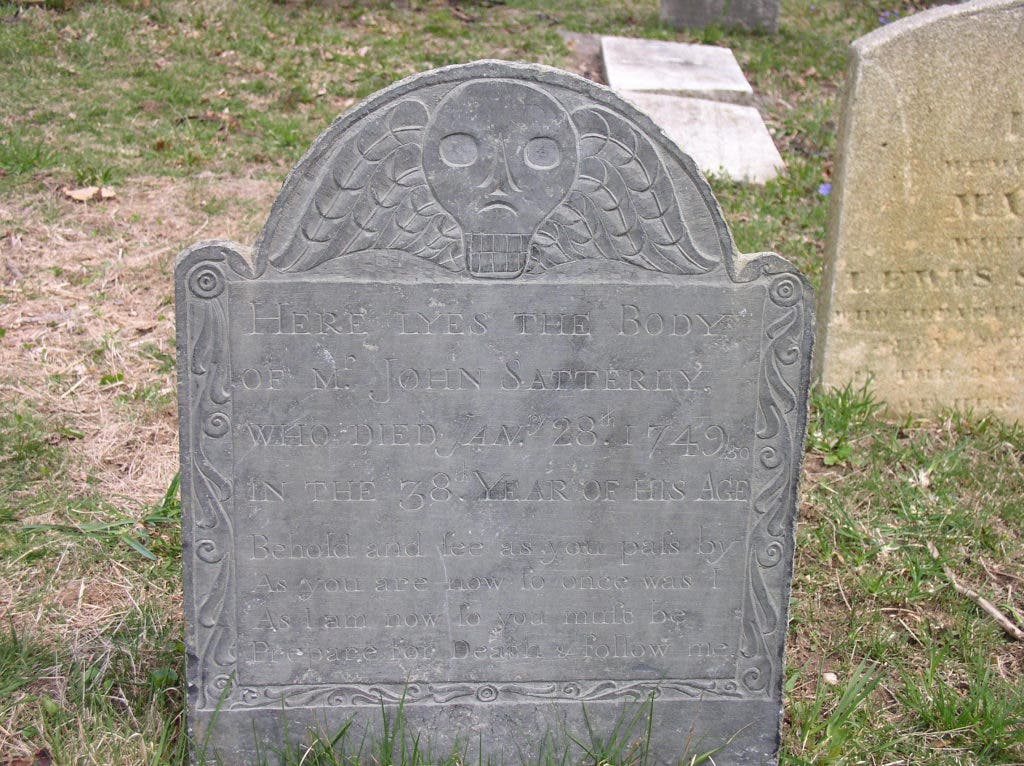


The Old Burying Ground on the south side of Main Street in Huntington has stories to tell, dating from the early 1700s. On a mild spring day, a crowd turned to hear about some of them, and see the resting places of its long-gone inhabitants.
The burying ground opened in 1700, with the first headstone dating to 1712, and it offered a bonus for early residents – you didn’t have to pay for a plot, you could just stake out the land and bury your family members, according to Cathi Horowitz, who gave the tour. It’s different from a cemetery, she said, in that it’s on a hill and the stones all face the same direction.
The cemetery was used most heavily from 1800-1852, during which time 703 markers were added, said Horowitz, the education outreach coordinator with the . Only 19 people were buried there after 1900, with the last person being buried there in 1957.
Find out what's happening in Huntingtonfor free with the latest updates from Patch.
A walk through the burying ground shows many familiar names of founding families – Sammis, Titus, Ketchum, Brush and Conklin. The names aren’t all spelled the same, since spelling wasn’t yet standardized, she said, and most likely it was the stonecutters who spelled them differently.
The early headstones are made of sandstone and slate, and the later ones are made of marble and granite. ”Slate holds the carvings well, you can still read some of them,” she said.
Find out what's happening in Huntingtonfor free with the latest updates from Patch.
It’s not a good idea to do a rubbing of the words written on a tombstone by laying a piece of paper over the words and using charcoal to get an impression of what’s written there. “It’s bad for the stones, the pressure can make the words crumble even more,” Horowitz said. Instead, bring a spritz bottle and squirt some water on the front of the stone to make the words show up, and then use a camera to take a closeup picture.
Horowitz offered a few basics for those on the tour. Dispose of your gum before you enter the cemetery, never litter, don’t write on anything, and don’t move any stones, even ones you think are just chips of rock, since they could be part of a gravestone that’s shattered. “Be respectful of where you are and what you’re walking on,” she said. “See those small boulders? They’re there on purpose, those little stones are “pillow” stones, or markers for the graves of servants or slaves.”
Old gravestones are considered folk art, with carvings of faces, lambs, and skulls and clasped hands cut into some of the stones. The years of rain and harsh weather have taken their toll and cracked or obliterated the engravings on many of the stones, although a few stones still show a death’s head and clasped hands, or a lamb.
There are quaint sayings: “who died in the 77th year of her age” is engraved on one headstone; sad stories, “Samuel Mathews, lost at sea on Steamship Pacific in 1856” on another; and rhyming epitaths on others: “Like as a shadow on the morning, My days are spent…, Grieve not for me my friend … it is in vain, Your loss I hope is my eternal gain.”
“They believed you were going on to something greater and better,” Horowitz explained.
She noted the many tombstones marking the graves of youngsters, a reflection of the era’s high child mortality rates. “We are wimpy,” in comparison, she told her audience, including some kids. “They just dealt with things and didn’t complain.”
The kids on the tour explored the burying ground, checking out the tilted tombstones and looking for carvings as they ranged over the 4-acre property. Comments on the gravestones ranged from “cool” to “neat” as they discovered one with a skull and wings, the angel of death, carved at the top.
The very top of the 4-acre cemetery, what used to be called “town hill,” was the site of Fort Golgotha (place of skulls), where the British soldiers could look out toward the harbor. The wooden fort was built toward the end of the Revolutionary War, in November 1782, and housed the British. The Brits occupied Huntington from Sept. 1, 1776, until March 1783.
The British worked at making town residents angry, Horowitz noted. They built the fort with wood from the just down the road, and out of spite sited it on top of buried residents. And legend has it that they laid stones of certain people that they disliked where they would be walked on going in and out of the fort, Horowitz said. The soldiers removed about 100 gravestones, used some as tables and baked their bread on some of those stones, so the carvings from the stone imprinted on the bread. “It showed great disrespect. The people were mortified,” she said.
The site was excavated for an archaeological dig and remnants of it barely show, but both the Old Burying Ground and the archaeological site of Fort Golgotha are listed on the National Register of Historic Places in 1981. The burying ground is at the center of the Old Town Hall Historic District, which was added to the National Register in 1985.
The town holds periodic cleanup days at the Old Burying Ground, where residents help remove downed branches, weeds, vines and generally spruce up the area. The area has had its ups and downs over the years, from the British desecrations to becoming overgrown and being vandalized.
About 90 trees were removed in 1925, and the town got a grant to help with conservation in 2004. Since then, 589 stones have been reset and 77 stones repaired, Horowitz said. It is open to visitors from dawn to dusk. The Historical Society gives occasional tours, which it announces in its calendar.
Stay tuned for No. 85 next week, same time same place, as Huntington Patch explores the places and activities in town.