Kids & Family
Now More Than Ever, Thanksgiving Matters
Thanksgiving, giving thanks, family, nation, gratitude, grateful, history, goodwill, Sarah Josepha Hale, Abraham Lincoln

History tends to repeat itself.
The year was 1863. The Civil War was already two years old, and it appeared that the Confederacy, inconceivably, beyond all expectation, was winning. The Union seemed…stunned. The nation was hurting, and divided.
Enter a woman.
Find out what's happening in Huntingtonfor free with the latest updates from Patch.
Her name was Sarah Josepha Buell Hale. Bright, erudite, and with a fondness for reading and writing, Sarah Buell began her career as a young New Hampshire schoolteacher in a one-room schoolhouse. Sarah left teaching when she married, because a married woman in the 1800’s was simply not allowed to continue being a teacher. She and her husband David had five children, and life appeared good. However, when her husband suddenly died, leaving her a widow with five youngsters to care for, she needed a way to make money that would allow her to spend her time with her children – and she turned to writing. Her first novel, Northwood: Life North and South, with its abolitionist overtones, became an instant success. On the strength of this success, she was asked to move to Boston to edit a small but popular journal, The Ladies Magazine. Eventually, the Boston publication was acquired by publisher Louis A. Godey, who put Sarah in the position of “Editress” of this expanded and intensely popular Godey’s Lady’s Book and Magazine (sort of a mix between Vogue and the New York Times Magazine of the day). There was a vast circulation, and Sarah Hale knew the power of numbers. She often encouraged the voices of millions of nameless, vote-less women across America to band together and write – write to their congressmen, their governors, their elected officials – and make their opinions known. Women may not have had the right to vote, Sarah argued, but they had power in numbers; they could - together - push their legislators to right things they perceived as wrong and to change the laws to make America a better place for everyone.
Sarah Hale, like other dyed-in-the-wool New Englanders, loved Thanksgiving, and encouraged her readers across America to write to their legislators to push to make Thanksgiving not just a state holiday, but a national holiday. For Sarah Hale, her dedication to achieving this goal lasted 37 years. She petitioned no less than five Presidents in her gentle and no-nonsense way, laying out all the reasons why a national day of Thanksgiving was important. Although individual states celebrated Thanksgiving, it was important to Sarah that the nation celebrated it together, to emphasize how much the growing nation was like a growing family, and like a family, needed to depend upon one another to succeed.
Find out what's happening in Huntingtonfor free with the latest updates from Patch.
But in 1863, America was in crisis. In the midst of the Civil War, state against state, brother against brother, families were torn apart through their ideology, values and beliefs. There was hatred and fear.
And yet, more than ever, Sarah believed that America needed Thanksgiving.
On September 28 of 1863, Sarah Hale sent an impassioned letter to President Abraham Lincoln. “Permit me”, she begins, “as Editress of the “Lady’s Book”, to request a few minutes of your precious time, while laying before you a subject of deep interest to myself and – as I trust – even to the President of our Republic…” She used all her influence as one might not imagine coming from a woman in the Victorian era, referring to her powerful position editorial position, enclosing encouraging documentation from “Governor (now General) Banks and one from Governor Morgan” and later mentioning that she had “written to my friend, Hon. Wm. H. Seward”. She entreated Lincoln:
As the President of the United States has the power of appointments for the District of Columbia and the Territories; also for the Army and Navy and all American citizens abroad who claim protection from the U.S. flag – could he not, with right as well as duty, issue his proclamation for a Day of National Thanksgiving?
In true Victorian fashion, she ends her letter:
Excuse the liberty I have taken.
With profound respect
Yours truly
Her words may imply an apology for being “forward”, but no one could mistake Hale’s words as being apologetic. The strength of her letter and her specifically mentioning that she had powerful backers was impressive – she may not have been able as a woman to vote in an election, but she had influence, and she intended to use it.
President Lincoln listened. Hale’s dedicated, passionate voice was reasonable and the request was one that could, at least for one day, serve to unite the country.
Just five days later, on October 3, 1863, President Lincoln made Thanksgiving a National Holiday. His Proclamation did not specifically refer to the strife between the North and the South, but rather emphasized the beauty of America and its productivity. Lincoln wrote:
The year that is drawing towards its close has been filled with the blessings of fruitful fields and healthful skies…which are so constantly enjoyed that we are prone to forget the source from which they come… It has seemed to me fit and proper that they should be solemnly, reverently and gratefully acknowledged as with one heart and one voice by the whole American People. I do therefore invite my fellow citizens …to set apart and observe the last Thursday of November as a day of Thanksgiving.
From November 1863 on, Thanksgiving was – and still is – meant to be a day of recollection and gratitude.
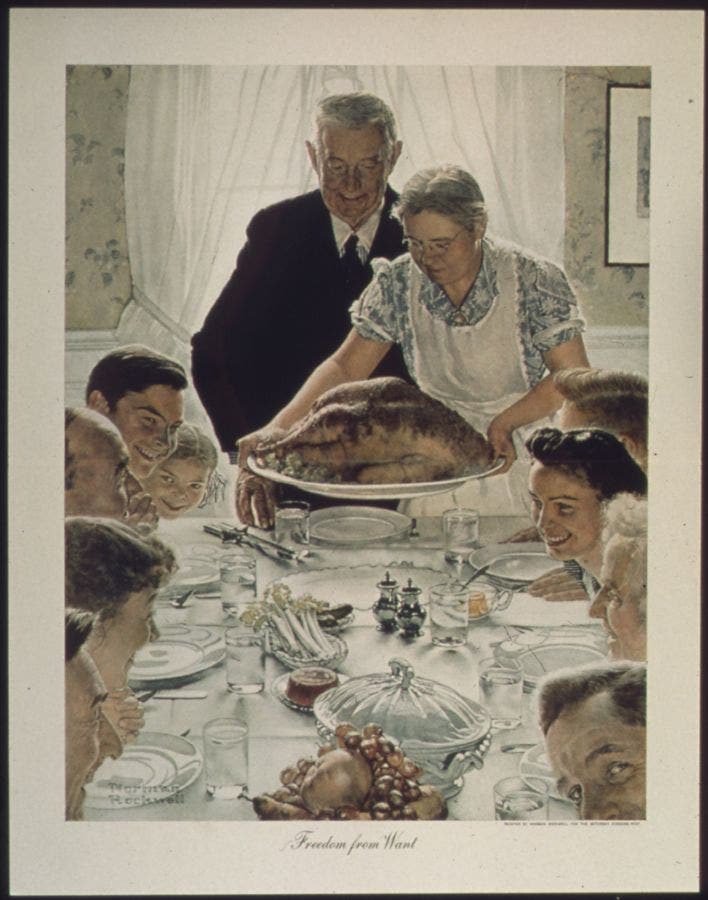
There is no other American holiday like Thanksgiving. It is not a day to celebrate the turkey, nor is it merely – as it seems increasingly today - the jumping-off point for the holiday season. No, Thanksgiving is the one and only holiday that asks nothing of Americans, except that they consider their blessings.
Gratitude – color-blind, economically-blind, non-denominational – is sometimes not easy. Our lives are far more complicated than those of Sarah Hale’s day. But being grateful only asks us to stop thinking about what is lacking or negative, and concentrate, even for a few moments, on what is good. When we take that moment to turn off the noise of our daily lives and stop to reflect, we realize that we are better, smarter, and our values are stronger than we might think.
We do not know what the future holds – but we know that we must face it together. Like a big, loud, opinionated family, we have our disagreements, but we are still better off with one another than without. America may not be perfect – but it is still our America - and that alone is a reason to give thanks, together.
On November 23, before the parade, before the turkey, before the football games and the Christmas television ads and the on-line shopping, let’s all celebrate Thanksgiving.
And pass the cranberry sauce…or the lasagna, or the curry. Together.
Long Island historic storyteller and performer Janet Emily Demarest is the author of Tales from the General Store: The Legends of Long Island. Her newest book, A Merry, Very Victorian Christmas!, launched November 1, 2016. www.janetdemarest.com