Health & Fitness
Nocturnal Nature: Owls
Owls are not often seen, but are fascinating part of our natural world. Here is an overview of their habits, characteristics, and some of the species to be found in our area in the winter months



Welcome to another installment of Kings Park Focus on Nature!
We tend to think of the winter season as a time of dormancy in the natural world. This is true for many plants and animals, but for some creatures like our native owls, the colder months spur activity. Beginning in late fall and peaking in December, some species of owls will be heard calling to one another as part of the process of selecting a mate.
Find out what's happening in Kings Parkfor free with the latest updates from Patch.
The owls Kings Park residents are most likely to hear, or perhaps see, in the winter months, are Great Horned, Screech, Barn, and Saw Whet owls. Long Islanders may even be able to see an impressive migrant from the far north - the Snowy Owl. There are a few other species that are less frequently encountered on Long Island, which I’ll touch upon briefly as well.
All of these of owls have adaptations in common which make them efficient nighttime hunters. The most engaging physical feature of all owls are their prominent eyes.
Find out what's happening in Kings Parkfor free with the latest updates from Patch.
Both eyes are forward facing, which affords the owl excellent binocular vision, a trait they share with humans. This positioning of the eyes allows for exceptional depth perception, which is critical to the owl’s success as a hunter. However, owls cannot rotate their eyes within their skull, as we do. To compensate they turn their heads on necks that are quite flexible and longer than they appear. While they cannot “spin” their heads around completely as is sometimes rumored, they can pivot their head as much as 270 degrees from front facing – quite a feat! They can also tilt their heads sideways to a remarkable degree. Their eyes are especially well designed to process light, although their ability to see color is limited. Most owls are active at night, but despite this, it is a myth that they are blinded by daylight.
Important as they are, owl eyes are well protected and maintained. Indeed, nature has provided them with not only an upper and lower eyelid, but also a third eye lid. This is called a “nictitating membrane”. It moves sideways across the eye, rather like a windshield wiper.
Their ears are also specially evolved. Unlike humans, the ears of an owl are asymmetrical – one ear is higher than the other. Because of this, sounds reach one ear slightly before the other. The owl can process this difference to perceive the direction from which the sound is being produced. It will turn its head until the sound of interest is reaching both ears at the same time. When this effect is achieved, the bird knows its target is in front of it. This enables the owl to accurately pinpoint the location of preferred food, such as small mammals on the forest floor.
So acute is an owl’s hearing, that it can succeed in capturing prey concealed from sight under leaves or snow, for example. By the way, those tufts of feathers atop the heads of many species of owls are not its ears. However the flat disk like arrangement of feathers on the face of most types of owls do act much like a radar dish – collecting sound and funneling it to the bird’s ears.
The design of the wing feathers of owls also contribute to their hunting prowess. The leading edges of the feathers are comb - like, while the back edges are edged with soft down, the combination of which serves to muffle the sound of flapping of wings.
Rounding out the inventory of this efficient nocturnal hunter’s survival kit are its talons. These can close around suitable prey and exert tremendous pressure – about five times as much pressure as a human hand grip. The foot of the owl has a special internal structure which allows it to lock into position when perching or hunting, so it is able to hold on with its four talons until the prey bleeds or suffocates to death. It may use its hooked beak to help subdue and dispatch its victim, but the beak is primarily used to tear the food up into manageable pieces, rather than as a hunting tool.
Owls, as well as other birds of prey produce pellets. The owl pellets are regurgitated (okay, barfed) masses of indigestible portions of their prey items. Grayish, compact, and oblong in shape, they contain hair, bones, and feathers, depending on the bird’s recent food sources. These are often disassembled and studied by biologists to learn about owl feeding patterns and other information regarding predator and prey relationships in nature. The species taken as prey can be identified by the structures of the bones, and types of feathers and fur in the pellet.
These raptors prey on all types of animals, depending on the owls size, seasonal availability of various prey species, and the owls preferred habitat. For example, the small Screech Owl may feed on small mammals, but also on insects. The large Great Horned Owl, by contrast, will tackle some quite large animals such as rabbits, skunks, raccoons, and even other birds of prey.
Now that we have a basic picture of these enigmatic creatures, lets explore in a bit more depth the types of owls Kings Park residents might encounter.
The Great Horned Owl (Bubo virginianus) is the species that will most likely be heard, and perhaps seen locally. This birds call is the classic “hoo-hoo hoooooo hoo-hoo"!” that we associate with owls. These are sizable birds, with a wingspan up to 60”. They are colored in various combinations of brown, buff, black, and gray, overlaid with dark bars, and a splash of white on the chest. Piercing yellow eyes surrounded by reddish brown facial feathers and prominent tufts on the head complete the picture.
This species is an opportunistic feeder. It takes a wide variety of animals as prey – including smaller owls. Typical menu items include mammals such as voles, rabbits, and squirrels. They will also take various reptiles, amphibians, fish, and large insects. Since Great Horned Owls are powerful, they hunt larger animals. Prey as diverse as herons and raccoons are on the menu. Even the Red Tailed hawks, which are large predators themselves, are often taken down by the Great Horned Owl. Truly this species is an apex, or top predator in our area.
Great Horned Owls do not build their own nests. Instead they use the nests of other large birds, or squirrels. A suitably large cavity in a tree will also serve as shelter for the two to four eggs that will be laid from January to February. Once the young are fledged, the adults resume their solitary lifestyle. Because of their ability to take a wide variety of prey, these owls have adapted to a number of habitats.
I’ve observed them at Sunken Meadow Park in Kings Park, Blydenburgh County Park in Hauppauge, in the woods along Callahan’s Beach, Makamah Park in Northport, and Arthur Kunz County Park in San Remo. Listen for their “hoots” around dusk, especially in late fall and early winter.
The Eastern Screech Owl (Megascops asio) is a much smaller bird than the Great Horned Owl, with an overall length of 10”. Their coloration is variable, with two color phases occurring. There is a grayish color morph, and a ruddy colored brown phase. Both variations sport very intricate, cryptic black markings which camouflage the birds very effectively. When at rest during the day, perhaps on an old decayed tree, these birds blend in perfectly. Screech owls are also breeding and nesting in winter. Despite their name, their call is not a screech but a rather melodic trill, which you might not associate with an owl when first hearing it.
These birds prefer to nest in cavities in trees, and will also readily take up residence in nest boxes. The Screech Owl feeds on small mammals, birds, and insects. Arthur Kunz County Park is a good place to hear these owls at this time of year, and I’ve also heard them at Sunken Meadow State Park in the trees among the picnic grounds. They’re comfortable in suburban settings as well, so you might observe one of these neat little owls in your own neighborhood.
The Saw Whet Owl (Aegolius acadicus) is even smaller than the Screech Owl, and similar in appearance and habits. It’s call is a series of “toots”, which have a metallic ring to them, which supposedly is similar to the sound of a saw being sharpened, hence the birds name. The adult birds have orange brown streaks on a pale breast, and especially large, yellow eyes surrounded by a whitish face. Juvenile Saw Whet Owls are very different in color from the adults, with buff colored breasts, a very dark brown head, and above their eyes is a bright white “v” shaped marking. These birds also prefer to use the nest cavities excavated in trees by other birds such as woodpeckers. Saw Whet Owls take small mammals as prey.
Barn Owls (Tyto alba) are less commonly found in our area in recent decades. As their name implies, they are particularly fond of dwelling, hunting, and nesting in old, man-made structures, such as barns. As our region has become less rural, there are fewer of these sorts of structures available to Barn Owls, and their numbers have decreased.
These owls are rather unique in appearance. They are relatively slim in profile and rather leggy, as compared to our other local owls. This owl’s coloration is very light, almost white. Their facial feathers form a pronounced “heart shape” which aids in identifying them. Black eyes, and an a beak which is placed low on their face gives a somewhat anthropomorphic look to their visage.
Barn Owls are late winter to early spring breeders, beginning courtship in our region during March. The Barn Owl’s call is a really scary screeching sound. You’ll never forget it once you hear it! These birds are prodigious feeders, and consume large quantities of rodents. This makes them especially beneficial to farmers, and also an important component of the ecosystem. I’ve observed Barn Owls at Blydenburgh County Park, and at Nissequogue River State Park.
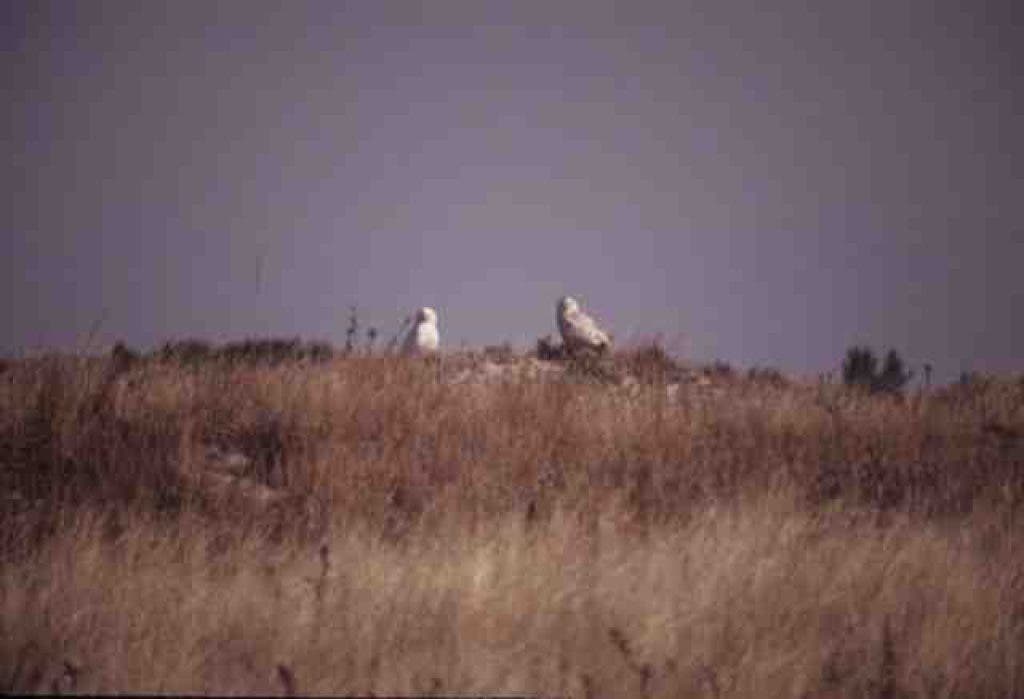
Another interesting owl species which visits Long Island in the winter months, is the striking Snowy Owl (Bubo Scandiacus). These birds are most likely to be seen along the seashore, especially along the south shore. The open, wind swept dunes of our ocean beaches most closely approximate the habitat in their home range in the arctic. At this time of year, the younger Snowy Owls are often pushed south in our area by competition with older, more established owls of their species. Environmental factors, such as reduced availability of food in arctic regions, like lemmings, can play a part in their temporary winter visits.
These are large, stout - bodied birds, with wingspans between 4’ and 5’. The males are whitest overall, while females and juveniles will have more black markings scattered over their white feathers. The talons of this arctic creature are largely covered with feathers to help insulate them. Unlike previously mentioned owl species, Snowy Owls prefer to hunt during the day. Look for them to sitting at the crest of a dune, scanning the landscape for mammals and shore birds with their vivid yellow eyes. I’ve occasionally had the privilege to see one of these handsome owls at Robert Moses State Park, usually after quite a search with binoculars.
While this concludes the descriptions of our most likely to be seen owls, I should mention three other species Long Island residents could cross paths with, though infrequently. Two medium sized owls, which may occasionally be encountered in our area, are the Long Eared Owl (Asio otus), and Short Eared Owl (Asio flammeus). Also known to be in the region is the Barred Owl (Strix varia).
Owls are superbly adapted to their nocturnal world, and though challenging to observe in nature, it’s worth the effort to seek them out. I hope this article will inspire readers to visit our Kings Park preserves and parks, right around dusk – and perhaps have the thrill of hearing or even seeing one of these fascinating members of natures night shift. I would like to thank Biologist, Educator and Ecotour leader Eric Powers of “Your Connection to Nature” for his generosity in providing his photographs, which accompany this blog.
See you outdoors!