Politics & Government
LWV Hosts Second Public Workshop on Local Waterfront Revitalization Plan in Mamaroneck
As Mamaroneck's Local Waterfront Revitalization Plan (LWRP) undergoes an update, the public is kept informed on the complex process.


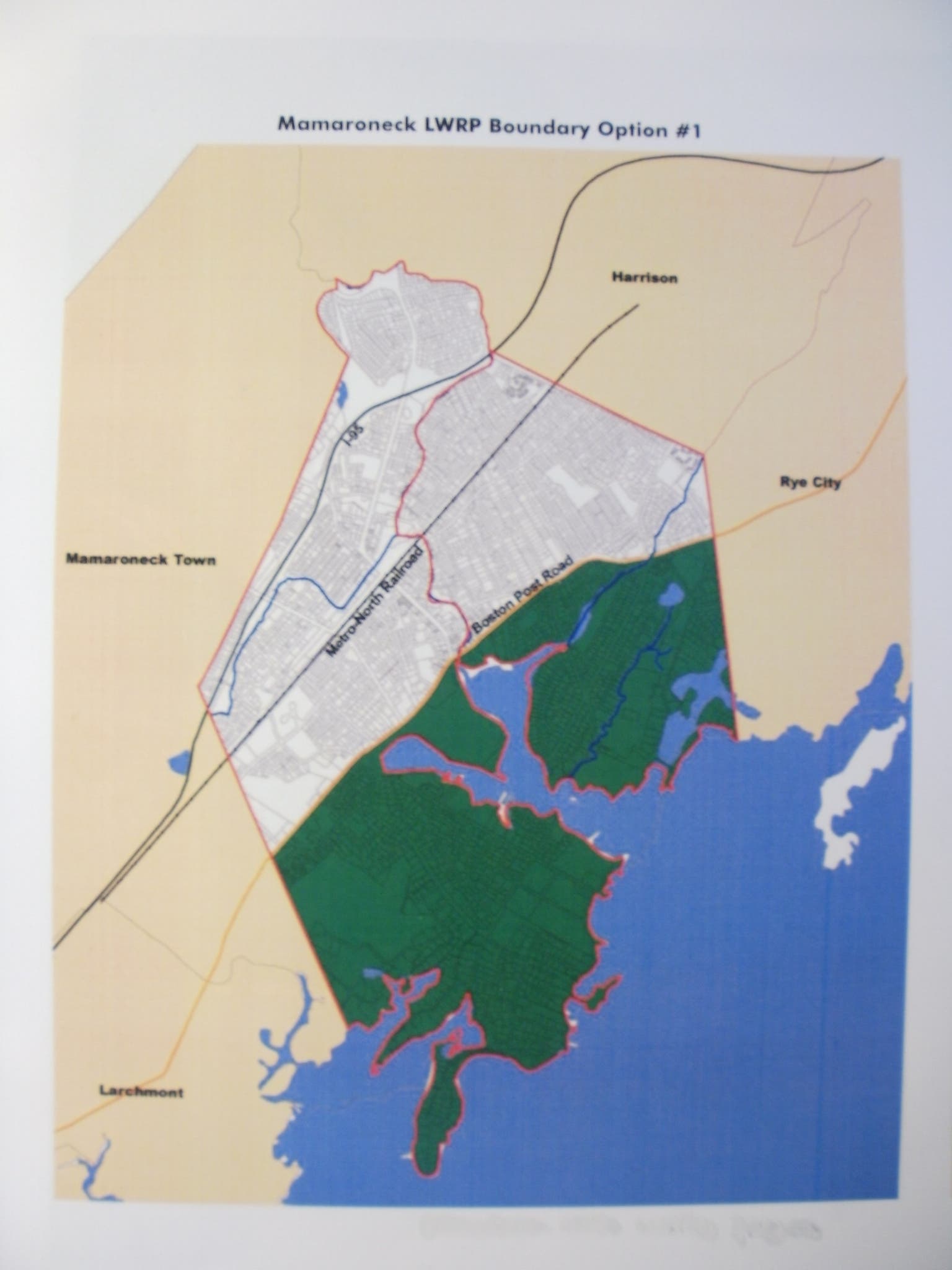
The Local Waterfront Revitalization Plan (LWRP) has been a hot topic in Mamaroneck lately, with the nearly 30-year old document undergoing it’s own revitalization. The focus of the amended LWRP is the enhancement of public access to the water, whereas the original thrust of the LWRP was on preservation of nearby clubs and boatyards. The finished product is due to be completed by year-end, and was the topic of discussion at a public workshop earlier this week, organized by the League of Women Voters (LWV) of Larchmont-Mamaroneck.
Elisabeth Radow, president of the Larchmont-Mamaroneck LWV, articulated both the enormity and complex nature of the 1,320 square mile Long Island Sound, an estuary that was declared to be nationally significant in 1987 by Congress.
As an estuary—a partly closed body of water that forms a transition between river and ocean waters—it is comprised of three freshwater rivers including the 15-mile Thames River in Connecticut, the 410-mile Connecticut River and the 139-mile Housatonic River in Massachusetts and Connecticut.
Find out what's happening in Larchmont-Mamaroneckfor free with the latest updates from Patch.
With an approximate 21 million people living on the Sound—90 percent residing near the shoreline—and an estimated $8 billion dollar boost to the local economy as a result of activities pertaining to the area, the issue of waterfront protection is of key concern to residents of Mamaroneck and Larchmont.
Steve Resler, the former deputy bureau chief at the NY State Coastal Management Program, urged a strong commitment by public officials as well as public involvement in the process to ensure the success of the waterfront protection plan.
Find out what's happening in Larchmont-Mamaroneckfor free with the latest updates from Patch.
Further, Resler said, a State Environmental Quality Review (SEQR)—or an identification and mitigation of the significant environmental impacts of a proposed activity—must be initiated early on, as the LWRP effectively acts as an Environmental Impact Statement (EIS), or a description of a proposed action that may have a significant impact on the environment.
More information on SEQR and EIS can be found on the state’s Department of Environmental Conservation website.
The process to amend the LWRP is similar to the steps that were involved in the initial approval in 1984. Initially, the Secretary of State has to make specific findings to approve the amendment, with both the Department of State and municipal government involved in final approvals, said Resler. Following that, “the changes will then be forwarded to Washington D.C. for the federal government’s concurrence with that amendment to the program as a former element of the state’s program,” he said. Once that happens, all three levels of government are bound to the policies and purposes of that program.
In terms of logistics on the LWRP project, Frank Fish, owner of BFJ Planning and a planning consultant to the village, cautioned against having an open time frame for completion as, “it’s hard to keep the momentum,” suggesting, instead, a one-two year maximum.
Currently, Charles McCaffrey—one of the original authors of the LWRP and a consultant on the amendments—is condensing the current document with 44 policies to a smaller number, representative of the new products of the Long Island Coastal Policy, said Fish.
Dan Natchez, owner of Daniel S. Natchez and Associates, Inc. who was involved in the original drafting of the LWRP in 1984, commented on the concept of public access in the LWRP document.
“Access by the public not public access,” he clarified,” because one implies unrestricted access and I don’t know of any park in the U.S. that has unrestricted access these days.”
Additionally, Natchez reminisced fondly the original LWRP drafting committee, a 33-member citizens committee comprised of anyone who was interested in becoming part of the decision making process.
“It’s served the village exceedingly well over the past 20 years,” he said.
A draft of the LWRP can be viewed on the Village's website here.
A future scenarios map can be accessed on the Nature Conservancy's Coastal Resilience Project website, providing information on demographics and potential for economic and ecological losses in a particular area.
The next LWRP public workshop is scheduled to take place on June 11 from 10 a.m.-12 p.m. at the Village of Mamaroneck courtroom on 169 Mt. Pleasant Ave. in Mamaroneck.
Editor's Note: A link to the updated LWRP and a future scenarios map were added to a previous version of this article.
Get more local news delivered straight to your inbox. Sign up for free Patch newsletters and alerts.