Schools
Mentors Needed For Mamaroneck High School Original Science Research Program
The Mamaroneck High School's Original Science Research Program (OSR) has given students passionate about science the tools to engage their interest.


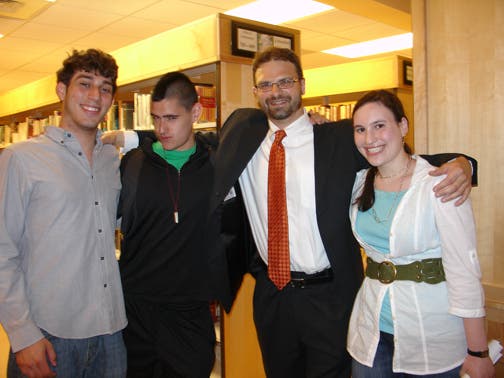

The Mamaroneck School District is currently seeking mentors to assist students enrolled in the OSR at (MHS).
The OSR program is a three-year elective course for MHS students in which they choose an area of science and conduct a research project, typically in collaboration with a mentor.
Find out what's happening in Larchmont-Mamaroneckfor free with the latest updates from Patch.
Last year, OSR student allowed her to place as one of 40 nationwide finalists in the Intel Science Talent Search.
According to Debbie Manetta, spokesperson for the Mamaroneck District, “Mentors need to be researchers or experts in their field. Most are PhDs, or MDs. Other experts can serve as mentors if they have the knowledge and ability to help a student to design and carry out a project in their field. Really, if they are able/interested in helping a student to design a project, it can work!”
Find out what's happening in Larchmont-Mamaroneckfor free with the latest updates from Patch.
Mentors can wear many different hats. For example, in lab-based research, the mentor may assign appropriate reading so that the student understands the work they are undertaking in the lab. For survey-based behavioral projects that take place at school, the mentor may assist with conducting a literature review, creating a research plan and survey and eventually analyzing data.
For more information, please see Mamaroneck Schools Superintendent Dr. Robert Shaps’ letter to parents below:
Dear Community Members:
As we near the conclusion of another school year, we appreciate our community’s support in so many important ways. It has been a true pleasure for me over these past two years to work in a district with such active and supportive parents.
I am writing to seek your help. Under Guido Garbarino’s leadership, our Original Science Research (OSR) program at Mamaroneck High School is thriving. The program, a three-year honors elective course in which students choose an area of science and conduct a research project in collaboration with a professional mentor, has grown from 39 students in 2006 to 68 students in the current year. In that time period, our outstanding students have produced six Intel semifinalists and one Intel finalist (Grace Phillips), as well as five finalists at the International Science and Engineering Fair (ISEF) and numerous other awards and recognitions. One of our students, Liza Strauss, just last spring was recognized at the ISEF with the Air Force Research Laboratory award on behalf of the United States Air Force and received a first place award from the American Psychological Association (APA).
We hope you’ll help us in bringing this rich program to even greater heights!
Be a mentor or help lead us to one
If you are qualified, consider being a scientific mentor yourself. Or, perhaps there's someone else in your institution that you may have in mind. We’re looking for mentors to work with our 10 th , 11 th and 12 th grade students as they pursue research projects in the biomedical, physical, behavioral and environmental sciences as well as engineering fields.
Role of the Mentor:
The student/mentor relationship is the most valuable and important component of the research class experience, as students learn how to work and think like professional scientists through their interactions with their mentors. The role of the mentor for science research students varies depending on the type of project the student pursues. For laboratory based projects, students usually spend one or two full summers in the lab, working full time. Before entering the lab, mentors assign appropriate readings (textbooks and journal articles) to help students develop an understanding of their work. Students usually begin in the lab by observing and learning techniques. They often accomplish this by shadowing lab personnel, asking questions, and assisting. As soon as possible, they begin to help the primary investigator, postdocs, and graduate students with their work so the benefits of the relationship end up becoming very reciprocal. Most often, students complete a small original project of their own during the first summer, once they understand the lab’s work. Then, when students go on to work for a second summer, they require much less training, bring more value, and typically complete a more in-depth project.
Past Placements for Our Students
Our students have been placed in some of the area’s top research institutions including:
- Albert Einstein College of Medicine
- Columbia University
- Cornell-Weill Medical College
- Hospital for Special Surgery
- The Lewis Calder Center/Fordham University
- Mount Sinai School of Medicine
- The Feinstein Institute for Medical Research
- The New York Botanical Garden
- Yale University
- New York University
Our contact at the NY Botanical Garden, Dr. Amy Litt, has this to say about our students:
“Our experiences with Mamaroneck High School students have been outstanding. They have consistently been bright, conscientious, independent, hard-working, and productive. Our relationships have been positive in all directions–not only have we had the opportunity to help train a new generation of scientists, but the students have generated important data for us in the lab, helping move our research programs forward. On top of that, the students have all be a pleasure to work with – smart, fun, cooperative, and responsible, they have all become part of our lab family. We are looking forward to many more Mamaroneck students over the coming years,” said Dr. Litt.
Former Project Titles :
- Treatment outcomes of patients with early stage cervical cancer treated with laparotomy compared to robotically assisted laparoscopic approach
- Placental pathologies modify the degree to which placental taurine concentrations are decreased in preterm births
- The effect of contrast density and mixing procedure on layering of contrast in myelography
- Use of Glial Restricted Stem Cells to Modulate Oxidative Stress in Neurodegenerative Disorders
- A study of HCAA conjugates in the context of the domestication history of S. melongena
- Determining molecular interactions between BK alpha and beta1 subunit using disulfide crosslinking
- A Study of the Cognitive Neuroscience of Arithmetic Combinatorial
- Processing Using Magnetoencephalography (MEG)
Professional Presentations:
- Fall 2011 - Senior Mark Alexander won a National Institutes of Health Travel Award to present his research entitled Culture negative prematurity is associated with decreased placental taurine independent of the clinical indication for preterm birth at the International Federation of Placenta Associations (IFPA) in association with the European Placenta Group (EPG). Mark is the youngest recipient of this award.
- Spring 2012 - Junior Benjamin Miller had his abstract selected for presentation at the American Roentgen Ray Society Meeting in Vancouver. His abstract was titled Experimental Fractures of the Greater Tuberosity: Assessment of Reader Experience Using Three Modalities.
Again, I hope you will consider becoming a mentor yourself or helping us brainstorm professionals you know who may be interested in taking on this opportunity. For our students, this mentor experience marks the beginning of their science research journey, and having a mentor that adeptly guides them through their research can significantly impact their path for many years to come.
Thank you in advance for your consideration to this matter.
Please e-mail me any time at rshaps@mamkschools.org with thoughts, questions or ideas.
Sincerely,
Dr. Robert I. Shaps
Superintendent of Schools
Get more local news delivered straight to your inbox. Sign up for free Patch newsletters and alerts.