Neighbor News
Westchester Community College: A Sometimes Undervalued Asset for High School Graduates and Westchester Residents
WCC Recognized for its Commitment to Serving the Needs of Immigrants and Foreign-Born Residents
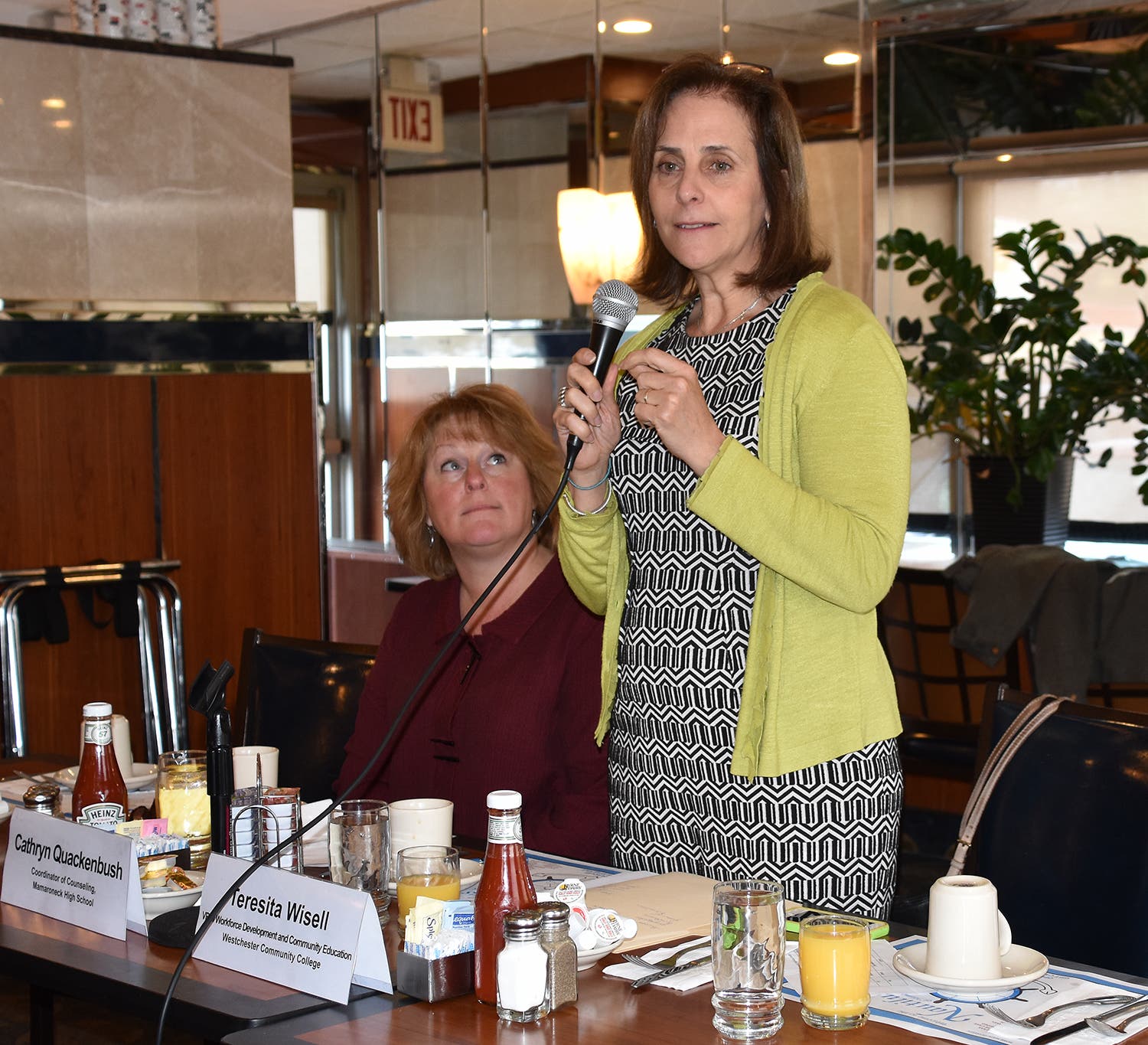
With the sky-rocketing costs of private four-year colleges – some approaching $70,000 a year – now may be the time for more families to give serious consideration to community colleges. Often overlooked by high school students focused on four-year college options, two-year colleges provide a valuable resource not only for high school graduates, but also for local residents seeking workforce training or enrichment, as the audience learned at the Larchmont-Mamaroneck Local Summit’s April 19 breakfast program. Cathryn Quackenbush, Coordinator of Counseling at Mamaroneck High School (MHS) and Teresita Wisell, Vice President and Dean of Workforce Development and Community Education at Westchester Community College (WCC) and Executive Director of the Community College Consortium for Immigrant Education, discussed the many important roles that two-year colleges, and in particular, Westchester Community College, play.
How Do High School Seniors and Their Families Select “The Right College”?
Cathryn Quakenbush shared that on average, 85% of MHS seniors attend a four-year college, 8% a two-year college, and the remaining 7% go on to a variety of alternatives, including international students returning home, and others taking a gap year, or joining the military or the workforce. A number of factors enter each student’s decision, including cost. Quakenbush explained that there are four main “tiers” of schools in terms of costs. At the high end are private four-year institutions, with the combination of tuition, room and board currently pushing $70,000 per year for the most expensive schools. Next are the out-of-state public schools which run around $40,000 per year for non-residents. For New York State residents, SUNY and CUNY schools cost in the low $20,000s each year. While some are made more affordable through scholarships or “discounts,” few can compete financially with the two-year colleges, which cost around $4,000 per year for tuition.
Find out what's happening in Larchmont-Mamaroneckfor free with the latest updates from Patch.
Of the MHS students selecting the two-year college option, Quakenbush said almost all opt for WCC. Students selecting WCC often do so for one of a few reasons: for some, it makes sense financially while others use it as an opportunity to “reset” their academic record in order to gain admittance to better four-year colleges or to qualify for scholarships. She pointed out that high school records and test scores mean much less once a student has completed college-level work. Quakenbush praised WCC for the opportunity it has provided for many MHS students, noting that it is a “nationally renowned academic institution” and “financially, none is better than WCC.”
Role of Two-Year Colleges Nationally
Find out what's happening in Larchmont-Mamaroneckfor free with the latest updates from Patch.
Teresita Wisell, who was recently recognized at the White House for her role as a “Champion of Change” for promoting citizenship education in the workplace, described how two-year colleges became popular following World War II, when those returning from the war needed local opportunities to pursue a higher education. With over 1,100 two-year community colleges across the United States serving 45% of the undergraduate population, Wisell firmly believes that community colleges are poised to take on President Obama’s challenge to “respond to the need for post-secondary education for our entire populace.” Thanks to Obama’s efforts, she asserted that community colleges have begun to dispel some of the myths that have stigmatized them as being a “second choice” or a “last resort.”
Many in the audience were surprised to hear Wisell relay that there are currently over 12 million individuals nationally “taking advantage of education and training that’s afforded to them through their local community college.” Of these, 7 million students are taking credit courses, which could lead to a one-year certificate or a two-year associate’s degree, after which students can either transfer to a four-year college or enter the workforce.
Another 5 million students are taking non-credit courses for workforce training purposes or for enrichment. As Wisell explained, while these students are not earning college credit, the courses often provide industry-recognized credentials or prepare students for licensing exams, making them very attractive candidates for entry level positions in some of the fastest growing fields such as healthcare, IT, and advanced manufacturing. Examples of such healthcare positions include phlebotomist, EKG technician, surgical technician, certified nurse’s aide, and medical administrative assistant.
Nationally, 62% of two-year colleges students attend part-time, with many working full-time in order to continue contributing to their family’s income. Of the students enrolled for credit, 50% are Caucasian, and 36% of the students are the first generation in their family to attend college.
Unique Role of Westchester Community College
With just under 14,000 full-time and part-time students enrolled, WCC plays a unique and vital role in our county. WCC takes the mission of community colleges very seriously and prides itself on “being available and accessible to individuals for whom college is not the norm.”
WCC’s primary areas of focus include student success, workplace development, and community engagement. Beyond ensuring that students have access to the school, WCC is concentrating on outcomes – on improving graduation rates, increasing opportunities for students to go on to four-year colleges, and helping students successfully enter the workforce.
Already addressing one of Obama’s directives for community colleges to “help American workers get the skills and credentials they need to succeed,” WCC has been actively playing a role in workforce development in Westchester County. By partnering very closely with local businesses, it aims to have programs in place to prepare students to enter and advance in the workforce, and drive economic development in our county.
For those students interested in continuing their education after WCC, WCC has 195 transition agreements in place with four-year schools. Wisell noted that upon successfully completing their Associates Degree at WCC, students are guaranteed spots as juniors at these schools, which include Lehman College, Manhattanville College, Manhattan College School of Engineering, and the Fashion Institute of Technology. New this year, PACE University is offering a $25,000 scholarship to juniors and seniors transferring from WCC.
Beyond its extensive academic and workplace oriented programs, WCC is dedicated to serving the non-English speaking individuals who reside in Westchester County, where 25% are foreign born and 33% speak a language other than English in their homes. Wisell explained that WCC has made a deliberate commitment “to help integrate those residents of our county as fully as possible . . . civically, socially, educationally, economically . . .and to fill the one gap that we know is the biggest gap that stands between their advancement and their full integration into our community . . . and that is learning English.”
As a result, Wisell continued, WCC offers an extensive English as a Second Language (ESL) program, from beginner level all the way to a course called “English for Academic Purposes” and also has undertaken workplace English initiatives to help incumbent workers improve their English so they can advance in their workplace. In fact, over 5,000 individuals are enrolled in WCC’s ESL classes, held not only at its main Valhalla campus, but also at its five satellite locations in White Plains, Ossining, Mt. Vernon, Yonkers, and Peekskill, and in conjunction with community-based organizations, such as Mamaroneck’s Community Resource Center. WCC is also part of a national Workplace ESL initiative and has just begun a partnership with Whole Foods to provide ESL classes to its workers.
Wisell acknowledged that WCC needs to increase its efforts to make Westchester County residents aware of the widespread opportunities it offers through its academic, workplace and ESL programs.
This breakfast forum was hosted by The Larchmont-Mamaroneck Local Summit, an informal community council that seeks to make life better for all in the tri-municipal area. Its monthly public meetings are held at the Nautilus Diner in Mamaroneck at 7:45 a.m. usually on the third Tuesday of the month. The next breakfast meeting will take place on Tuesday, May 17, and will explore the recent history of the Town of Mamaroneck.