Politics & Government
Schumer Calls For Extension Of Nassau Back Bays Study
The senator says the research into preventing flooding will stop on Sept. 30 and go unfinished unless Congress allocates more money.


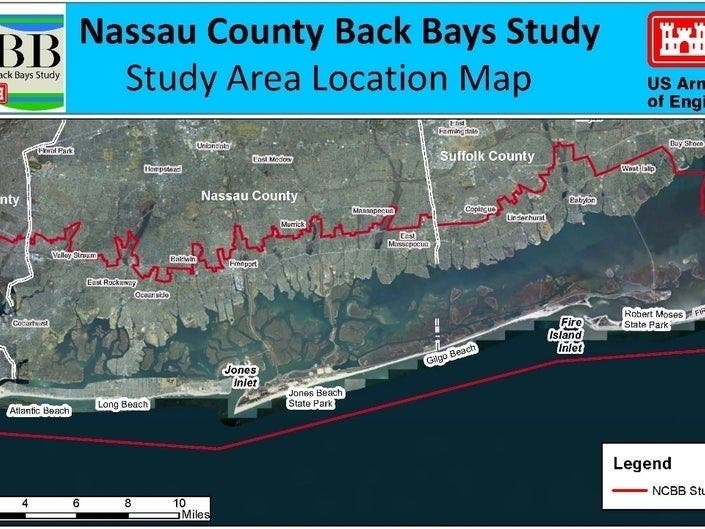
Sen. Charles Schumer said that an important study by the Army Corps of Engineers into how to prevent flooding in southern Nassau could lose its funding at the end of the month unless Congress acts.
Funding for the Nassau Back Bays Study will end on Sept. 30. Schumer was joined by local politicians in Island Park Wednesday morning to call on the federal government to allocate more funding to complete the study.
“All the federal work thus far on Nassau’s Back Bays would be for naught if the feds simply left the resiliency project unfinished, to collect dust on some shelf while the threat of major storms and hurricanes that might impact Long Island remains on the table,” said Schumer. “That’s why the feds must green-light a modest three year extension of this critical study that scrutinizes thirty miles of coast, and several communities to find ways to mitigate the threat of future storms.”
Find out what's happening in Long Beachfor free with the latest updates from Patch.
The Nassau Back Bays include all the water on the South Shore, and includes the ocean, the bay and the channels that run up the coast, mainly to around Sunrise Highway. The area being studied starts in the west at Valley Stream and goes east to Bay Shore, stretching about 30 miles.
“As we know well from past hurricanes and tropical storms, the south shore of Nassau County is in danger of being exposed to storm surge, flooding, severe winds and coastal erosion,” said Nassau County Executive Laura Curran. “I stand with Senator Schumer in urging the US Army Corps of Engineers to continue this essential study of the back bays so we can soon pinpoint what needs to be done to preserve our south shore coastal communities.”
Find out what's happening in Long Beachfor free with the latest updates from Patch.
The government has already spent $3 million on the study, which began in the fall of 2016 and is examining the effects of different flood-prevention measures that could be used to guard against future storms like Hurricane Sandy. The study is examining creating living shorelines, storm surge barriers, bulkheads, floodwalls and more. You can read more about the study here.
Schumer says that an extension of the study — until 2022 — would cost another $6 million. The study was designed to continue until then.
“If there is one good thing to come from Sandy, it’s that we learned of our vulnerabilities, and the Back Bays are still a weak point we need to invest in if we are going to avoid jaw-dropping costs in the future, both to homeowners and local governments,” Schumer said.
Nassau County’s Back Bay communities have endured flooding on numerous occasions. After Hurricane Sandy, Long Beach, Island Park, Oceanside, Baldwin, Freeport and the Five Towns were extensively flooded. On the Long Beach barrier island, the ocean met the bay. According to the comprehensive U.S. Geological Survey’s Observed Storm Surge Mapper from Oct. 29, 2012, it is clear there was storm surge on both the oceanfront and Bayfront side of the barrier island. In addition to Hurricane Sandy, these South Shore communities experience severe flooding during regular high tides and heavy rainstorms.
"The Army Corps of Engineers need to stay until the job is complete," Town of Hempstead Supervisor Laura Gillen said. "Right now the Town of Hempstead has only half a blueprint to support the long-term resilience and sustainability of our coastal communities in the event of the next major hurricane."
Get more local news delivered straight to your inbox. Sign up for free Patch newsletters and alerts.