Neighbor News
AI Can Help Teach Your Children What You Do Not Know
How one Long Island dad used AI to create a free Roblox coding trainer for his 12 year old, and how other parents can do the same.

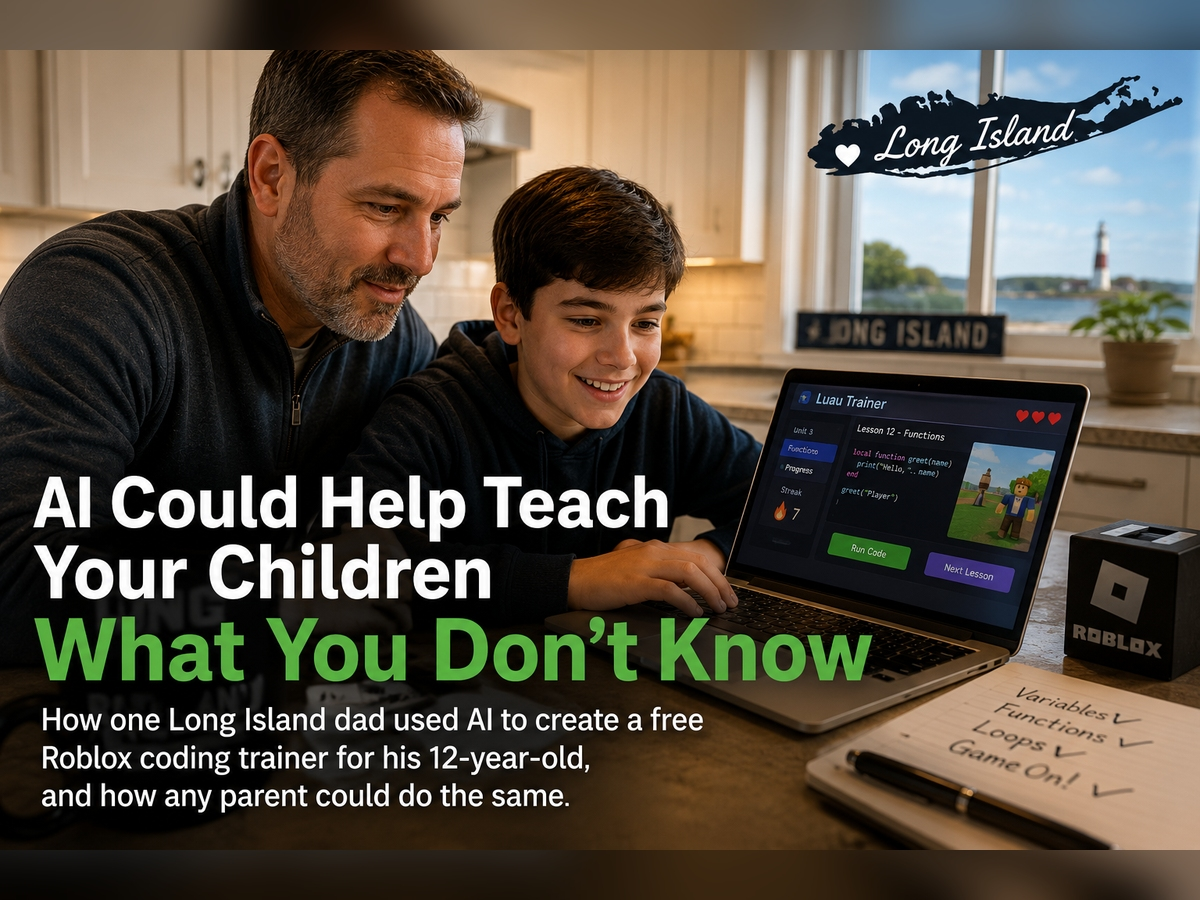
Parents carry a list of worries that never gets shorter, and two concerns sit near the top of that list: time and education. The question of what our children learn, how they learn it, and whether we still have real influence over the process follows families from the elementary years straight through high school graduation.
Many families face limitations they rarely discuss at the bus stop or the sideline. Some parents work two jobs and cannot sit with a kid for an hour of homework every night. Some hit a wall with technology their children already understand better than they do. Others simply want to meet their kids where they already spend their attention, which in 2026 means a screen, a device, and a game they care about more than most things adults try to hand them.
Long Island has a great public school system, and nothing in this article argues otherwise. At the same time, some parents want a little more influence over the methods, the values, and the content our children absorb during the hours we cannot control. The goal is to supplement, not replace.
Find out what's happening in Long Islandfor free with the latest updates from Patch.
The problem at the kitchen table
My youngest son plays Roblox every single day. If you have a kid between 8 and 15, that sentence probably sounds familiar. Roblox is not just one game. It is a platform where players build games and other people play them. The coding language behind many Roblox experiences is called Luau, and it carries real programming concepts: variables, functions, loops, conditional logic, and data storage.
Find out what's happening in Long Islandfor free with the latest updates from Patch.
My son wanted to learn Luau and asked for help. The honest answer was that I have no coding background at all. I spent my career in law enforcement, not software engineering. A year ago the realistic options were "ask your teacher" or "watch YouTube," and neither felt adequate. YouTube operates like a firehose with no quality filter, a classroom teacher has 25 other students, and both options left me entirely outside the learning process.
What AI made possible
The term "vibe coding" has entered the tech conversation over the past year. In plain Long Island English, vibe coding means typing a regular sentence to an AI and getting working code back. Not copying someone else's work, not pretending to hold an engineering degree, just describing what you want in normal words and letting the machine build it.
That process produced the Luau Trainer over the course of 15 iterative versions. The first version was rough and the AI built it from a plain description: make something that teaches Roblox coding the way Duolingo teaches languages, with quick lessons, hearts, streaks, and points. Each version got better because the AI responded to specific feedback typed in regular English.
Six AI platforms contributed to the build: Claude, ChatGPT, Grok, Gemini, MiniMax, and Kimi. Every one of them offers a free version that any parent can use tonight. The number does not matter. A parent could use one platform or three and still get a working result. Using more than one adds a natural quality check because each platform catches mistakes the others miss, but the process works with whatever a family has access to.
The final quality check came from the actual user, and that part of the process turned into something nobody planned. My son tested every version at the kitchen table, and the sessions stopped feeling like testing within the first five minutes. "Dad, the UI looks like AI boxes" led to a complete visual overhaul and a 30-minute conversation about what good design looks like. "Can you add music?" turned into a discussion about how apps connect to Spotify. The kid was excited in a way that homework has never produced, because the project belonged to both of us. Every round of feedback taught me something about what a 12 year old values in a learning tool, and taught the kid that his opinion could change a real product. The bonding happened without anyone scheduling it or labeling it, and the learning ran in both directions.
What the trainer does
The product is a single HTML file. Download it, open it in Chrome or Safari, and the learner starts immediately. No account to create, no app to install, no subscription to pay for, and no internet connection required after saving the file, unless the learner chooses to use the Spotify feature.
The trainer teaches Luau through 50 interactive lessons across 10 units, starting with basic variables and building through server architecture and object-oriented programming. Each lesson opens with a Roblox scenario the kid recognizes, teaches the code pattern through that scenario, and connects the concept to a real project the learner can build in Roblox Studio.
Six hands-on labs walk the learner through building real Roblox projects: obstacle courses, coin collectors, item shops, and a complete round-based mini-game with data saving. A Spotify player sits inside the app so the kid can listen to music while working, and sound effects respond to correct and incorrect answers to keep the feedback loop tight.
Why this matters beyond one family
This project did not require a computer science degree, a coding bootcamp, or a paid software budget. It required a few minutes of describing what my kid needed and a willingness to test what came back. The first version existed within an hour. A working trainer took about a day. The polished product took longer, but the bonding started on day one.
That part surprised me more than anything the AI produced. I did not set out to build a bonding experience. I set out to build a coding tool. The bonding was the thing that happened while we were both paying attention to something we cared about, and it turned out to be worth more than the product itself. The trainer is a perk. The time it created around learning is the actual win.
The larger point extends beyond Roblox, Luau, and coding. This applies to any subject a child cares about: music theory, chess strategy, history, a second language, math concepts the parent forgot twenty years ago. The subject does not matter. What matters is that a parent no longer needs to know the material in order to build something that teaches it. AI closed that gap.
You do not need to pay for the next app, the next subscription, or the next tutor. A free AI tool, a few clear sentences describing what your child wants to learn, and an evening at the kitchen table can produce a working learning tool that belongs to your family. The technology did not replace my judgment. It did not decide what to teach. I decided the content, the structure, and the quality standard. The AI handled the part I could not do on my own: writing the code.
The trainer is free, the code is public, and the MIT license allows anyone to download it, use it, modify it, or share it. If your neighbor has a kid who plays Roblox, the resource costs nothing to pass along.
Get the trainer
The fair questions first. There is no catch, no upsell, no email list, and no account required. The file contains no tracking, no ads, and no network calls beyond Spotify if the learner chooses to turn on music. The entire trainer is a single HTML file that runs in a browser, which means it does not install software and does not request device permissions. Download it, look at it, open it in Chrome, and decide for yourself.
The code is public on GitHub, which means anyone can read every line before downloading. The MIT license means anyone can use it, share it, modify it, or build on it. If your kid finishes the 50 lessons and wants something different, a parent with access to the same free AI tools could modify the content or add new lessons using the same process described in this article.
If something does not work, the GitHub page accepts feedback. This is a family project, not a commercial product with a support team, but problems get fixed the same way they got fixed during development: describe what went wrong in plain English, test the fix, and let the AI help sort through the issue.
Download the free Luau Trainer at github.com/basilpuglisi/Roblox-Luau and open the file in any browser.
Basil Puglisi is a Long Island dad, retired LEO who writes about AI and Digital Content at basilpuglisi.com.