Neighbor News
AI Leadership, Governance, & Growth
Tucker Carlson's Interview and Stephen Klein's Call for Accountability

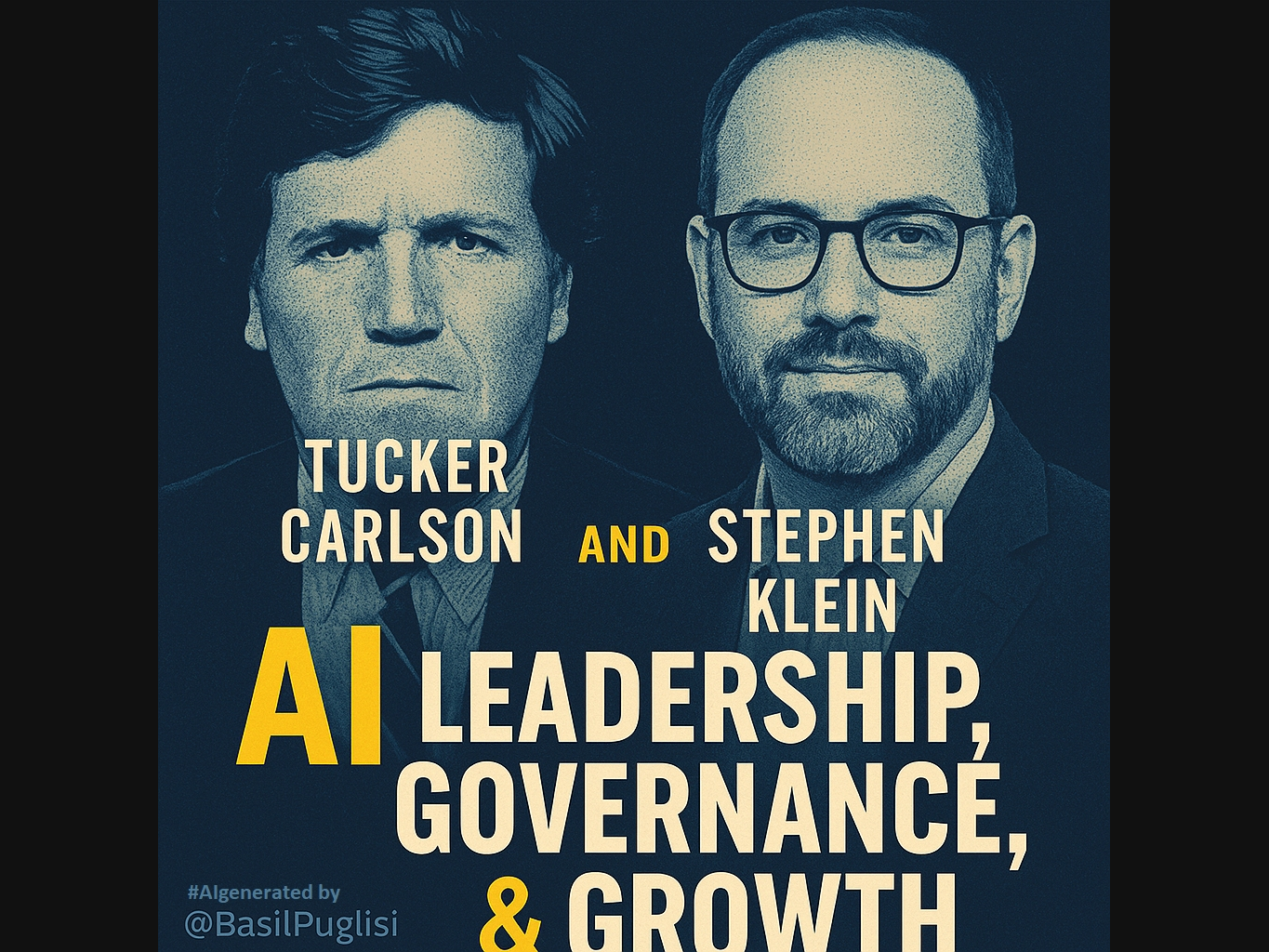
OpenAI’s Nov 2023 ouster & reinstatement of Sam Altman showed how much power sits at the top. The recent Tucker Carlson interview put that power under a brighter light. It was not pleasant to watch. It was necessary.
Stephen Klein called this out well. His point is not about liking or disliking a person. It is about governance. Who decides. Who they answer to. What guardrails exist. Stephen’s work at Curiouser.ai pushes leaders to slow down & ask better questions. That matters.
But asking is not enough. In my forthcoming essay The Human Advantage in AI: Factics, Not Fantasies, I argue that AI is not alive & not sentient. At scale it acts like a mirror. It reflects the values, choices, & blind spots of the people who design & deploy it. The risk is not a model going rogue. The risk is human error that goes untested, unreviewed, & then scaled.
Find out what's happening in Long Islandfor free with the latest updates from Patch.
We need systems that turn questions into action. That is where Factics fits. Facts & data should become tactics & strategy that leaders can fund, staff, measure, & improve. Then we should run the results through a simple review lens so governance becomes real work, not a slogan.
Problem. What is broken or missing.
Pain. What it costs if we ignore it.
Possibility. What trust or growth we gain by fixing it.
Path. What process we put in place so it does not repeat.
Proof. What metrics show it is working.
Tactic. Who owns the next step.
Find out what's happening in Long Islandfor free with the latest updates from Patch.
This is how we move from conversation to accountability. It also keeps the focus where it belongs. On people. On incentives. On the choices we make before a system reaches scale.
Balance matters. Automation has value. It can lift output & remove waste. But as more firms use the same tools, advantage shrinks. Augmentation is the moat. Human creativity with AI speed keeps you from sliding back to the mean. It is also how you build trust with customers, employees, & the public.
There is data behind this. Leading firms report that meaningful gains show up when AI sits inside human workflows with visible oversight. Productivity rises in sectors that put people in the loop. Earnings follow when leaders tie AI to clear outcomes like revenue per employee, customer lifetime value, & sales velocity. Regulators & standards bodies call for continuous monitoring & points of human intervention across the AI lifecycle. In plain terms, governance as a practice, not a press release.
Ethics belongs here too. Power without oversight is a risk to everyone. In my work on AI ethics I argue a simple line. No company, government, or individual should hold unchecked power to design & release systems that affect millions without responsibility, transparency, & review. Communities do not accept that in finance, health, or aviation. We should not accept it in AI.
So what do we do locally. Start with sunlight. School boards, city councils, & business groups can ask the same core questions Stephen raised. Who is responsible. To whom. Under what guardrails. Then build a small, clear operating rhythm. Publish how AI is used. Set review points. Track impact. Invite outside eyes.
The Carlson interview was a rare public stress test. Stephen is right to push for more scrutiny. The next step is to make scrutiny repeatable. Questions are step one. Systems are step two. If we want AI to serve people & not just profit, we need both.