Neighbor News
Danny Reagan's AI Warning in "Boston Blue" Shows Why the Tech Is Just a Tool and Accountability Still Matters
When a TV detective explains AI ethics better than most policymakers, Danny Reagan reminds us that responsibility can't be automated.

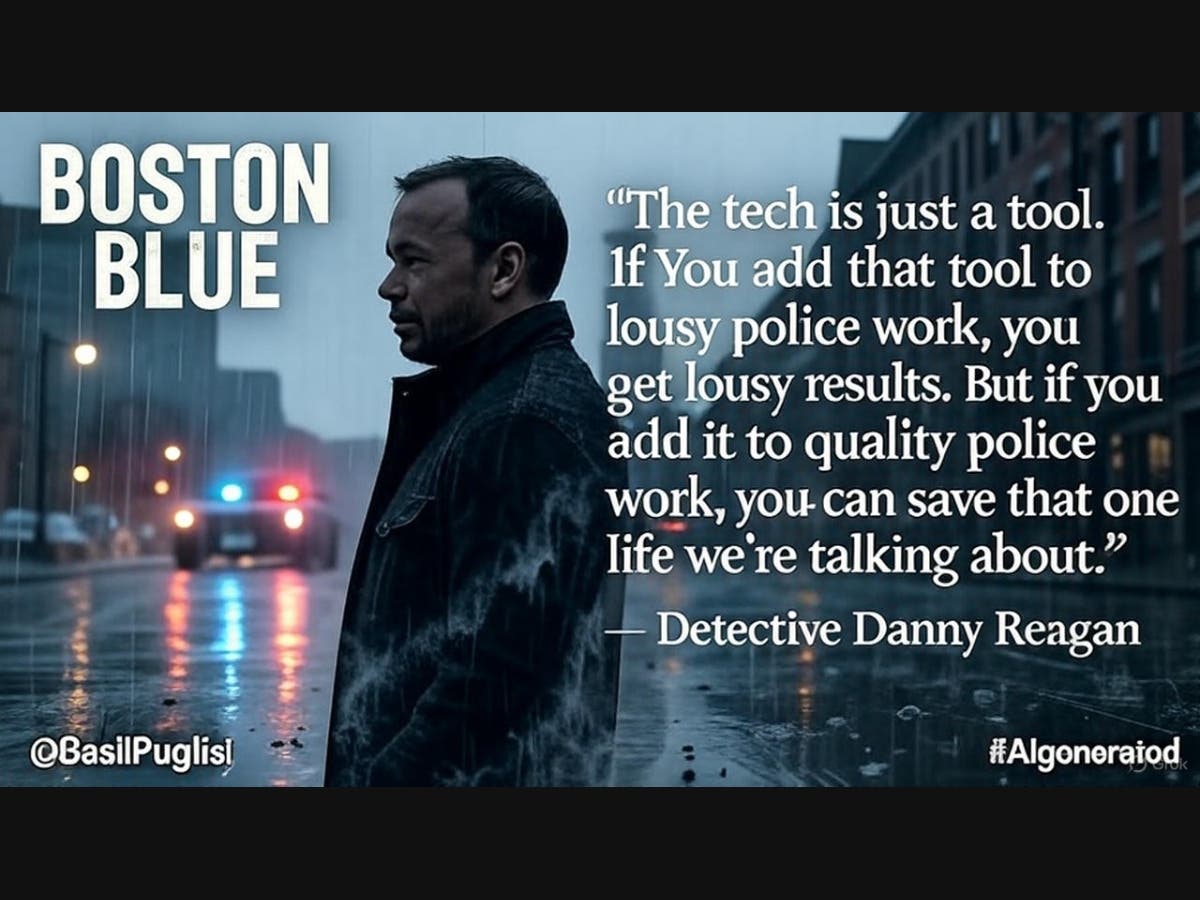
Detective Danny Reagan is back, and he is talking about the problem that defines our technological moment.
In the Boston Blue premiere on CBS, Donnie Wahlberg's character delivers a line about police technology that sounds like standard cop-show wisdom but actually captures something urgent: "The tech is just a tool. If you add that tool to lousy police work, you get lousy results. But if you add it to quality police work, you can save that one life we're talking about."
If you watched Blue Bloods for 14 seasons, you recognize that Reagan family clarity. Take responsibility. Own your decisions. Answer for your mistakes. Frank said it at the dinner table. Erin said it in the courtroom. Danny said it on the street.
Find out what's happening in Long Islandfor free with the latest updates from Patch.
But this time, Danny is describing something bigger than police work. He is describing the crisis we face every time artificial intelligence makes a recommendation and a human acts on it: when things go wrong, who answers for what happened?
The Real Case That Proves the Point
In 2020, Detroit police arrested Robert Williams after a facial recognition system matched his driver's license photo to security footage of a shoplifting suspect. Williams was held for 30 hours. His wife watched officers take him away in front of their daughters. He was completely innocent, as The New York Times later reported.
Find out what's happening in Long Islandfor free with the latest updates from Patch.
When Williams sued, responsibility scattered. The algorithm vendor said they just provided a tool, not a decision. The police department said they followed procedure. The detective said they relied on the system. Everyone had a reason. No one had accountability.
Testing by the National Institute of Standards and Technology confirmed that some facial recognition systems were up to 100 times less accurate when identifying people with darker skin tones. The Williams arrest was not a random mistake. It was a predictable outcome of a known technology limitation combined with a governance failure: no one had to document why the algorithm's recommendation justified an arrest.
That is the gap Danny Reagan is talking about. Not whether the technology works, but who is responsible when it does not.
Why "Just a Tool" Changes Everything
We encounter AI constantly. Your smartphone suggests text responses. Your GPS reroutes you. Streaming services recommend shows. Banks use algorithms to approve loans. Hospitals deploy AI diagnostic support. Police departments consider facial recognition.
When AI helps decide who gets arrested, who gets a loan, who gets hired, who gets medical treatment, someone human needs to own that decision. And here is the critical distinction Danny's line reveals:
A human can be held accountable. You can ask what evidence they reviewed, examine what alternatives they considered, evaluate whether their reasoning was sound. If the error was serious, there are consequences.
An algorithm cannot answer questions. When AI gets it wrong, there is no one standing there to explain the decision. The accountability dissolves.
A sentencing algorithm called COMPAS was found to label Black defendants as high risk at twice the rate of white defendants who did not reoffend, as ProPublica documented in an extensive investigation. When researchers exposed this bias, the system kept operating. No one faced consequences. The algorithm just continued making recommendations that courts acted on.
That is what happens when we forget the tool is not the decision-maker.
What Proper Accountability Requires
Danny Reagan's insight points to what governance should look like. The technology provides intelligence. The human makes the decision. The human documents why.
In the Williams case, proper governance would have required the detective to document the match quality, note the known accuracy limitations, explain what corroborating evidence existed, and record why those factors justified arrest. If the arrest proved wrong, investigators could review that documentation and determine whether the detective's reasoning was sound.
That is not asking for perfection. Humans make mistakes. Judges err. Engineers miscalculate. Doctors misdiagnose. But those professions have accountability structures that create institutional pressure to learn and improve.
AI needs the same framework. Decisions affecting people's lives should trace back to a human who can be held responsible. That means documented checkpoints:
Before deployment, someone certifies that training data represents all affected populations fairly. During evaluation, someone tests the system for accuracy across demographics. At decision points, someone reviews the AI recommendation, considers alternatives, documents their reasoning, and owns the choice to act. After outcomes, someone monitors real-world results and has authority to modify or suspend the system if harm occurs.
Each checkpoint requires the same thing: a designated human makes a decision and documents why. When things go wrong, investigators can trace who decided what, based on what information, considering what alternatives.
New laws in the U.S. and Europe now require exactly this kind of documentation and human oversight for high-risk AI systems. But laws alone are insufficient. Organizations must operationalize oversight by treating algorithmic recommendations the way Danny Reagan would treat tips from confidential informants: useful intelligence that still requires detective work, corroboration, and documented judgment before action.
Why Long Islanders Should Pay Attention
This is not abstract policy debate. School districts across Long Island are implementing AI-assisted learning platforms. Local banks use algorithmic credit scoring. Hospitals deploy AI diagnostic tools. Police departments consider facial recognition for investigations.
Each deployment creates the same question Danny Reagan's line forces us to ask: when the algorithm recommends something and a human acts on it, who owns that decision? What documentation exists showing the human's reasoning? If the outcome is wrong, can anyone explain why the choice seemed justified?
Those questions matter whether you are a parent whose child gets tracked into the wrong program, a borrower whose mortgage application gets rejected, a patient whose symptoms get misdiagnosed, or a resident who gets wrongly investigated.
Whether it is facial recognition at MacArthur Airport or AI tools in Syosset schools, the same rule applies: someone human must answer for the decision. The algorithm can process more data than any human and identify patterns human attention might miss. But it cannot explain its reasoning in ways that withstand scrutiny. It cannot weigh competing values. And most critically, it cannot be held accountable when things go wrong.
The Reagan Standard
The Blue Bloods Reagan family represented a standard we should not abandon in the age of AI: someone has to answer. Tools make work easier and decisions faster, but they do not make humans less responsible for outcomes.
Danny Reagan, whether walking the streets of New York or Boston, represents clarity we need: the tech is just a tool, and we are still the ones on the hook for how we use it.
We are responsible for ensuring AI remains a tool rather than becoming a shield that hides human decisions from accountability. That means documenting who decided what, based on what information, considering what alternatives, and why.
The Reagan family spent 14 seasons teaching us that accountability is not optional. Boston Blue reminds us that lesson applies just as much to algorithms as it does to badges.
The tech is just a tool. Someone human still has to answer for what happens next. The question is whether we will build systems that make that person identifiable, or whether we will let responsibility dissolve the moment something goes wrong.
Danny Reagan knows the answer. The rest of us need to catch up.
Because whether it’s police tech in Boston or classroom AI in Nassau, accountability still starts with us.