Neighbor News
The Girl Who Just Wanted to Skate
How Alysa Liu Became One of America's Greatest Olympic Ambassadors

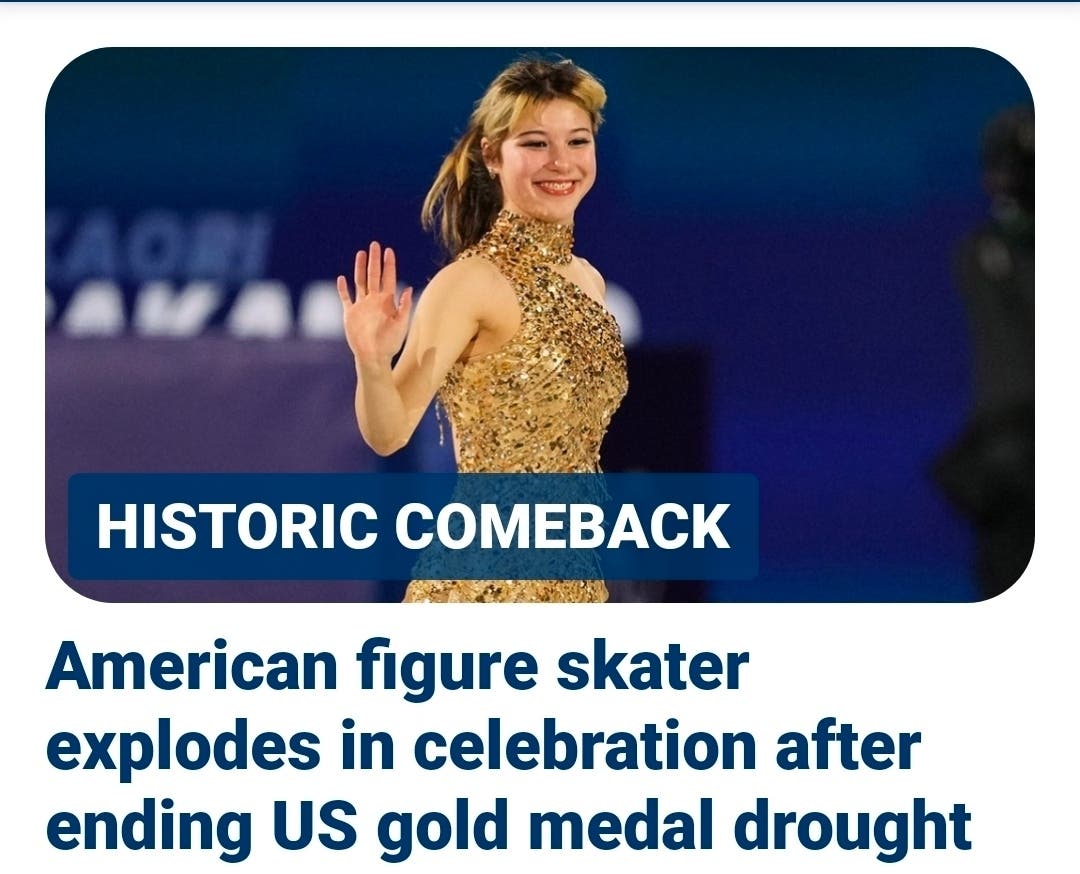
It has been 24 years since Long Island's own Sarah Hughes won Olympic gold in figure skating. If there was one person to watch at the 2026 Milano Cortina Games, it was Alysa Liu, and she did not disappoint.
But the moment that matters most has nothing to do with her score.
Watch the warmup footage. Six minutes before the biggest skate of her life, Liu glides through the Milano Ice Skating Arena and waves to people she does not know. Her four younger siblings sit in the stands next to her father and her best friend. They have never seen her skate in competition before. She finds them, locks eyes, and grins. Then she gives that same grin to the rest of the arena. Strangers get the same warmth as family.
Find out what's happening in Long Islandfor free with the latest updates from Patch.
That tells the whole story.
The world argues over which countries use the Olympics as a stage for politics. Social media fights about who belongs and who does not. Meanwhile a 20 year old from Oakland, California steps onto Olympic ice and does the oldest thing in sport. She competes in the thing she loves. She represents her country by being herself while doing it.
Find out what's happening in Long Islandfor free with the latest updates from Patch.
This makes Liu the finest ambassador the United States has sent to an Olympic Games since Jesse Owens laced up his spikes in Berlin ninety years ago. That comparison rests not on race but on purpose. Owens walked into a stadium thick with political theater and ran. He ran because he was a runner and the Olympics exist for runners to run. The statement came from the act itself, not from any intent to make one.
Liu does the same thing on ice.
She retired at 16. That fact still shocks people. Here was a prodigy who became the youngest U.S. women's national champion at 13, the first American woman to land a quad in international competition, and a World Championship bronze medalist. She had every reason to keep grinding. She chose otherwise. She went to Nepal, trekked to Everest Base Camp, took road trips with friends, and described that stretch of her life as the best of it.
When she returned in 2024, something had shifted. Not the talent. The relationship to the talent. She picked her own music. She built her own choreography. She showed up to the rink with raccoon striped hair and a piercing that catches light when she smiles, which is constantly. Her coach Phillip DiGuglielmo described the change plainly: for years she got dropped off at the rink and told what to do. Now everything is collaborative. She chooses. She creates. She owns the process.
That shift carried her to a World Championship in 2025, the first for an American woman since 2006. It carried her to a gold medal in the Team Event at these Games. And on February 19, skating to Donna Summer's "MacArthur Park Suite," it carried her past Japan's Ami Nakai and the great Kaori Sakamoto, a three time world champion competing in what may be her final event, to claim the individual gold with a career best 226.79.
She landed her signature triple Axel. She sailed through every jump with the calm of someone skating alone on a weekday morning. The crowd got louder with each clean landing and she fed off it, looking out into the seats during her transitions, breathing through a technique she uses to stay present. After her final pose the arena rose.
She skated to the boards, looked into a camera, and let the moment hit her all at once.
Asked later what she felt on the ice, she said: "I was so calm when I started. I felt everyone's energy. I felt my energy." Asked if she was glad she came back, she said two words: "It was just right."
Compare that to the noise surrounding these Games. Boycott talk. Broadcast fights. Doping histories. Geopolitical friction at every turn. Liu did not address any of it. She did not have to. Her presence was the answer. A person who knows who she is, doing the thing she loves, in front of the world, with joy that needs no explanation.
After the short program two days earlier, a reporter asked if she felt she could beat the Japanese skaters. Her answer belongs in a frame: "Whether I beat them or not is not my goal. My goal is just to do my programs and share my story. And I don't need to be over or under anyone to do that."
She said that before she won. That is not a victory speech rewritten for humility. That is a person who actually believes the doing matters more than the winning. And that belief, held honestly, is what let her skate without the weight that buries other athletes when the stakes get this high.
There is a principle here that reaches past the rink and into every office, classroom, and boardroom where people chase outcomes at the expense of the work itself. The people who find happiness in what they do, who carry pride in their craft rather than dread of falling short, will reach places that raw ambition alone cannot touch. Not because ambition fails. Sakamoto wanted gold. Nakai wanted gold. Every skater in that building wanted gold. Liu wanted something else, and gold came to her because of it.
Her teammate Amber Glenn showed the same spirit. Glenn entered the free skate in 13th after a costly error in the short program. She came back with a near flawless performance, climbed to fifth overall, and told reporters she was proud of her fight. Liu embraced her the moment she stepped off the ice. Nakai, the 17 year old bronze medalist in her Olympic debut, said Liu walked up to her and said "Congratulations, it's amazing that you won a medal at your first Olympics." These are not the gestures of someone thinking about herself. These are the gestures of someone thinking about the sport.
Every nation sends athletes to the Olympics. The nations that get it right send people who remind the world why the Games exist. America sent a 20 year old who retired, came back because she missed the ice, chose joy over calculation, waved to strangers during warmups, skated to Donna Summer, and then walked down a hallway saying "I just like, can't process this. There's no way."
In a year when so much noise surrounds the five rings, the clearest signal came from the quietest confidence. Not someone trying to prove a point. Someone who already knew who she was, and skated like it.
That is the oldest story in the Olympics. It still wins.
-My Opinion-