Neighbor News
Leadership Is Not a Vibe, It Is a Result
The Trump Doctrine is Leadership in Action, Like it or Not

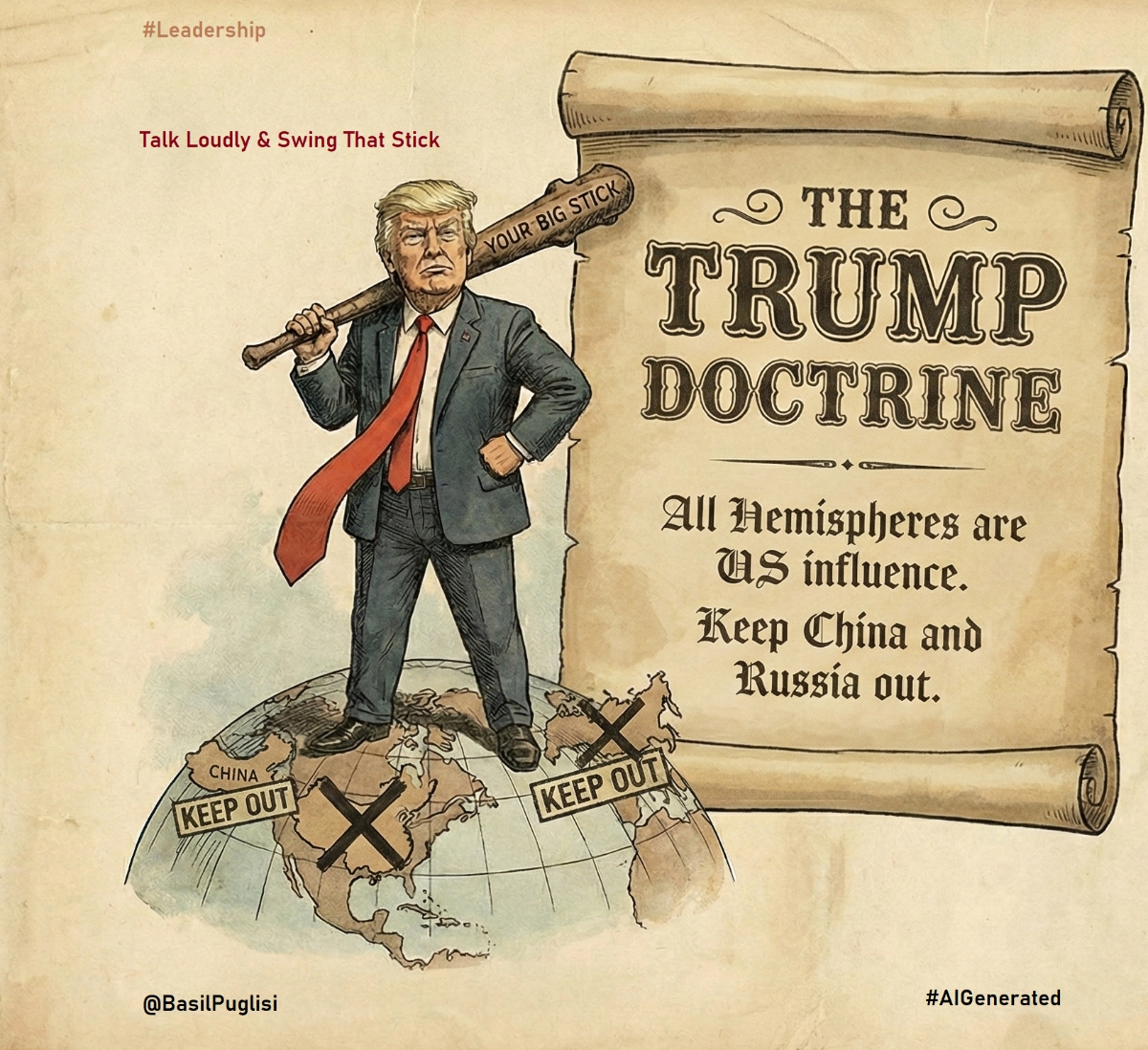
Much gets written about what makes a great leader. People are told to listen to those they lead, adapt to changes, keep an open mind, and show humility. These are all useful behaviors. But at the end of the day, leadership remains about results. Strip away the fluff and leadership stands on full display in the United States right now.
Yesterday, the United States launched airstrikes on Venezuela and captured Nicolás Maduro. The world is still reacting. But for those watching American foreign policy, the action fits a pattern that stretches back two centuries.
President Trump builds on two of America's most consequential foreign policy templates: the Monroe Doctrine and Theodore Roosevelt's Big Stick. His supporters see a results first standard in action. Peace is the stated preference, strength is the credibility layer, and action follows when U.S. interests demand it. Roosevelt's famous line was "speak softly and carry a big stick." The Trump Doctrine inverts the tone: Speak Loudly and Swing the Big Stick.
Find out what's happening in Long Islandfor free with the latest updates from Patch.
The historical foundation is plain. In 1823, President Monroe warned European powers that any attempt to extend their political system into the Western Hemisphere would be treated as "dangerous to our peace and safety." That was deterrence in direct language, a boundary declared without apology. The doctrine was meant to keep rival powers out of America's strategic neighborhood. For decades the United States lacked the military strength to enforce it, but the warning stood. When American power grew, the enforcement followed.
Theodore Roosevelt turned the warning into operational method. Big Stick policy meant diplomacy backed by credible force, and the Roosevelt Corollary framed the United States as justified in exercising international police power to prevent chronic instability in the hemisphere from inviting European powers in. Roosevelt did not theorize. He acted. During the Panama episode in 1903, he sent warships to Panama's coast, ordered Marines to seize the railroad, and blocked Colombian reinforcements during the Panamanian revolt. Within days he recognized the new nation and secured canal rights. He moved first. The world reacted. In the Dominican Republic, Cuba, Nicaragua, and Haiti, Roosevelt deployed the same logic: American interests required stability, stability required American control, and rivals would be denied entry. Neighbors understood that resistance meant American reprisal. The Big Stick was not metaphor. It was method.
Find out what's happening in Long Islandfor free with the latest updates from Patch.
Trump operates from the same instinct, then extends the method beyond the hemisphere. The core claim is not that the Monroe Doctrine becomes a global document. It does not. The claim is that the leadership mechanic, deterrence plus compellence backed by American power, becomes portable. What Monroe reserved for the Americas, what Roosevelt enforced in Panama and the Caribbean, Trump now asserts wherever American strategic interests require it.
Yesterday's strike on Venezuela shows the doctrine still works inside its traditional zone. The trajectory stretches back years. In 2015, President Obama declared Venezuela a threat to U.S. national security and imposed targeted sanctions. The Trump administration escalated with financial sanctions in 2017 and a comprehensive oil embargo in 2019 that cut Venezuela off from U.S. markets. Maduro was labeled a narco-terrorist. Military assets moved into the Caribbean. The Council on Foreign Relations describes Venezuela under Trump as "ground zero for his 21st century corollary of the Monroe Doctrine," framing hemispheric dominance as a national security imperative.
Then came the kinetic phase. CBS News reports that the United States struck multiple sites across Venezuela and captured Maduro. Trump stated the U.S. would temporarily "run" the country. Reuters describes the operation as the most direct U.S. action in Latin America since the 1989 Panama invasion. Venezuelan authorities are calling it military aggression. Supporters are calling it decisive leadership. The debate will continue for months. The action is already complete.
The strike serves a dual purpose in the Trump Doctrine framework. It removes an adversarial regime, and it neutralizes Russian and Chinese influence in the hemisphere. Both powers had expanded economic and military ties with Caracas. Yesterday's strike sends a message beyond Venezuela: the Americas remain inside an American security boundary, and rival powers are not welcome. The Big Stick lands where Monroe always pointed.
Iran shows the doctrine now operates globally. The logic is identical. The geography is different.
The foundation was laid during Trump's first term. In 2018 he withdrew from the JCPOA nuclear agreement. In 2019 he designated the Islamic Revolutionary Guard Corps a terrorist organization, the first time the United States applied that label to a foreign government's military. In January 2020 a U.S. drone strike killed Qassem Soleimani, commander of the IRGC's Quds Force, at Baghdad airport. Iran retaliated with missile strikes on U.S. bases in Iraq. The Council on Foreign Relations documents this sequence as part of a "maximum pressure" campaign designed to compel behavioral change through coercive leverage rather than diplomatic concession.
The pattern continued. Last year, U.S. strikes hit Iranian nuclear sites, placing kinetic force inside a broader pressure strategy. Sanctions alone had not changed Iranian behavior. Direct military action raised the stakes. Supporters interpret this as the same results first leadership deployed outside the Western Hemisphere. Pressure and force shape outcomes, not simply signal disapproval. The Big Stick swings in the Middle East with the same logic Roosevelt applied in the Caribbean.
That framing captures the Trump Doctrine. American influence extends beyond the Americas. All hemispheres fall within the scope of U.S. strategic interest. Rivals like China and Russia are treated as powers to keep at bay through strength, leverage, and willingness to act. The doctrine holds that American power is not defensive but assertive, not regional but global, not reactive but preemptive. Speak Loudly and Swing the Big Stick.
This is supported opinion, grounded in the continuity of deterrence logic from Monroe and the force backed diplomacy of Roosevelt, then connected to Trump era action as the modern application. The Conversation argues that Trump's approach goes beyond classical Monroe formulations in ideology, intent, and scale, calling it unprecedented. That critique can hold while the core claim remains intact. Trump does not abandon the Monroe logic. He universalizes it. The geographic constraint falls away. The mechanic stays the same: declare the boundary, back it with credible force, move first when rivals test it, and let the world react.
Some will call this reckless. Others will call it overdue. The debate will intensify in the coming days as the implications of yesterday's action become clear. But the debate should not obscure the underlying leadership philosophy. Trump governs with a recognizable doctrine. He names rivals. He uses economic and military pressure as tools of compellence. He acts without waiting for consensus and forces other powers to respond to new realities rather than negotiate terms in advance. Whether that approach serves long term American interests is a legitimate question. Whether it constitutes leadership by a results first definition is harder to dispute.
I share a need for transparency, humility, and an open mind in leadership. The strongest leaders stay governable and accountable. But results still matter most. Forget that, and leadership becomes theater.
Sources:
- Al Jazeera. (2025, June 23). History of US-Iran relations: From the 1953 regime change to Trump strikes. https://www.aljazeera.com/news/2025/6/23/history-of-us-iran-relations-from-the-1953-regime-change-to-trump-strikes" class="redactor-linkify-object">https://www.aljazeera.com/news...
- CBS News. (2026, January 2). U.S. strikes Venezuela and captures Maduro. https://www.cbsnews.com/live-updates/venezuela-us-military-strikes-maduro-trump/
- Council on Foreign Relations. (2020, July 29). Timeline: U.S. relations with Iran. https://www.cfr.org/timeline/us-relations-iran-1953-2025
- Council on Foreign Relations. (2025, October 23). Much ado about Maduro. https://www.cfr.org/article/much-ado-about-maduro
- FSCJ Pressbooks. (2020). Roosevelt's "Big Stick" foreign policy and Taft's "Dollar Diplomacy". https://fscj.pressbooks.pub/modernushistory/chapter/roosevelts-big-stick-foreign-policy-and-tafts-dollar-diplomacy/
- Lumen Learning. (n.d.). Roosevelt's "Big Stick" foreign policy. https://courses.lumenlearning.com/wm-ushistory2/chapter/roosevelts-big-stick-foreign-policy/
- Reuters. (2026, January 3). Trump says Venezuela's Maduro captured after strikes. https://www.reuters.com/world/americas/trump-says-venezuelas-maduro-captured-after-strikes-2026-01-03/
- The Conversation. (2025, November 1). Trump's squeeze of Venezuela goes beyond Monroe Doctrine. https://theconversation.com/trumps-squeeze-of-venezuela-goes-beyond-monroe-doctrine-in-ideology-intent-and-scale-its-unprecedented-226589
- U.S. National Archives / DocsTeach. (n.d.). Monroe Doctrine. https://docsteach.org/document/monroe-doctrine