Politics & Government
LI Leaders Tackle Cost Of Living, Housing, Taxes At LIA Event
Lawmakers debated SALT, energy costs, and immigration as rising expenses continue to squeeze Long Island families.


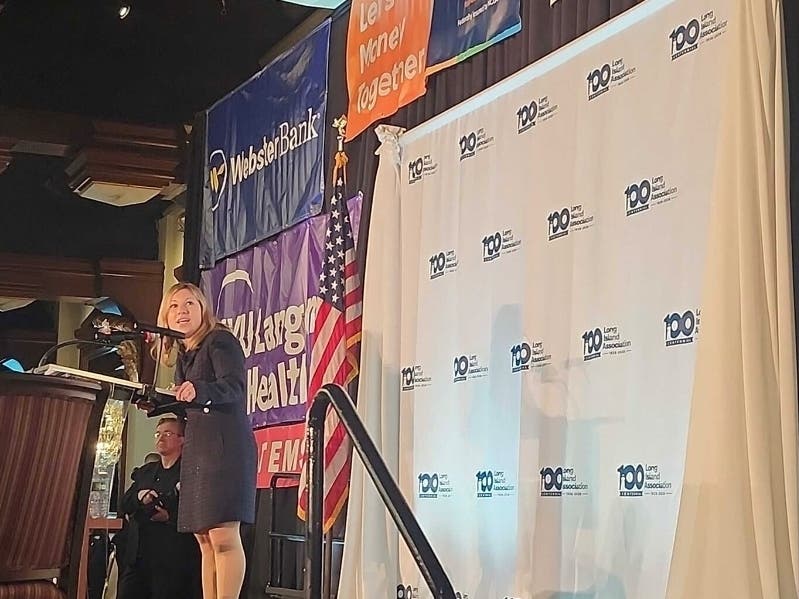
WOODBURY, NY — Long Island’s bipartisan congressional delegation took the stage Monday at the Long Island Association’s “What’s New in Washington” event for a wide-ranging discussion on affordability, taxes, energy, immigration and the economic pressures facing the region.
Held at Crest Hollow Country Club as part of the LIA’s centennial year, the event brought together U.S. Reps. Nick LaLota, Andrew Garbarino, Tom Suozzi and Laura Gillen for a public conversation moderated by Stacey Sikes, the LIA’s acting president and CEO.
The conversation made clear that while the lawmakers often disagree on causes and solutions, they are responding to the same reality: Long Island is becoming increasingly expensive to live in.
Find out what's happening in Long Islandfor free with the latest updates from Patch.
“My husband and I are raising two daughters here, and I want them and all our future generations to enjoy this beautiful place we call home,” Sikes said. “We have a lot of work to do together to tackle our challenges.”
Affordability At The Center Of Debate
Affordability — including housing costs, property taxes, utilities and everyday expenses — dominated the discussion. Lawmakers agreed the pressure is real, but differed sharply on why.
Find out what's happening in Long Islandfor free with the latest updates from Patch.
Rep. Andrew Garbarino pointed to recent federal tax changes as a source of relief.
“I got an extra $4,000 back this year in my tax return because of that SALT deal,” Garbarino said.
Rep. Tom Suozzi pushed back, arguing that many Long Islanders are not experiencing that relief.
“Everybody knows that the economy is in trouble,” Suozzi said. “The stock market is doing well, but… that doesn’t affect most people.”
“Affordability is not a hoax,” he added. “It’s a real-life issue that’s affecting people throughout the country.”
He said rising healthcare costs, interest rates, tariffs, and global instability are all contributing to higher prices.
Rep. Laura Gillen grounded the issue in everyday experience.
“Go to the grocery store and ask people there if they’re doing better,” she said. “Ask them who just got a utility bill… I know I just got mine. It’s over $1,000.”
Rep. Nick LaLota took a different view, arguing that much of the problem originates at the state level.
“Albany is the cause of most of our pain in this state,” LaLota said. “It’s been causing most of our pain for 20 years.”
SALT Debate Highlights Tax Pressure
A major part of the affordability debate centered on the SALT deduction — a federal policy that allows taxpayers to deduct state and local taxes, including property taxes, from their federal income.
Because Long Island property taxes are among the highest in the nation, limits on SALT have had a significant impact on homeowners.
Gillen said the issue remains unresolved.
“We introduced the bill together to restore the full deduction permanently, and that’s what I’m still fighting for,” she said.
Suozzi said broader solutions should also be considered.
“We need a bigger SALT deduction, or we need to do revenue sharing so more of our money comes back to New York,” he said.
LaLota argued that Republican lawmakers delivered recent progress.
“It was five Republican members that got the quadrupling of SALT done,” he said.
Energy Policy Tied To Rising Costs
Energy policy — and its impact on utility bills and housing costs — was another major issue, including offshore wind, solar and natural gas.
LaLota defended offshore wind projects like Sunrise Wind but criticized changing policies after projects are underway.
“You don’t change the rules in the middle of the game,” he said. “These projects are way more than 50 percent underway. To then unplug it — you’ve denied yourself all of the return.”
He added that the state is limiting its options.
“There’s a ton of natural gas in New York’s Southern Tier that we’re leaving untapped,” LaLota said.
Garbarino said state-level policies are increasing costs.
“Eliminating gas in new homes is adding $15,000 to $20,000 per new home in construction costs,” he said. “That doesn’t help affordability.”
“All of the above makes us safer when we can produce more energy here at home,” he added.
Immigration Debate Shows Local Impact
Immigration policy — another issue tied closely to the economy — drew strong reactions.
Garbarino said enforcement has become more targeted.
“I think there’s more of a focus now on going after the worst of the worst,” he said.
Gillen said the impact is being felt in local communities.
“I met someone who just opened a shop… and they’re going to go out of business already because people are afraid to go out,” she said.
Suozzi called for a balanced approach.
“The answer is not wide-open borders… and the answer is not masked men breaking windows and beating up landscapers,” he said. “We have to find some common ground.”
LaLota emphasized the need for prioritization while criticizing sanctuary policies.
“There ought to be a prioritization… you deport the worst of the worst,” he said.
Housing Shortage Looms Over Every Issue
Underlying nearly every issue discussed was the region’s housing shortage.
High construction costs, zoning restrictions, and energy policies have made it difficult to build new housing — especially at prices young residents can afford.
Despite disagreements, the delegation highlighted areas where they have worked together, including infrastructure funding and regional priorities.
“Every issue we face in America is complicated,” Suozzi said. “To solve a complicated problem, you need people of goodwill — to find some common ground.”
Get more local news delivered straight to your inbox. Sign up for free Patch newsletters and alerts.