Neighbor News
When the Walls Fell: Trump, Democrats, AI & the End of Censorship
Trump uses AI to redefine the Meme Wars as #ShutDown continues

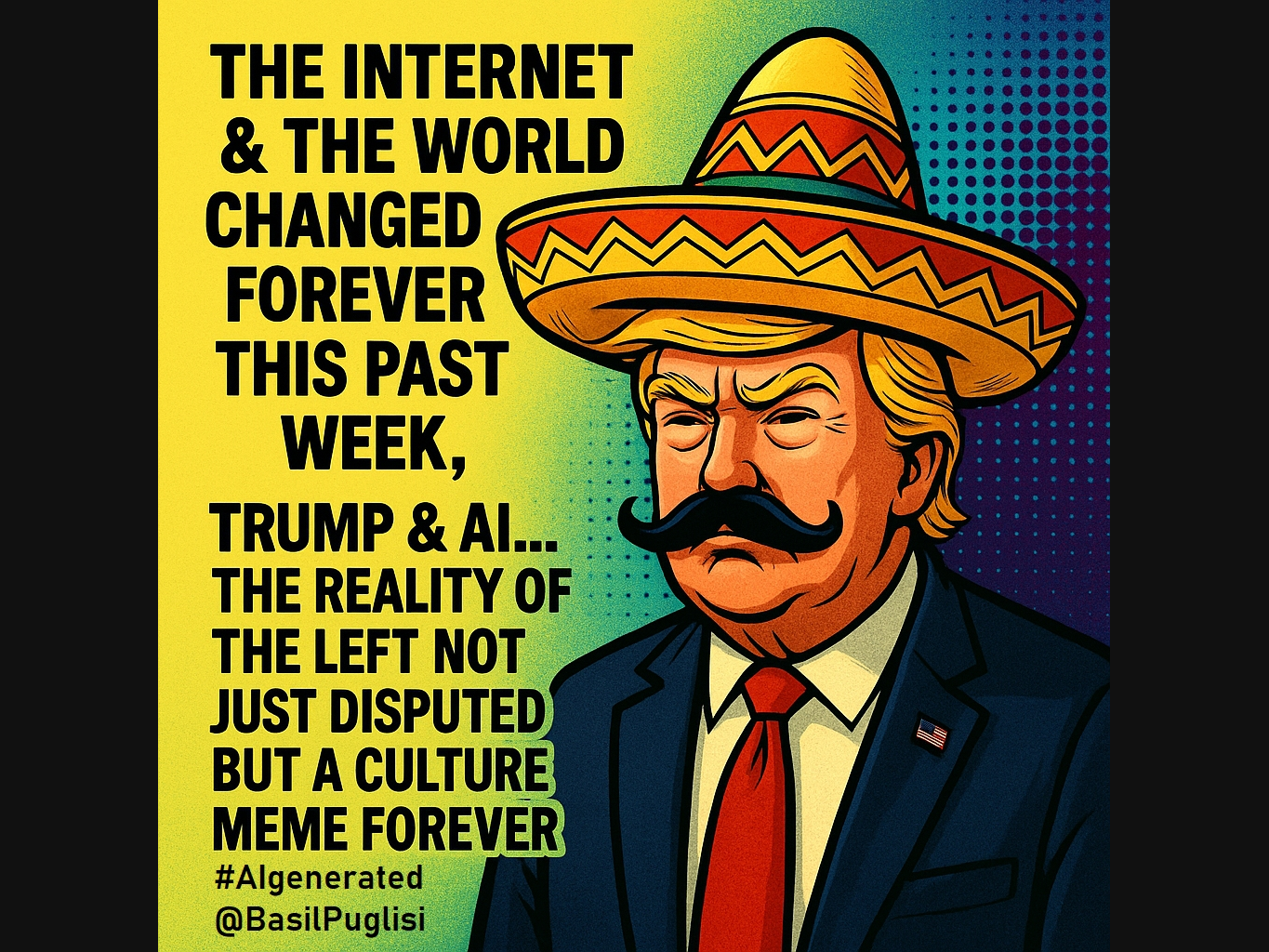
On October 1, 2025, at 12:01 a.m. Eastern Time, the United States federal government entered another shutdown (Wikipedia, 2025; Associated Press, 2025). Not exactly breaking news. But this one? Different. This was not just a pause in government operations. It was a cultural pivot point, the moment when control of narrative, power, and digital discourse began to shift from establishment politics to the open chaos of public attention.
Here’s the irony nobody wants to admit. Republicans hold the House, Senate, and White House, yet power on paper does not translate into authority in practice. The Senate’s sixty-vote rule still binds both parties to negotiation. Even a majority cannot move forward without help from the other side. That reality became clear when Senators John Fetterman of Pennsylvania, Catherine Cortez Masto of Nevada, and Angus King of Maine, who caucuses with Democrats, joined Republicans to support a clean continuing resolution (CBS News, 2025; ABC News, 2025). Had more Democrats followed their lead, the shutdown might have been avoided.
Power on paper. Impotence in practice. Political control means nothing without persuasion.
Find out what's happening in Long Islandfor free with the latest updates from Patch.
Instead, Democrats held the line. They demanded expansions to health-insurance tax credits and adjustments to Medicaid funding, tying every funding bill to their own agenda. Compromise meant surrender, so they were willing to risk a shutdown to maintain leverage (Le Monde, 2025; The White House, 2025; Oregon Public Broadcasting, 2025). Analysts from across the spectrum pointed out the paradox. Democrats, who control neither chamber nor the presidency, were leading the nation toward a shutdown through obstruction (Brookings Institution, 2025). If they could not win by vote count, they would win by narrative control.
When the shutdown took effect, federal agencies began publishing notices and banners blaming “radical left obstructionists” for halting government operations (The Guardian, 2025; Politico, 2025; Associated Press, 2025). Ethics experts warned this could violate the Hatch Act, which prohibits partisan messaging on official government platforms (Politico, 2025). The visual message was unmistakable. The administration was willing to use digital channels as political billboards. The shutdown became less about operations and more about information warfare.
Find out what's happening in Long Islandfor free with the latest updates from Patch.
But here’s where it gets interesting. The long-protected wall of censorship that had shielded political elites from bottom-up critique began to crumble. Earlier this year, Meta’s CEO Mark Zuckerberg admitted that the Biden administration pressured Facebook to moderate or remove certain COVID-19 content during the pandemic (PBS NewsHour, 2024). Zuckerberg stated directly that the White House “pressed” his team to alter moderation decisions and acknowledged that Facebook “caved” to those demands (YouTube, 2024). Congressional investigations later confirmed the same through internal documents released by the House Judiciary Committee (House Judiciary Republicans, 2024).
Think about that for a second. The admissions showed that censorship was not speculative or accidental. It was systematic and directed.
Google executives later told Congress that officials from the Biden administration also contacted YouTube to suppress or deprioritize content viewed as politically sensitive (Yahoo News, 2024). Together these disclosures created a moment of reckoning. The gatekeepers of digital speech were no longer neutral. They were political actors protecting one side’s narrative at the expense of the other.
Trump and his allies seized the moment. The shutdown became a platform for counterattack. Trolling, once dismissed as internet noise, evolved into a political weapon. What began as mockery turned into strategy. By provoking outrage, Trump dominated attention. When his critics broke the cardinal rule of the internet? Never feed a troll. They didn’t just feed him. They basically gave him the keys to the narrative. He did not just win the argument. He owned the reaction. Each attempt to silence him multiplied his reach.
Then came another unexpected twist. OpenAI released Sora 2, an advanced text-to-video generator capable of producing near-cinematic realism. Almost too perfect, if you ask me. The timing could not have been more symbolic. The launch of a tool that can recreate visual truth on demand occurred precisely as the narrative about censorship was collapsing. Sora 2 turned the debate about digital truth from theory into reality. When anyone can create believable video, truth itself becomes a contested space. The question is no longer who holds the facts. It is who defines them (OpenAI, 2025).
The revelations from Meta and Google shattered a long-standing illusion. For years, discussions about algorithmic bias and content moderation were treated as academic exercises. Once corporate executives admitted direct government influence, the mask fell. Censorship was not an algorithmic quirk. It was administrative policy. That acknowledgment changed everything. Once citizens saw behind the curtain, they began to question the legitimacy of every moderation decision that followed.
Transparency broke the spell.
Look. This does not mean moderation will disappear. It means that moderation has lost its untouchable status. Every takedown and label is now subject to scrutiny. Every account suspension becomes a rallying point for alternative media. Platforms can still enforce rules, but their authority to define “truth” has evaporated. The wall that separated public narrative from private control has fallen.
Trump’s success in this environment is not about ideology alone. It is about his instinct for narrative velocity. He understands that in a meme economy, the first response wins. Outrage feeds attention. Attention feeds dominance. The left continues to argue about civility while the right has mastered the grammar of virality. When Democrats react with anger, they confirm the premise. When they call for censorship, they expose their fear. Each attempt to suppress only amplifies the message.
We are living in a world where censorship no longer silences. It exposes. The institutions that once filtered dissent have become participants in the very discourse they sought to control. The shadow bans, the algorithmic demotions, the quiet moderation freezes? No longer invisible tools. They are now evidence in a cultural trial about truth, fairness, and power.
The government shutdown was political theatre, but it carried symbolic weight. It revealed how fragile the old systems of control have become. The wall between establishment messaging and the raw pulse of public conversation has cracked. What happens next will define this decade. Meme networks, independent journalists, and AI tools will not just report on politics. They will shape it. The next battles over policy will be fought as much through narrative as through legislation.
Here’s what keeps me up at night. The walls have fallen. The institutions that once mediated what could be said and who could say it are now part of the open contest. Truth has become a living thing, shaped by those who dare to speak when others hesitate. The question now is not whether control can be restored. It is whether anyone should want it restored at all.
What happens in your local community when national narrative control collapses? Watch your school board meetings. Watch your city council. The meme wars are coming home.