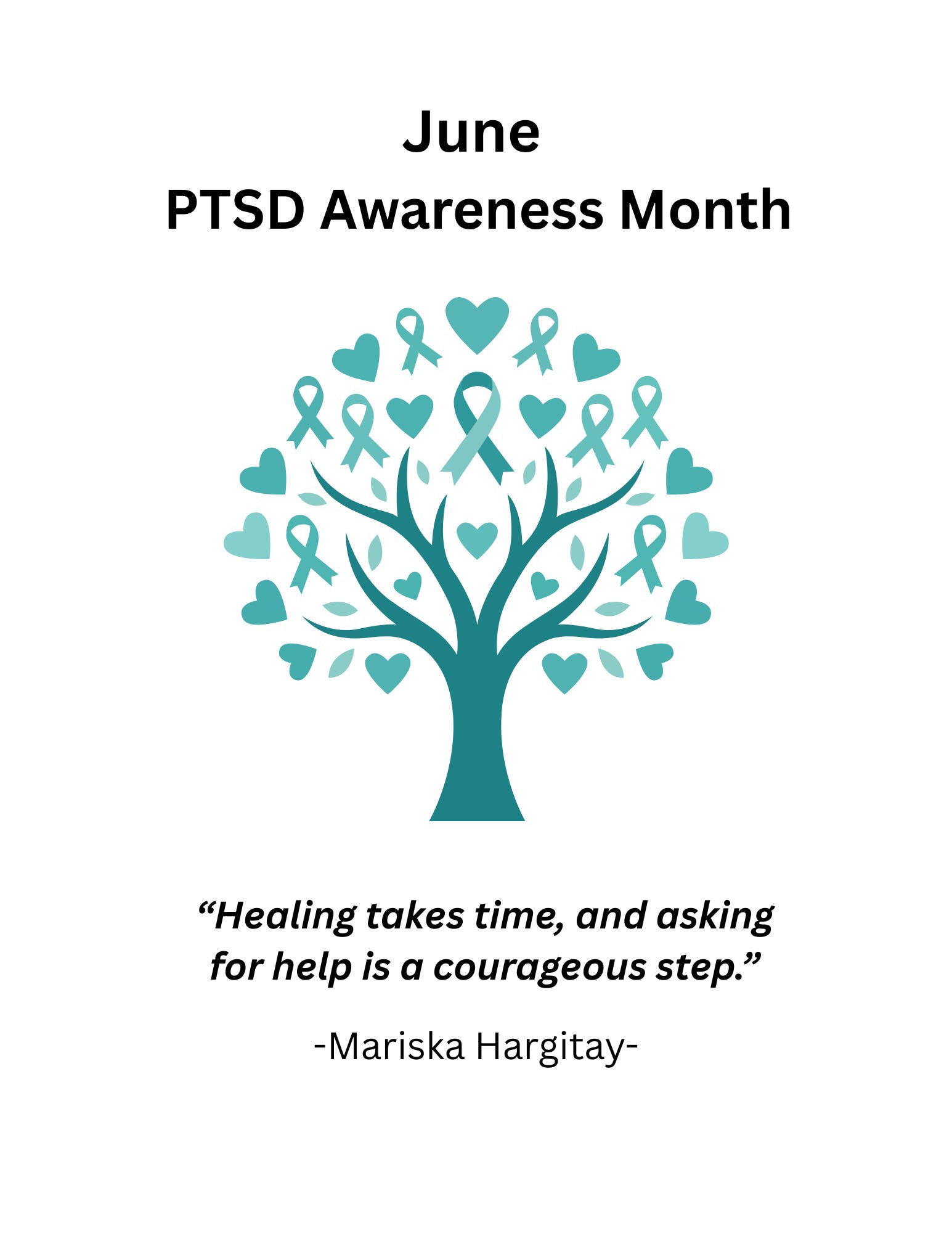
PTSD Awareness Month provides an opportunity to share research and resources related to this mental health challenge that affects an estimated 1 of every 20 Americans.
Experiencing, witnessing, and learning about life-threatening or deeply distressing events can result in PTSD or post-traumatic stress disorder. (Source: PubMed Central)
These traumatic events can include interpersonal violence, combat and military exposure, serious accidents, natural and human-caused disasters, sudden or violent loss, and medical trauma. Interpersonal violence can include domestic abuse, child abuse, physical assault, and sexual assault. Violence can include emotional and verbal abuse.
Symptoms of PTSD fall into four categories: reliving or re-experiencing the traumatic event, avoiding things that remind you of the traumatic event, having more negative thoughts and feelings than before the traumatic event, and feeling on edge or “keyed up” that’s also referred to as hyperarousal. (Source: National Center for PTSD)
About 13 million Americans or 5% of the population suffer from PTSD. (Source: U.S. Dept. of Veteran Affairs)
PTSD is more common in high-risk groups that include military veterans and first responders. (Source: Armed Forces Benefit Association)
Following the Vietnam War, the American Psychiatric Association formally recognized PTSD in 1980. Formerly, the anxiety disorder was referred to as combat fatigue, shell shock, gross stress reaction, transient situational disorder, and other terms.
Several well-known public figures have openly talked about their own PTSD journeys and advocated for others experiencing the aftermath of trauma exposure: Jason Kander, Whoopi Goldberg, Audie Murphy, Ariana Grande, Oprah Winfrey, Lady Gaga, Darrell Hammond, and Mariska Hargitay.
There are many resources to help individuals contending with PTSD, as listed below.
National Alliance on Mental Health, New York City Metro: Post-Traumatic Stress Disorder (PTSD) - National Alliance on Mental Illness of New York City , Inc.
New York State Office of Mental Health: Mental Health and Wellness Information
New York State Department of Veteran Services: Post Traumatic Stress Disorder (PTSD) | New York State Department of Veterans' Services
New York, The Headstrong Project: New York - The Headstrong Project