Crime & Safety
De Blasio Blasts Police Union Over Racist ‘Dog Whistling’
Mayor Bill de Blasio rekindled a years-long dispute with a powerful police union as he defended his handling of crime in New York City.


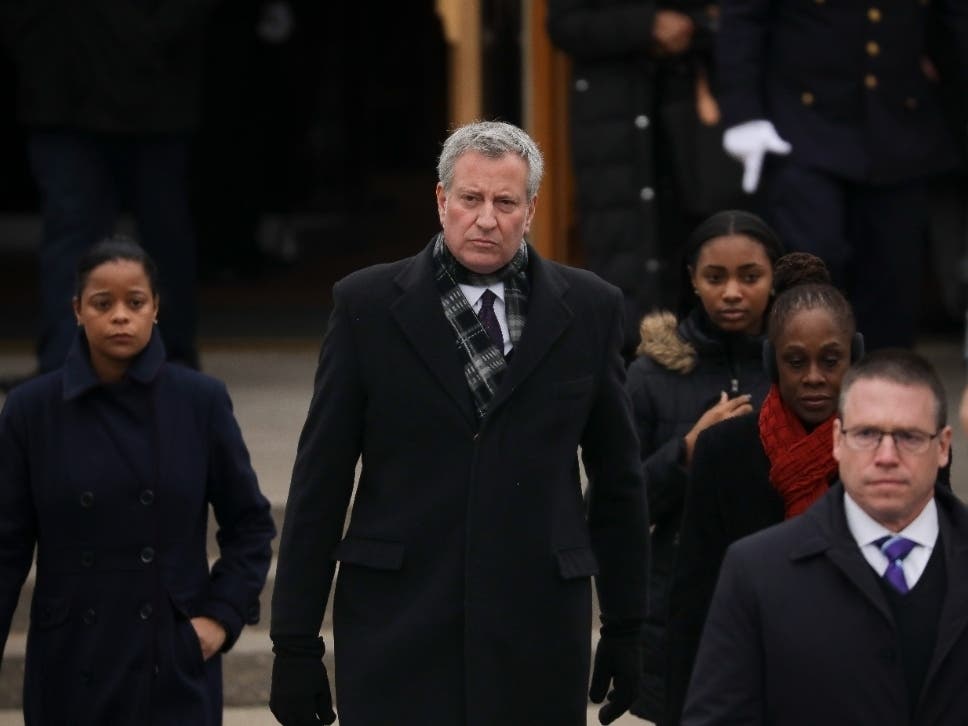
NEW YORK CITY — Mayor Bill de Blasio continued defending his record on crime with a parting shot leveled at long-time nemesis: the Police Benevolent Association.
The union's leadership has undertaken a highly politicized effort to scuttle any type of reform, de Blasio told WNYC's Brian Lehrer on Friday.
He said their constant portrayal of New York City as on "brink of disaster" — when, in fact, it has gotten safer — reeks of President Richard Nixon's "Southern Strategy," which whipped up votes by appealing to the racism of white voters against Black people.
Find out what's happening in New York Cityfor free with the latest updates from Patch.
"We got to deracialize because there's a lot of dog whistling going on, and just get back to the facts," he said. "We know how to make the city safer — it begins and ends with deepening the relationship between police and community."
De Blasio has spent much this week touting his record on policing, despite a spike in murders and violent crimes over the pandemic.
Find out what's happening in New York Cityfor free with the latest updates from Patch.
Disruptions over the pandemic — a "perfect storm" — caused the upticks in violence, de Blasio maintains.
He said crime overall is 11 percent lower than when he took office and arrests were down by 180,000 by 2019 — a sharp contrast to his predecessors Rudy Giuliani and Michael Bloomberg.
"There are a lot of other ways to achieve public safety without arrests," he told Lehrer.
"I said, we are going to make substantial reforms to policing and changes. We're going to use arrest less. We're going to get rid of stop at frisk. We're going to deescalate. I put it before the people twice, the people ratified it overwhelmingly twice in two elections."
But these reforms often didn't go far enough for many advocates. And many critics, especially PBA President Patrick Lynch, have accused de Blasio of making the city unsafe and waging a war against police officers.
Lynch and other critics have pointed to de Blasio acknowledging he had "the talk" — a discussion Black parents have with their children about how to interact with police — with his son Dante de Blasio, who is biracial.
Lehrer said he was surprised by the negative reaction — which extended to many NYPD officers turning their back on de Blasio after officers Rafael Ramos and Wenjian Liu were shot and killed in 2014 in apparent revenge over the death of Eric Garner — given he doesn't know the parent of a Black teenager who hasn't had the talk.
"So, maybe I was naive, but they thought you contributed to this notion that police are in general racist, which helped create the conditions for someone to want to go out and assassinate cops," Lehrer said. "Were you surprised by that reaction at the time and in a bigger picture sense, what did you learn from it that you carried into the rest of your mayoralty?"
"It was not meant to be anything but a statement of empathy with millions and millions of people, including millions of New Yorkers who have had to have that conversation with their family," de Blasio said. "The notion that anyone could interpret that as an affront was absolutely shocking to me, especially if you listened to what I said and the tone in which I said it."
De Blasio blamed "some people" played out a "cynical agenda" that turned what should have been a moment of unity into something negative.
Lynch didn't wait long to pounce on de Blasio's swipe.
“At the exact moment people were chanting in the streets for ‘dead cops,’ Mayor de Blasio chose to turn up the rhetorical heat and suggest that police officers should be feared and hated," Lynch said in a statement. "We all know what happened next. In three weeks, he’ll be gone. New York City police officers will still be on the street, trying to reclaim this city from violence. We’re focused on the future."
Get more local news delivered straight to your inbox. Sign up for free Patch newsletters and alerts.