Traffic & Transit
Key Rail Tunnel Under Hudson Could Derail By Next Week Without Federal Funds
Officials pleaded with President Donald Trump to keep the mammoth public-works project alive.

Jan. 29, 2026
Elected officials, hardhats and transit advocates from both sides of the Hudson River pleaded with President Donald Trump Tuesday to keep the country’s largest public works project from derailing as soon as next week.
Find out what's happening in New York Cityfor free with the latest updates from Patch.
Construction on the $16 billion Gateway rail tunnel between New York and New Jersey is set to grind to a halt by Feb. 6 unless the Trump administration restores federal funding to a mammoth operation that the president “terminated” during the government shutdown last October.
“This makes absolutely no sense, yet here we are,” Senate Minority Leader Chuck Schumer said Tuesday at a Lower Manhattan meeting of the Gateway Development Commission. “There is only one person who terminated Gateway and there is only one person who can get it back on track and that is President Trump, make no mistake about it.”
Find out what's happening in New York Cityfor free with the latest updates from Patch.
Even after federal funding was paused in October, construction has continued at five sites in Manhattan, New Jersey and in the Hudson with a line of credit that Gateway chief Thomas Prendergast described as a “short-term solution.” But the line of credit that has propped up that work is now set to expire within days.
“I want to be very direct about what we’re facing here: this transportation crisis is a five-alarm fire, nothing short of that,” said New Jersey Rep. Josh Gottheimer. “In 10 days, on February 6, the money runs out and shovels go down on the Gateway Project, the most consequential infrastructure project right now in the United States of America.”
Federal transportation officials said in October that the pause would hold until the completion of a review that determines whether the project’s contracts are in line with the administration’s rules on women- and minority-owned businesses. At the time, the White House’s budget director claimed spending on the project was being used for “unconstitutional” diversity efforts.
With 70% of the $16 billion project funded by federal grants, members of the Gateway Development Commission — the public authority created in 2019 to carry out a series of passenger-rail improvements between New York and New Jersey — conceded that the project could be on the brink.
At the heart of those improvements is the new tunnel, which would replace the 116-year-old North River Tunnel that suffered extensive damage during Hurricane Sandy in 2012. The creaky rail tunnel regularly subjects 200,000 daily travelers on New Jersey Transit and Amtrak to commuting headaches and delays. It is the key artery linking the Garden State to New York City and a vital link along the Northeast Corridor, the busiest rail stretch in the country that spans between Boston and Washington, D.C.
The new rail tunnel is supposed to be carved out by two tunnel-boring machines that are as long as a football field and will be built on site. One machine is ready for assembly in New Jersey while the other is set to be shipped next month, even as Gateway could face a similar fate as a previous proposed rail tunnel in the river that was scrapped by then-New Jersey Gov. Chris Christie in 2010.
“Pausing construction even temporarily will have serious negative consequences,” Prendergast said. “First and foremost, nearly 1,000 workers who are employed working on this project will lose their jobs working on Gateway.”
“A longer construction pause could put all 96,000 jobs that would be required to complete this entire program at risk,” he added.
Alicia Glen, a former deputy mayor who now co-chairs the Gateway Development Commission, said members have to contend with “the harsh reality that President Trump himself made the decision to cut off federal funding” while commuters deal with frequent delays in the existing tunnels.
“All of you who’ve been in these tunnels know this is not just an idle threat, this is not a drill — this is showtime,” Glen said. “If we don’t have a tunnel in service, then the fallout for our economy and for our nation will, in fact, be catastrophic.”
A White House spokesperson threw the potential shutdown of the project back at Trump’s political rivals.
“It’s Chuck Schumer and Democrats who are standing in the way of a deal for the Gateway Tunnel Project by refusing to negotiate with the Trump administration,” spokesperson Kush Desai said in a statement. “There is nothing stopping Democrats from prioritizing the interests of Americans over illegal aliens and getting this project back on track.”
Representatives from the building trades, several unions and even some construction workers personally appealed to Trump to keep the project in motion.
Addressing Trump directly, ironworker John Mooney noted how he’s from Queens — “like where you came from,” he said — while his union job allows him to own a home there while raising two teenage daughters and coaching youth softball and volleyball.
“President Donald Trump, you said you want to make America great,” said Mooney, a member of Ironworkers Local 580. “Union workers go home and they can afford to make their communities better; they can afford to make their communities great.”

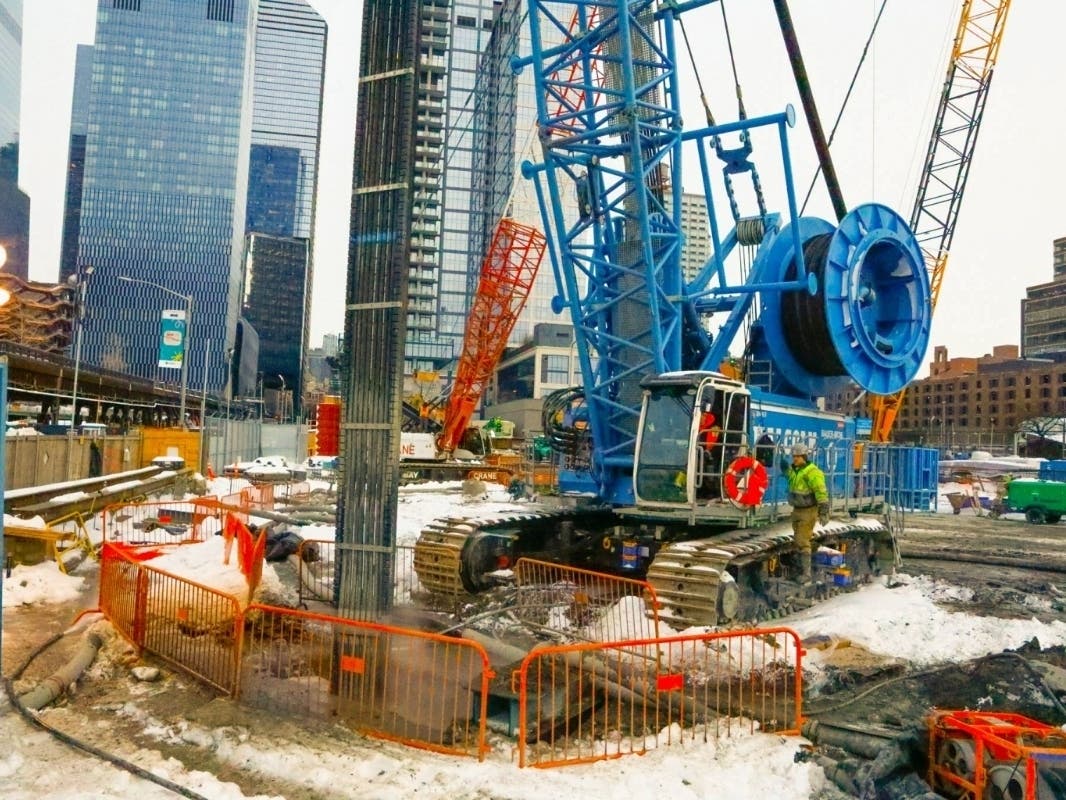
There are five sites in New York, New Jersey and in the Hudson River where Gateway tunnel work has started, Feb. 14, 2025. Credit: Alex Krales/THE CITY
Robert Sirois of Teamsters Union Local 282 said he wanted to “make it personal” for Trump while saying he remains “optimistic” that the project can be put back on track for laborers who would build Gateway.
“Leave the political stuff aside, look at the hardworking people that this project will affect,” he said. “Not only the commuters, but the people who will benefit from this project all around: thousands and thousands of men and women going to work every single day.”
Prendergast, a veteran transportation executive who previously led the MTA, New York City Transit and the Long Island Rail Road, said he remains optimistic about Gateway’s future.
“Where there’s a will, there’s a way and I’m confident we’ll come out on the other side, we’ll have the money and we’ll complete this program,” he said in response to a question from THE CITY.
This press release was produced by The City. The views expressed here are the author’s own.