Health & Fitness
Opioid Abuse Epidemic: Comparing New York in the USA, Looking at Rockland and Westchester
New state and national numbers from the Centers for Disease Control; plus data on Rockland and Westchester from a state senator


New York is part of the raging opioid epidemic sweeping the nation, leaving a sea of victims struggling with the insidious tentacles of addiction — and it's a scourge that's showing no signs of slowing down.
In 2015, New York's number of opioid overdose deaths was the fifth highest in the country, according to new national data that depicts an ongoing battle that claims victims across all socioeconomic and demographic lines.
All communities in New York have struggled with the raging crisis, including Rockland and Westchester counties.
Find out what's happening in New Cityfor free with the latest updates from Patch.
In June, 2016, a report found that overdoses related to heroin and opioids rose faster in New York State than in other areas in 2014, with the highest rate of heroin-related overdose deaths between 2009 and 2014 in Dutchess County.
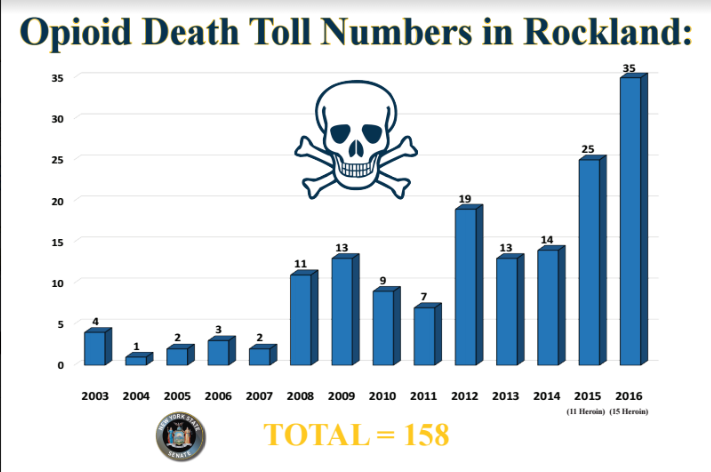
The yearly death tolls in both Rockland and Westchester have more than tripled since 2008.
Find out what's happening in New Cityfor free with the latest updates from Patch.
“Our community cannot allow this alarming trend to continue,” said State Senator David Carlucci.
National numbers recently released by the Centers for Disease Control give a picture of how New York State compares to other states struggling against the same deadly epidemic. The new numbers look at 2015, the most recent year for which full data is available.
According to the CDC, opioids — both prescription and illegal — were involved in 33,091 deaths in 2015, and opioid overdoses have quadrupled since 1999.
In New York, the number of drug overdose deaths in 2015 was 2,754, according to the CDC.
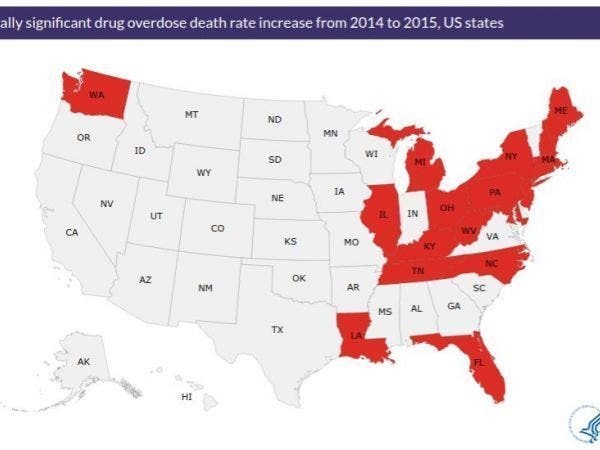
The CDC also reported that the statistically significant drug overdose death rate increase in New York indicated a 20.4 percent increase in 2015, compared to 2014.
Still, it was not the highest.
In 2015, the five states with the highest rates of death due to drug overdose were West Virginia (41.5 per 100,000), New Hampshire (34.3 per 100,000), Kentucky (29.9 per 100,000), Ohio (29.9 per 100,000) and Rhode Island (28.2 per 100,000).
In New York, in 2015, that rate was 13.6 per 100,000 people, according to the CDC.
New York was among the states with the most significant increases from 2014 to 2015. Those states were largely in the Northeast and South, according to the CDC.
Other states with statistically significant increases in drug overdose death rates from 2014 to 2015 included Connecticut, Florida, Illinois, Kentucky, Louisiana, Maine, Maryland, Massachusetts, Michigan, New Hampshire, New Jersey, North Carolina, Ohio, Pennsylvania, Rhode Island, Tennessee, Washington and West Virginia.
In Westchester County, there were 107 drug and drug-related deaths in 2015 compared to 72 in 2011 (in nearly every case, drugs were found in combination). Heroin/morphine deaths went from 29 to 57 and Fentanyl deaths went from 2 to 21, according to the county Medical Examiner's Annual Report.
In Rockland County, there were 35 opiod-related deaths in 2016, compared to 7 in 2011, Carlucci said.
Gov. Andrew Cuomo has embraced new weapons in the ongoing war against addiction, even creating a new statewide heroin task force in May, 2016.
Now Carlucci has introduced S377, a bill that will require chain pharmacies throughout New York to operate as drug disposal sites for unwanted drugs. He said he will also advocate during the current State budget season for an expansion of access to medication assisted treatment including buprenorphine, a drug that is used to treat opioid addiction in higher dosages.
Buprenorphine has traditionally been limited by the number of health providers who are registered to prescribe it, but recent federal legislation has authorized physician’s assistants and nurse practitioners to prescribe it. Under this effort, New York will seek to double the number of trainings in 2017 for health care practitioners to be able to utilize this tool.
“Making more drug disposal sites is a common-sense measure that will help prevent opioids from getting into the community in the first place," he said. "If we take proactive measures to control the flow of drugs and expand use of preventative medications, I am confident we can slow the tragic trend we have seen over recent years.”
Carlucci will also continue to provide periodic training sessions on administering Naloxone, the antidote to overdoses. The next training will take place at 7 PM April 27 in the Suffern Free Library.
Images courtesy of CDC
By Lisa Finn and Lanning Taliaferro
Get more local news delivered straight to your inbox. Sign up for free Patch newsletters and alerts.