Politics & Government
Rockland Rabbis Sue Cuomo, NY Over Red-Zone Coronavirus Rules
The suit alleges the 14-day restriction on houses of worship is anti-Semitic and unconstitutional.


ROCKLAND COUNTY, NY — Three Rockland County rabbis have asked a federal court to end Gov. Andrew Cuomo's coronavirus restrictions, arguing they violate religious constitutional rights and are "blatantly anti-Semitic."
The rabbis filed a lawsuit Wednesday and they're not the only ones suing.
The Roman Catholic Diocese of Brooklyn and Jewish nonprofit Agudath Israel of America filed lawsuits Oct. 8, arguing that the governor's limits on gatherings in houses of worships in certain Brooklyn and Queens neighborhoods seeing coronavirus spikes have violated their religious freedom. Last week, Agudath Israel, together with associated synagogues and rabbis, filed for injunctive relief in federal court seeking a temporary restraining order blocking restrictions on attendance at houses of worship, but the judge refused.
Find out what's happening in New Cityfor free with the latest updates from Patch.
Within the 7 square miles of Rockland County's high-risk, or "red," zone, there are 133 synagogues, 20 yeshivas, and 14 Jewish day schools, the lawsuit says.
The plaintiffs include two synagogues in Rockland's red zone and one in the yellow, or moderate-risk, zone, where restrictions were ordered Friday: Congregation Yesheos Yakov, through Rabbi Moshe Rosner, Congregation Oholei Shem D’Nitra, through Rabbi Samuel Teitelbaum, and Congregation Netzach Yisroel, through Rabbi Chaim Leibish Rottenberg.
Find out what's happening in New Cityfor free with the latest updates from Patch.
Congregation Yesheos Yakov and Congregation Netzach Yisroel are in Monsey; Congregation Oholei Shem D’Nitra is in Spring Valley. Monsey and Spring Valley are at the epicenter of Rockland County's surge in coronavirus cases, which went from 272 Sept. 16 to 1,500 before beginning to drop this week.
On Wednesday, the coronavirus positivity rate in the rest of New York was 0.99 percent, according to state data. Rockland County posted a positivity rate of 3.6 percent, with a red-zone rate of 8.4 percent. Most of Rockland County's 1,340 active cases were in Spring Valley (595) and Monsey (380).
In a news briefing Thursday morning, Cuomo said it was important not to treat the ultra-Orthodox Jewish community as monolithic. "The majority of ultra-Orthodox groups that I've been speaking with are cooperative," he said. "There are a relatively small number, loud but small, that are uncooperative and believe they should be exempt.
"What's complicating it is that they really have not ever followed any of these rules. I have had dozens and dozens of conversations. They never complied with any of the close-down rules going back to March. That's why some find this shocking, because they didn't follow any of the rules all along."
The Rockland rabbis said in their lawsuit that Cuomo's executive order targeted and was intended to restrict the rights and activities of specific minority religious communities during one of the most important religious holidays in their faith.
The executive order came after the High Holy Days of Rosh Hashanah and Yom Kippur but before Hoshana Rabbah, which is followed immediately in the Jewish calendar by the festival days of Shemini Atzeres, and Simchat Torah.
To the plaintiffs, the conduct of congregate worship is not nonessential; in the United States, it is constitutionally protected under the freedoms of religion, speech and assembly, they said.
They argued in the lawsuit that restrictions placed on houses of worship are more stringent than "those placed on 'so-called essential businesses.'"
They also noted houses of worship were constrained under the pandemic rules while mass demonstrations involving tens of thousands of people gained Cuomo's "endorsement."
The plaintiffs said the governor's conversation Oct. 6 with ultra-Orthodox leaders was taped. They said in that phone call Cuomo said the decision to restrict schools, businesses and mass gatherings in the six downstate micro-clusters of coronavirus cases was "not a highly nuanced, sophisticated response, this is a fear driven response" because the number of cases was rising sharply and "people" were demanding that everything be shut down. They said the governor went on to say, "Hopefully we get it under control in a few weeks, people take a deep breath, and then we can have a more intelligent, sophisticated policy."
In the suit, they said because the red-zone rules limit group worship to 10, and a prayer quorum — or minyan — in Judaism requires 10 male adults, women and children are prevented from communal worship.
They said the governor played into anti-Semitic tropes by drawing a border around a Jewish community and putting special restrictions on it, intimating that Jews spread disease.
The suit says the restrictions have caused considerable pain and frustration to all observant Jews, given their timing as well as the governor’s "express vitriol aimed at them as a religious and ethnic group," but particularly to Rabbi Rottenberg.
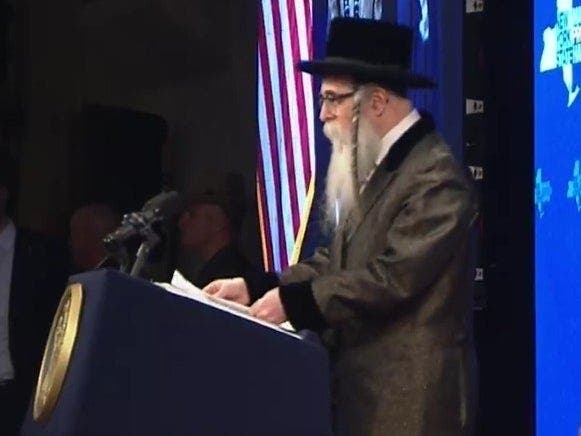
About 100 people were at the rabbi's home next door to Congregation Netzach Yisroel in Monsey on Dec. 28 when a man entered and attacked people with a machete. Five people were injured; one died. The governor visited the next day, invited Rabbi Rottenberg to give the invocation at his annual State of the State event in January, directed $720,000 to beef up security around the ultra-Orthodox communities in Rockland, and renamed his 2020 anti-domestic terrorism law after the victim.
Get more local news delivered straight to your inbox. Sign up for free Patch newsletters and alerts.


