Politics & Government
Task Force Working On Water Conservation In Rockland
Changes need to be made at the county, town, village, hamlet, planning board, business, school, college and home levels.


From the Rockland County Legislature
Rockland County is getting closer to a Water Conservation Plan, with a framework expected by June following a successful stakeholder workshop led by the county Water Task Force.
County Legislator Harriet Cornell, who chairs the Rockland County Water Task Force, said the goal in developing the plan is to identify cost-effective and meaningful conservation measures that can be implemented by the county, Rockland’s five towns and its villages. The measures must make sense for both residents and businesses.
Find out what's happening in New Cityfor free with the latest updates from Patch.
“We have learned that if we truly want to avoid or at least significantly postpone the need for new water sources that would come at extreme cost, we can’t close our eyes to reality.” Legislator Cornell said. “Awareness has brought us here as we seek solutions that come at a significantly lower cost and translate into cost avoidance.”
Margie Turrin, who chairs the Water Task Force’s Conservation Committee, said all the experts the Task Force has interacted with have agreed on a key approach.
Find out what's happening in New Cityfor free with the latest updates from Patch.
“Conservation is the most important tool to ensuring our long-term water supply,” Turrin said. “It’s the least expensive alternative. It’s the least energy intensive alternative and it has the lowest impact on the environment.”
Turrin is also Director of Educational Field Programs for Lamont-Doherty Earth Observatory of Columbia University.
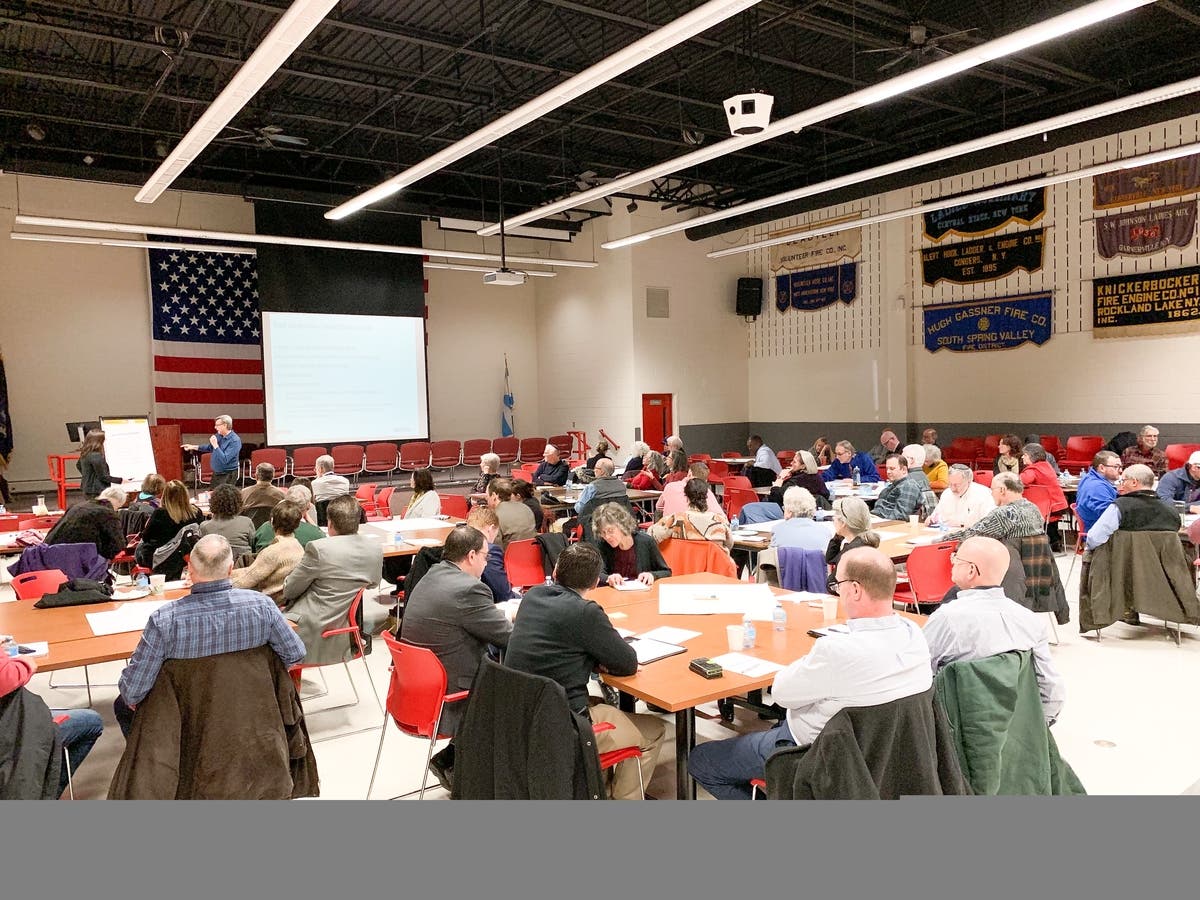
Cornell and Turrin both offered remarks last week at a Water Task Force workshop that brought about 100 participants to the county Fire Training Center to offer their thoughts on the steps that might be taken to make significant strides in water conservation efforts.
Representatives of the Manhattan-based company, Jacobs Civil Consultants, Inc., the consultants hired by the county to help develop a water conservation plan, will continue to accept suggestions from participants and interested community members.
By June, it is expected that the company will provide 1- to 2-page summaries for up to 20 water-demand reduction strategies, including the steps municipalities would need to take to implement a particular strategy.
A draft comprehensive water conservation plan, followed by a final water conservation plan will then be created, with public meetings held to obtain input from residents, businesses, municipalities and others.
Jacobs’ presenters Kara Pho, a project manager and water resources engineer, and Susan Butler, a senior technologist professional for integrated water resource management, pointed out that the final decisions on which strategies to employ will revolve around the amount of water targeted for conservation. The strategies Jacobs will submit will include measures that can lead to water-use reduction through at least 2050.
Legislator Cornell said our area typically gets excessive water runoff and usually gets plentiful rain.
“Some may wonder why conservation is important here,” Legislator Cornell said. “The reason is that Rockland is somewhat unique in that our water comes mostly from within our own borders. That recognition helped to generate a $250,000 grant in the New York State budget to do this planning process and its initial implementation.”
Turrin pointed out two key take-aways from a study done by USGS Scientist Paul Heisig.
One, due to the design of Rockland’s sewer systems, more than 1.4 billion gallons of water end up in the Hudson River each year versus being returned to the groundwater system to recharge our aquifers. This situation involves planning issues that can be reviewed and tackled at the various levels of government, Turrin said.
Two, Rockland needs to manage its water, especially its peak summer usage. Turrin said summer should be thought of as an “opportunity zone” for better water management during those hot months.
“There are changes that need to be made at the county level, the town level, the village, the hamlets, the planning boards, the universities and colleges, the businesses and in our residences,” Turrin said. “Every part of this has to be really thought out carefully. How can we all make changes and how can we work together to bring things forward? Each of us is part of the solution and I think that’s a very powerful place to be.”
Get more local news delivered straight to your inbox. Sign up for free Patch newsletters and alerts.