Community Corner
4 Years After Brother's Heroin Overdose, Laurel Man Inspires Hope with First Narcan Training
Laurel's Paul Maffetone is on a mission to save others from the horrors of heroin addiction.



Next Thursday will mark four years since the devastating night when Laurel resident Paul Maffetone’s brother died at 29 of a heroin overdose in their family’s home.
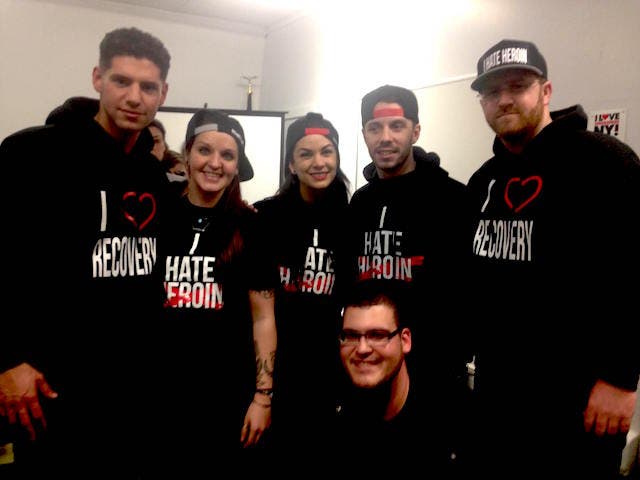
Four years later, and Maffetone has turned tragedy into a joyful mission, creating an enduring legacy and tribute to his brother with the launch of Michael’s Hope, a group founded to help raise awareness, promote education, shatter the lingering stigma associated with heroin addiction — and save lives.
On Wednesday, Michael’s Hope officially became a 501c3 not-for-profit organization.
Find out what's happening in North Forkfor free with the latest updates from Patch.
And on Thursday night, Maffetone and his Michael’s Hope team, including Trevor Murray and Jordan Stierle of Coram, Kristina Amato of Commack, Samantha Paulus of Port Jefferson, and Matt Liquori of Riverhead hosted their first-ever Narcan training session to a packed house, with more than 100 in attendance.
The presentation took place in conjunction with the Mattituck Fire Department and was held at the American Legion; Robert Delagi, Suffolk County Department of Health EMS Coordinator, gave the Narcan training to a standing room only crowd.
Find out what's happening in North Forkfor free with the latest updates from Patch.
An EMT in the audience before the presentation described the escalating problem in Riverhead. Last year, he said, there were 70 to 80 overdoses in the Riverhead area alone. One woman, he said, watched her friend OD one night, and overdosed herself the next.
One Southold man in recovery said he had been sober for nine months. He said the problem often lies in the fact that addicts want the heroin “that makes you OD.” Dealers cut heroin with fentanyl, and it has great appeal. “They want what kills you,” he said.
Both men said Riverhead is a “hub” for heroin, with dealers selling the drug on both the South Fork and in Southold Town. “It’s everywhere,” they agreed.
And that’s exactly why Maffetone said his mission is so urgent. When he lost his brother, he said, “I realized I was alone. I felt that no one else suffered what my family suffered.”
Setting out to shatter the stigma, Maffetone decided to make a change.
His life-altering journey all started with the Michael’s Hope Facebook page, and quickly gained tremendous momentum, as scores of supporters donned “I Hate Heroin” hats and bracelets and began spreading the word on social media.
“We decided to take it to the next level,” addressing students at schools and giving community Narcan trainings, Maffetone said.
Trevor Murray, a member of the team, shared his personal journey, and the tremendous new life he celebrates after recovery.
”I used to be the biggest liability in people’s lives.” Now, he’s fully engaged in giving back to his family and those who used to suffer from his actions, he said.
Murray, who said he used to “lie, cheat, steal and manipulate,” described the dark years. Having been brought up in a Manorville home surrounded by love, he attended Westhampton Beach High School, played sports —and began using drugs and drinking in tenth grade.
Soon, his grades began to slip and he began falling asleep in class, barely graduating.
Taking a year off from school, he soon began hanging out with the wrong crowd, getting into trouble with the law, and disappointing the ones he loved.
The first time he stole $100 from his mother’s purse, he felt guilt when his mom, unsuspecting, called him to say she couldn’t find the money. “She was so trusting,” he said.
But that didn’t stop him from doing it again, Murray said.
Eventually, people started seeing him as a “liar, manipulator and a thief — and it began to weigh heavily, because I really did have a conscience,” he said.
Turning from cocaine to opiates “brought me to my knees,” he said. Soon, Murray began mixing drugs and his self-loathing escalated.
“I used to bypass the mirror because I couldn’t look at myself. I used to brush my teeth in the shower so I wouldn’t have to look in the mirror. I was disgusted.”
Soon, he’d lost his job, his girlfriend, and his friends.
When he finally got sentenced to rehab, Murray cried, from the relief of finally knowing no drug dealer would be knocking at the door looking for money, knowing his mother wouldn’t discover yet another piece of missing jewelry, he said.
After rehab, “I made it my mission to take my story and use it for good,” he said.
Jordan Stierle, who was saved by Narcan, shared the story of the night he almost died.
“I woke up in a mall in a parking lot a mile away from where i did that bag of dope,” he said. “When I woke up I was mad at the guy, the EMT,” he said. “The reason I was mad was because I didn’t know if I wanted to be here anymore. I used to drive to Queens, close my eyes, and see how high I could count,” waiting to see if he’d die trying.
Today, he hopes to be a role model for others struggling as he once had.
Samantha Paulus, another member of the Michael’s Hope team, said she grew up saying she’d never do drugs. Once struggling with addiction, she was scared to tell anyone because of the stigma — and that’s her goal today, to help others who might be afraid to ask for help.
Narcan Training
Delagi, from the Suffolk County healh department, spoke from the heart about his work.
“My motto is ‘One life at a time,’” he said.
He gave an overview of how to use Narcan, and spoke to those who criticize the use of Narcan, claiming it makes addicts more apt to use drugs, knowing they can be saved.
“People still take a dim view, saying that you are enabling people to use drugs by telling them you have the magic bullet. They think they can engage in risky behavior because you’re carrying the antidote. But in the public health world, we look at it as harm reduction strategy.” Their aim is to reduce the number of lives lost, he said.
Narcan, or naloxone, he said, was once injected by needle but is now administered in a victim’s nose.
While in the past only paramedics could administer the Naran, today, every EMT, police department and ambulance is equipped; Narcan is now also sold over the counter, he said.
In 2015, Narcan was administered 536 times in Suffolk County. “That’s a lot of reversals,” he said.
Despite the fact that deaths from opioids continue to rise, Delagi said, “It almost feels like we’re not making a difference but that doesn’t deter us. We’re still saving one life at a time.”
In addition the goal is to follow up with those saved, and help them find recovery programs. “We just don’t want to drop you off at the door.”
Discussing legislation on the state level, Delagi said a new law is aimed at those witnessing an overdose. Good Samaritans who see a person in crisis can call 911 without fear of arrest, as long as there are no weapons present or drugs for sale. Those using recreationally will not be arrested, Delagi said. “We think that’s huge.”
Next, Delagi showed each piece of the Narcan kit and explained how to use it.
He described how a person overdoses, when opioids bind to receptor sites on the brain that stimulate the neurotransmitters that control breathing. With opioids on the receptor sites, the neurotransmitters don’t work, so a person cannot breathe, and the respiratory rate slows, he said.
As respiration starts to decrease, oxygen levels decrease and carbon dioxide levels spike, leading to a loss of consciousness and death.
When Narcan is injected, it gets quickly into circulation, ”prying” the opioids off the receptor sites and allowing the person to breathe.
Delagi also explained that overdoses normally take place in experienced users and progress over a period of one to two hours.
Those witnessing an overdose can take life-saving action, he said. Narcan only works on opioids, he said, but has no harmful effects if used on a person who has been using other drugs.
Signs of overdose include slowed or shallow breathing, a heavy head nod, not responsive to stimulation, bilateral constricted pupils, and bluish nail beds or lips.
Those trying to help should yell the person’s name, shake the person or do a sternal rub, but not try to walk them around or put them in a shower or ice bath, Delagi said.
A call to 911 is critical and if a person has to leave the room to call, the victim should be placed in the recovery position on their side so they don’t choke on their vomit. Heads should be tilted back before administering the Narcan, he said.
He then demonstrated how to assemble the Narcan dose and said, after a save, rescuers should stay with victim until an ambulance arrives, assuring them that withdrawal symptoms will decrease and encouraging them to go to a hospital.
Each participant was given a Narcan kit and certification.
A second Narcan training session has been added: Michael’s Hope will give a presentation and free Narcan training on March 31 from 5:30 p.m. to 7:30 p.m. at the Old Schoolhouse on Front Street in Greenport.
Get more local news delivered straight to your inbox. Sign up for free Patch newsletters and alerts.