Politics & Government
After Huge Public Outcry Board Withdraws Winery Code Changes
Scores of speakers pleaded with the Southold board to withdraw legislation they say would damage farming on the North Fork forever.


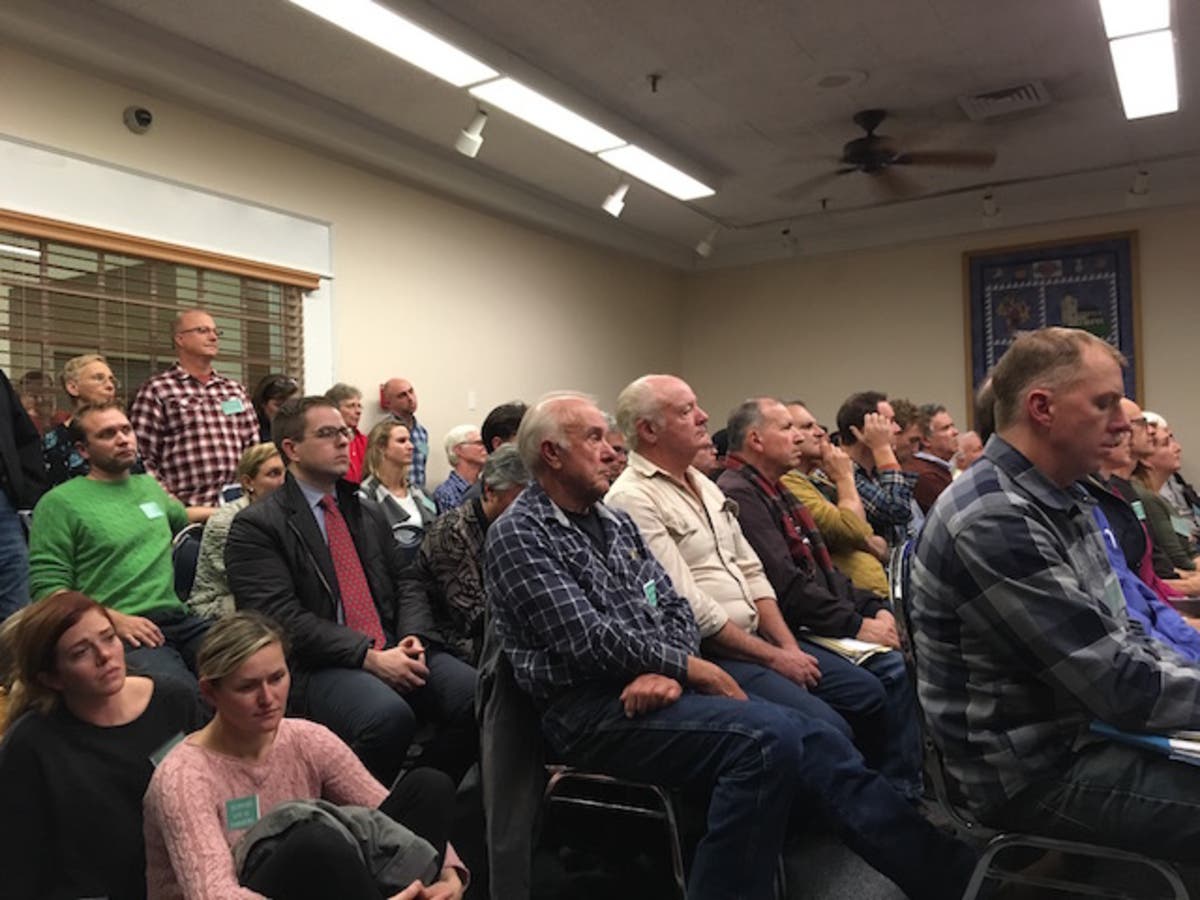
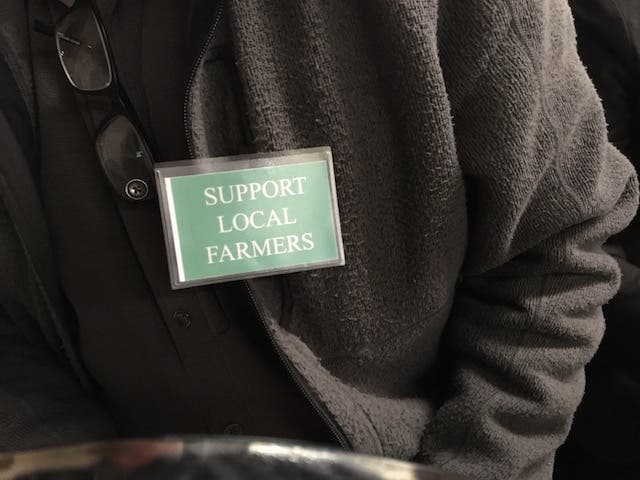
SOUTHOLD, NY — A standing room only crowd of residents and representatives of the North Fork winery and farming communities turned out Tuesday night, sitting on the floor of the Southold Town Hall meeting room and wearing buttons that said "Support Local Farmers" as, one by one, scores headed in solidarity to the podium to unanimously express outrage and dismay at proposed code changes they say would shatter the farming industry in Southold forever.
And, after 5 hours of heated testimony from the public, the Southold Town board voted unanimously to withdraw the legislation.
The public hearing Tuesday night focused on proposed amendments to the town code's Chapter 280, zoning, in connection with use regulations for wineries in residential districts. Proposed changes included that wineries would be a place or premises on which wine is produced, processed and sold. The wine was to be made from grapes of which at least 80% were grown on the premises or other land owned by the winery owner. The 10 acres devoted to growing grapes would be in addition to any land where structures were to be built and should not be included in calculations as the whether the lot size conforms to the bulk schedule for the proposed use or uses on the parcel, the legislation read; in addition, winery structures would need to be set back a minimum of 100 feet from a major road and wineries would need to obtain site plan approval, according to the proposed changes.
Find out what's happening in North Forkfor free with the latest updates from Patch.
Steve Mudd of Mudd Vineyard in Southold was the first of a long line of speakers who stood strong in opposition, with not a single voice expressing support for the proposed legislation.
Southold Town Supervisor Scott Russell said he wanted to clear up misunderstandings; he also spoke out earlier in the week on misconceptions. The current code, he said, already requires 10 acres for wineries with 2 acres for a winery building.
Find out what's happening in North Forkfor free with the latest updates from Patch.
What the legislation aimed to do was to ensure that grapes were actually being grown at the sites, Russell said. When the town board passed changes to agricultural definitions in May, the agricultural advisory committee, he said, urged the board to adopt the changes and later, work out the "glitches."
As for the proposed change that 80% of grapes would need to be grown on site, Russell said the number was one that had been agreed upon at an earlier meeting of industry representatives; he added that the number kept changing, according to members of the wine and ag community.
Russell also said it was critical to note that not one existing winery, or one in the pipeline, would be affected by the proposed legislation.
And, he said, "If you're going to buy grapes and want to open a winery, a commercial area would work until you can get yourself to the position where you can meet the criteria of the code."
But all who spoke out said the proposed changes would effectively alter the face of farming on the North Fork forever and strangle future generations of new, young farmers who would never be able to put down roots in the industry if they were forced to buy prohibitively expensive farmland first and not rent or lease the land while building their fledgling business.
"The proposed new code is 100% anti-farming, 100%," Mudd said, to loud applause. "I am requesting that this gets voted down tonight by all of you. Please, let's go back to the table and regroup."
Louisa Hargrave, a pioneer in the North Fork wine industry and a member of the town's alcohol farm products working group, asked where the proposed changes to town code had originated. She said, of a code committee meeting in question, that she had been told there was nothing to be discussed that concerned the wine or farming community, so she didn't attend, only to find out on Nov. 8, after Election Day, that the town board had voted to schedule the hearing. Russell said an email had been sent; Hargrave maintained the group didn't know about the proposed code changes until Nov. 29.
"This language does not reflect the work of our group. Are you aware of that?" she asked the town board. Years ago, she added, she did advocate for a required 10 acres for a vineyard. "Today, I feel that legislating the minimum for farmers is like making new clothes for a dinosaur," she said. "I know it's in the code — but we can change the code. We don't farm the same way now."
Requiring a minimum of 10 acres means that anyone who wants a winery will be forced to spend an exorbitant sum of money, a minimum of $5 million, meaning unintended consequences could ensure. "They will have to depend on special events and weddings for their business model," she said.
Hargrave said she agreed with Russell, that an individual should be required to plant grapes to operate a winery, "but it needs to be more flexible," with options such as micro wineries on the table. In Europe, Hargrave said, such wineries have small reception areas the size of a farmstand or smaller, and are open by appointment, especially on weekends. "This gives existing farmers the option to diversify into wine and young farmers, the chance to develop with a focus on quality," she said.
She also asked why someone couldn't buy an existing farm and adapt rather than buying a new building.
Of the 80% mandate, she said, "Our group didn't discuss or advocate this. It would end 40 years of Southold as a farm wine region."
During her own years of owning the winery, Hargrave said between 1989 and 1999, more than half the grapes came from a farm leased in Mattituck because grapes they planted initially had disease and viruses — weather, disease and unpredictable factors such as hurricane can level a year's crop, all agreed.
"This 80% would have put us out of business right away," Hargrave said.
The goal, all agreed, was to look to the future of farming on the North Fork, not just protect what exists today, but to preserve the area's legacy for generations of young farmers to come.
Hargrave said if the board was not careful, that whole industry could be forever altered — a group of venture capitalists has purchased a large amount of acreage and is "looking to plant marijuana," she said; town board members confirmed they'd heard about that development.
"You need to decide what this place will look like" in the future, Hargrave said. "Do you want Burgundy, Baldwin — or a tangle of barbed wire?"
Russell said he'd discussed the idea with Hargrave of looking at smaller boutique winery concepts, culling out the smaller businesses.
Hargrave countered that the code as written didn't even include tasting rooms as an accessory use.
"We, as a farm alcohol working group, we didn't even know about this, it wasn't a collaborative effort," she said, despite volunteers devoting hours to discussing the issues.
Russell said he'd met with a group of representatives who supported the 10 and 2 acre concept.
"This is not one and done," Councilwoman Jill Doherty said, adding that the intent was to clarify language so all were on the same page and then move on and make changes so a final product worked for all.
Rob Carpenter, administrative director of the Long Island Farm Bureau, said farming in Southold Town has been an integral part of its 377 year history. Farming, he said, gives Southold its rural character and has made it a unique place to work and play.
Farmers, he said, are "heroes, much like policemen, firemen and teachers. They feed us, provide food and sustenance for us to live."
Farmers have a lot at stake, Carpenter said, and turned out Tuesday with " concerns and dismay."
'The farming community will no longer be denied a voice in matters affecting our industry."
With more than 9,600 acres in production, farming comprises 30% of the land base in Southold Town, Carpenter said. "How are you protecting them with this proposed code? Very few young farmers can pay $1 million to do what's necessary to start a new farm. Who are you helping to become the next Hargraves?"
He added that many in the ag industry had never been brought into the discussion.
"Our vote was not widely heard or engaged in this process," Carpenter said. 'The farming community will no longer be denied a voice in matters affecting our industry."
With the proposed legislation, the town board "has awakened a sleeping giant," Carpenter. "We will no longer stand for being pushed around, being intimidated. We are a force to be reckoned with. We are watching, and watching closely."
That said, he and others all agreed they were willing to sit down with the town and work together on legislation that works for all.
Russell said no one spoke out against the definitions adopted — and he'd heard a variety of numbers suggested, besides the 80%. "You can't keep moving the goal post," he said.
Russell said the town's farm alcohol products working group was told to bring in whoever was needed; he also said he met with the LIFB and gave them pages of bullet points before bringing the idea forward.
"We did what we were asked to do, which was to adopt the definitions even though we knew it was flawed and stringent," Russell said.
Carpenter then said many farmers feel intimidated. "People have told me they are afraid to speak out for fear of repercussion," he said. "They are afraid if they decide to put a proposal in to the zoning board of appeals or planning board, their application will be delayed, denied, or not moved forward. I don't have facts to substantiate it, but the fear is there. People shouldn't be afraid to speak out."
Later in the meeting, Russell said he found Carpenter’s mention of "retribution insults the integrity and professionalism of everybody that works for the town, which is abhorrent."
Chris Baiz, vineyard owner and chair of the Southold Town agricultural advisory committee, said for agriculture to survive in an area with the highest priced farmland in the country, value added products are critical. The goal is to keep 10,000 acres in farmland for the next generations, he said.
"The ag advisory committee does not support legislation as currently written," he said.
One fear, he said, is that the 80/20 mandate would become the standard for all agricultural operations.
Baiz and others discussed a community and culture on the North Fork where farmers barter and trade, collaborate, swapping sweet corn for tomatoes so that all prosper.
Baiz said while he doesn't know what the right number would be, he suggested a broader two thirds, for the definition. He suggested the town board keep working on the code.
Adam Suprenant, co-owner of Coffee Pot Cellars, speaking as a private citizen and business owner, said he never attended a meeting where the 80/20 percentage was discussed.
"The amount of changes that Gov. Cuomo has put through Albany has transformed our industry and made it possible for a small operator like myself to buy a few tons of grapes and open a storefront in a commercial zoning where retail is allowed, make friends and build my brand," he said.
While his dream as a winemaker would be to his own his own vineyard, he said, crop failure due to weather and other issues could mean some lean years.
Courtney Shaudel read a letter from her father, chef Tom Schaudel, stating how the wine industry was important to local businesses including restaurants, and critical to keeping the bucolic nature of the area intact.
Without the wide open spaces and farmland, the area could become like "Levittown," he wrote. "If you kill off the golden egg the dominoes will fall."
Young farmers filed to the podium and said if the legislation was enacted, they would be forced to close up shop.
"Farms will soon fade from the horizon," one said.
Russell Hearn of the Premium Wine Group said Southold Town has long been a proponent of agriculture, urging on its website for individuals to "grow local, buy local."
Buying grapes has traditionally allowed new winery owners to jump start their businesses while waiting for their own vines to take root. Paying a huge capital investment at the outset would not allow for that, he said.
The number one driver of bottle price, he said, is its appellation, or a legally defined geographical indicator used to identify where the grapes were grown.
He then said there was one winery in Southold with 26 acres of its own fruit that hadn't bought a grape in more than 20 years. "That winery was Vineyard 48," he said.
Russell reminded again that every winery currently existing in Southold Town was compliant; there was no impact on existing operations.
"What you're facing here tonight is fear," said Mattituck farmer Doug Cooper."Fear on your part because of changes taking place. Fear on our part of not being allowed to have the changes we need. Let's try to get beyond that fear."
There's no need to require 10 acres of purchased land when it can be rented more efficiently, he said.
"Our family land has been farmed for more than 200 years. The one constant in agriculture is change," Cooper said. "That's what we have to embrace, the ability to have change and deal with it."
Other said they were fearful that if the changes were adopted they could be adopted across the board in the ag industry.
Russell said the ag industry is regulated more heavily; the farmstand code is far stricter, he said.
Duncan Kennedy of Jamesport and others discussed how critical the winery industry is to Long Island tourism.
Robert Van Bourgondien and others in his family said young people are the future of Southold Town.
He asked what would happen if someone wanted 10 acres of grapes and one of blueberries; Russell said after the 10 acres a farmer could plant whatever he wanted.
Attorney Gail Wickham pointed out that the ownership restrictions had people in a "tailspin. Farmers don't operate that way. They own land but often buy product, lease it, custom crush, so we don't have to build a huge winery. Patterns change every year depending on weather and marketing. so the 80% ownership requirement is crushing," she said. "This is not Southold Town friendly. Farming has softened the blow of us becoming mediocre suburbia. We need to focus on how agriculture can be more sustainable for existing and new farms and let that create open space."
Kathleen Sepenoski of Sep's Farm said she had a "constitutional right to speak without fear of retaliation." She read a lengthy testimony, painting a picture of years of farming on the North Fork, on a place where her grandparents instilled deep roots and her children want to come home to thrive and continue the tradition.
"Respect the land. Be a steward for the next generation and preserve history," she said. "The legislation you proposed will forever alter this community negatively. Be innovative, not legislative."
Councilman Jim Dinizio said the town's focus was on zoning, while those present were concerned were farming.
"I'm glad we're talking about farming instead of homes," he said, adding that the issue is that he does not want to see a business owner buy a small parcel and then proceed to host weddings; 10 acres, he said, would be the minimum for "goodies" such as special events. He said he believes in allowing farming to prosper but does not want to hear music in a residential neighborhood at 11:30 at night.
Winemaker Anthony Nappa pointed out the industry coming out to defend one another.
The legislation as it stood, he said, "would shut down farming in this town." He suggested perhaps regulating size without regulating farming.
Russell said the board would be willing to scale a winery to size of production and that the concept was a "good start."
And, Nappa said, even if farms today are protected, "We care about the future of farming, not just today."
He pointed to the business model of Chobani yogurt, which has become a national success and said that possibility would be impossible in Southold under the proposed code.
"We are the public," he said. "We are your constituents. We all live here. This is our community. These are our neighbors."
Nappa, who has two small children, said the future is relevant. He added that he, too, wanted to extend the olive branch and collaborate with the town.
Russell said again that the changes did not preclude anyone from buying grapes, it only applied to doing so on a farm; commercial zoning would be appropriate, he said. "I don't think asking a winery owner to grow grapes is onerous."
Tom Stevenson of Orient, who served for 5 years on the town's ag advisory committee, said the title of the legislation was problematic; he believes the agricultural conservation or AC zone should not be looked at as residential. Houses, he said, are encroaching on farmland, not the other way around.
Jim Glover of Cutchogue said he started his nursery on 2.5 acres of rented land, where he stayed for 8 years, built equity and eventually purchased property. Ownership, he said, should not be an issue.
Robert Dunn of Peconic said the issue had been discussed for months and many in attendance might do well to attend town board meetings regularly. "Nothing was done in secrecy," he said. "It doesn't have to get to this, pushed on you without your knowledge."
Sal Diliberto, former president of the Long Island Wine Council, said the farm alcohol products committee didn't see the proposed changes until Nov. 29 and said it was important that industry representatives be notified first, so the ideas could be discussed beforehand.
Louise Harrison of Peconic spoke with passion about how she felt "dismayed by the disrespect shown by some" of the town officials. "No matter how strongly you feel it's inappropriate to argue with the speakers."
Giovanni Borghese of Borghese Vineyards thanked Russell for all his help in the past and his open door policy.
He asked if Southold wanted to be a part of stopping a young farmer who might be on the brink of creating a national brand.
Russell said all that was intended was for someone to plant grapes; a potential applicant would like a 4,000 square foot winery but only planned to plant 4 to 5 acres of grapes, with the rest privet hedges. "Should we allow someone to build a 4,000 square foot winery who hasn't shown a commitment to planting grapes?" he asked.
The audience said it was expensive to plant grapes and maybe the intent was to plant them as the individual built up the business.
Russell said other established winery owners are mentioning unfair competition; they have 30 acres and are paying $5,000 an acre per year to maintain a winery while others were opening without making the same commitment.
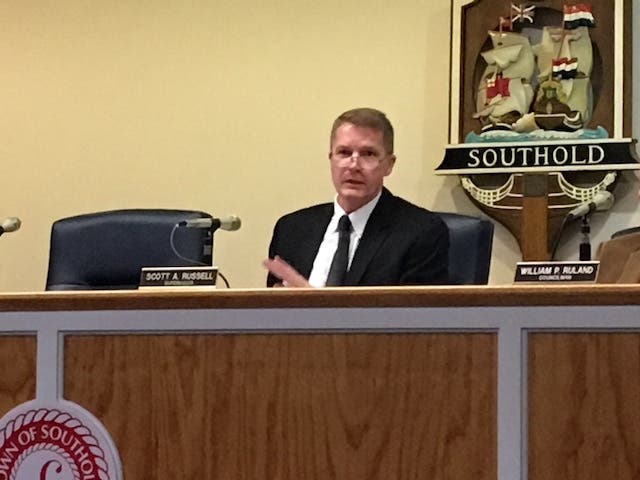
And, he said, the concerns of neighbors concerned about the burgeoning winery industry also needed to be considered. "The community matters, too," Russell said.
Alie Shaper, who operates the wine-tasting room Peconic Cellar Door in Peconic, spoke out on Facebook before the hearing and spoke.
"My whole life depends upon wine," she said, adding that she started her business with $50,000, 500 cases of wine and all purchased grapes. One day, she added, she would like her own winery.
"If this code passes tomorrow I am disqualified because I don't have $1.2 million," she said. "I won't be able to eat. My stepchildren won't be able to visit. I'll probably have to leave the country to find work."
After the hours of testimony, Councilman Bill Ruland, a farmer himself all his life, said based on the "overwhelming comments, while the idea of this may not be ill conceived" the issues need to be revisited.
He agreed that he'd vote to withdraw the resolution. "We need to go back to the drawing board," he said, urging that it be done soon so the process keeps moving.
Councilman Bob Ghosio said change is constant in all businesses and all have obstacles. In addition, he said, "There is a contingent that is worried about the unbridled growth of this particular industry. That's the driving force in our acknowledging the issues, where this comes from, not a nefarious place where any one of us is anti-winery," he said.
However, he said, he wasn't sure the exact code would be appropriate and said work needed to be done.
Councilwoman Jill Doherty said the outcry showed "we failed in writing this code. I, for one, do not want to tell you how to farm. We're here to administer zoning and make sure it gets done properly," she said.
She added that the goal was to avoid another Vineyard 48. "We don't want someone to come in, throw money, and have weddings and events, after all the work you have done. We are trying to protect the farming way of life out here. But a few bad apples can ruin it for everyone." She added, "We need to formulate trust."
Russell said he understood the apprehension and opposition. He said he's already stated the idea of revisiting the 80/20 processing proposal. "But if some of you expect me to say you shouldn't have to process anything..I'm not your guy." He added, "I'm not willing to budge on the 10 acres," but said he would discuss small boutique wineries.
Dinizo pointed out the egregious offenses the town suffered due to Vineyard 48 but said he'd be available to hear what industry representatives needed.
The board voted unanimously to withdraw the resolution; Justice Louisa Evans was absent.
Patch photos by Lisa Finn.
Get more local news delivered straight to your inbox. Sign up for free Patch newsletters and alerts.