Community Corner
Community Comes Together To Protect Kids From Violence
"I don't want to see another kid injured or hurt." What do you think can be done to protect kids from violence or drugs in the community?


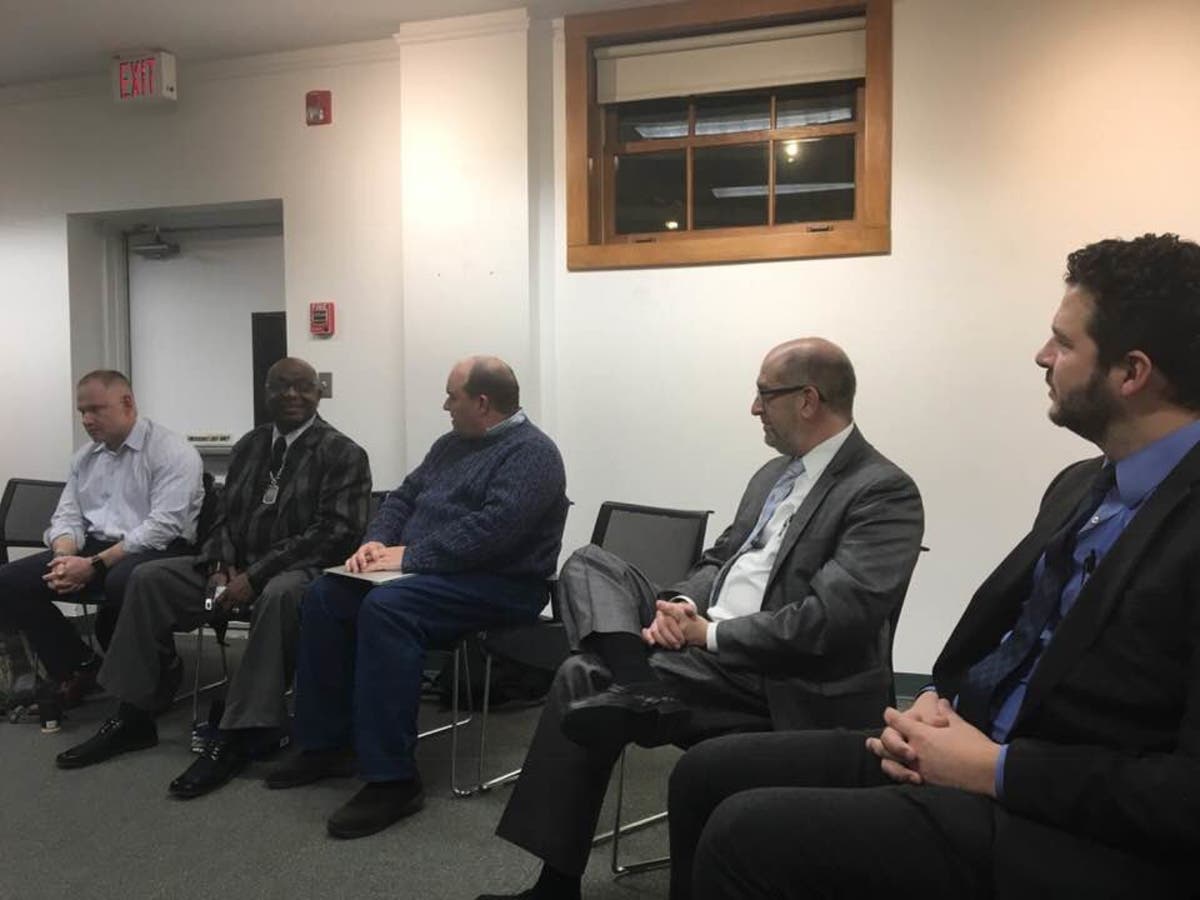
GREENPORT, NY — If it takes a village to raise a child, then the Village of Greenport is coming together in a big way to keep all children and teens safe from violence.
A "Community Discussion On Drugs, Violence — And Our Kids," was held Monday at Floyd Memorial Library, and was organized by Greenport Village Trustee Doug Roberts.
"As a dad and concerned neighbor, I am hoping to bring together Greenporters to engage in dialogue about how we can protect our young people from violence in the wake of recent events," Roberts said.
Find out what's happening in North Forkfor free with the latest updates from Patch.
Roberts reached out to James Banks, aka "Dr. Love," Suffolk County Community College's coordinator of multi-cultural affairs, to help kick off the discussion.
Greenport Village Trustee Jack Martilotta, former Village Trustee Val Shelby, Greenport School Superintendent David Gamberg, Greenport Junior/Senior High School Principal Gary Kalish and Pastor Natalie Wimberly of the Clinton Memorial AME Zion Church were among those in attendance.
Find out what's happening in North Forkfor free with the latest updates from Patch.
"I just want to create a safe space for us to discuss this issue as neighbors, so our young people know there are a bunch of people here who care about them — people they can turn to if they are heading down a path that could lead to the next violent attack in our community," Roberts said.
"Whispering and gossiping isn't going to solve problems, but dialogue might. Twice in the last year Greenport has woken up to police tape around a home in our community. That's two times too many."
At the meeting, Roberts said he was hoping to bring together adults, educators, spiritual leaders and others who care about kids to brainstorm solutions. "I wonder if there is something we can do to help our young folks know that there are other ways to connect, ways to find help, if you find yourself going down a path that could end up with you on the other side of a weapon," Roberts said.
Banks began by saying he had statistics about gun violence; Shelby asked if the group would talk about gun control and said illegal guns should be addressed.
Ashley Price, who sees patients at an outpatient facility in Riverhead, said as a professional, she encounters challenges with teens and young people who may have been arrested on gun or drug charges and ask why they have to undergo drug and alcohol treatment; marijuana, for many, she said, is not considered "a big deal."
Her goal in attending the meeting, she said, was to understand how children — and adults — can be educated.
Shelby said there's been a shift in drug dealing over the years. "I never did drugs. But what I find is, years ago, a dealer wouldn't mess with children. There was a code of honor. Now, there is no honor. They will sell to whatever kid has money."
Banks agreed that kids are targeted both by drug dealers and by those selling vaping products, among other issues.
One resident asked why no young people were present; Banks said that should be a strategy and a goal.
Roberts said he and many parents feel safe in Greenport, walking around town. Greenport, he said, is a place where kids look after one another and parents at the park watch out for one another's kids, as well.
However, he said it was fairly well known to most residents who the drug dealers were in the community; Wimberly said she had no clue.
Banks said he imagined the same was true about weapons, with no one really knowing who owned guns. He added that crime tended to be moving "eastward on Long Island."
"We're not immune," Shelby agreed.
Others said suicide, with guns, has been an issue in Greenport over the years, in instances where untreated drug abuse, alcoholism and depression "led to desperation and suicide."
"Violence does infect, and affect, everyone," Banks said. He added that in social work, field research includes determining if individuals have developed adequate social skills; many who are depressed or suffer from anxiety anesthetize with drugs or alcohol.
Gamberg said another critical concern was, with the advent of cyber technology, that issues are amplified and educators and parents have lost control in many instances. In past days, families went to church; there were only two choices in sneakers and no smart phones. He added that he wrote an article about civility in schools and said in the district, every week, students participate in an exercise where they thank one another, apologize for anything they've done wrong, and compliment one another, with a goal of building a sense of communication.
"This doesn't happen around the dinner table anymore," Gamberg said. "Teaching that sense of care and respect, with genuine, heartfelt, honest, eye-to-eye giving of compliments, regrets and apology."
Banks said similar exchanges can happen during family meetings.
Price asked if young people are educated in school health class about signs of depression and drug prevention awareness.
New York State has a mental health curriculum, Gamberg said; Banks added that Suffolk County has agencies that will come in to help. Mary Roberts, who teaches in the Mattituck-Cutchogue School District, said there's a student-led presentation in health classes.
Greenport Village Trustee Jack Martilotta, who is also a football coach in Greenport, said "none of the bad practices were taught in school." What worries him, he said, is the fact that, with many parents working after school, there is a window of "unstructured and unsupervised time" during what can be deemed "dangerous years."
When he was growing up, kids went to the Y or to sports practice up until dinner time. In Greenport, he said, there are kids sometimes seen riding bikes after school. "I'm not questioning anyone's parenting but there are kids who are unsupervised," he said. He added that as a football coach, "I guarantee that if you give me your kid for the season, that kid will sleep very well at night."
However, with just 10 to 15 kids each signed up to play boys or girls basketball, that leaves "three quarters of the kids doing something else," he said.
Shelby said a youth recreation center would be an answer; Martilotta said the cost, close to $20 million, was prohibitive.
"I don't have the answer," Martilotta said. "I've been wracking my brain for years."
"Even if we had a place where a large group of kids could go . . . ." Roberts said. He mentioned the roller skating rink at the American Legion.
Banks said it was important to determine kids' interests and said colleges are starting, for example, to develop curriculum around gaming, to develop programs students will respond to because they are interested.
Wimberly said kids in her church are honest about what they want and need.
"But they are fickle," Shelby said.
Roberts said he'd tried to start a youth soccer league but wasn't able to get kids to sign up.
Shelby said there had been a teen center in Greenport when she was young, with guest speakers on important topics, field trips, and activities.
"If the parents aren't there someone needs to step up," she said.
Wimberly said growing up, there was a funded community center. She said there was a need to talk about mental health issues. "I don't want to see another kid injured or hurt," she said. "Kids are my passion. When children are hurt, I'm hurt."
Banks said some areas have after-school programs in collaboration with the local school districts.
Shelby said as it stands, some kids are hanging out at the 7-Eleven or outside the supermarket. "We have to get to them," she said.
The goal, all agreed, is to assess what assets the community has now, including the schools, libraries, and skating rink, and see how those can be augmented.
Price said the reality, as she sees it, is that kids are glued to their phones, worried about what's happening on social media, or that they want to be like others getting high, because that is where they feel they can fit in or be valued. She said she's not sure the parents or kids who need the after school programs the most will pay attention or join.
Gamberg discussed the new funding for a teen mental health initiative on the North Fork unveiled this year; the funding followed a similar initiative on the South Fork launched after teen suicides in East Hampton, he said.
The program, he said, partners school districts with the Family Service League so students have access to mental health care close by.
Others asked for a list of community resources, a resource guide, and where to find them.
Shelby said she believes Price is right, by saying the kids who need help most might not speak out.
"We need to end the shame," Price said.
"Instead of them coming to us, we have to go to them," Roberts said. He said that looking into the roller skating rink might be an option for a few hours every afternoon and he'd look into it. "Maybe it would fill the void," he said, adding that the school districts and the village could team up to provide funding needed to cover the skating rink costs.
Roberts, who also owns a business in town, said he has data entry he could hire teens to do; he believes other local businesses could do the same, offering work to youth.
Martilotta said in the village and town, there were examples of "excellence," including the school, skating rink, the fireboat, and the hospital, but there was a greater need for communication among all. "How do we bring these things together?" he asked. "It's a challenge."
One idea, to open the Greenport school gym during school holidays, has brought in crowds of kids.
The village does have a successful after-school program, but for younger kids, not teens, Shelby said.
Wimberly suggested a youth council; Shelby said one existed when she was young and Roberts said it could potentially be re-created.
Price said many kids simply do not have the time to pursue after-school activities because of adult burdens they bear. "I have one family where the kids are going to the Greenport school. They get off the bus, unlock the door, and are taking care of infants," she said. "They may have the drive, but there is so much shame and fear of what will happen to their family."
Martiotta agreed participation in sports has gone down "fairly steeply"; when he asks a young person with talent why they are not signing up, they might say, "'I've got to watch my brother and sister.' The amount of kids I lose to that is quite startling," he said.
Price added children of undocumented parents might also be afraid. Other issues include the financial cost of programs that parents simply can't afford, others agreed. Grant opportunities could be explored, all agreed.
Louise Wilkinson, of Riverhead, said 15 to 20 years ago, she applied for grant funding for an after-school program that afforded kids the opportunity to take pottery, sewing and other elective classes as well as go on field trips and hear keynote speakers.
A coalition was formed, she said, with help from the Business Improvement District and civic groups. The program ran from 3 p.m to 6 p.m.., the critical hours "when most kids are getting pregnant and experimenting," she said. The grant also covered three school buses to help the kids with transportation.
Other ideas included possibly recruiting older-parent volunteers and enhancing a inter-generational program that already exists in the school district, bringing kids to Peconic Landing to learn from, and spend time with, seniors.
Patch photo by Lisa Finn.
Get more local news delivered straight to your inbox. Sign up for free Patch newsletters and alerts.