Community Corner
Doctor, Wife Help In Ukraine: 'Why Is The World Letting This Happen?'
A pediatrician and his wife went to Ukraine to help and came home with a message: "Do everything you can to stop this barbaric nightmare."


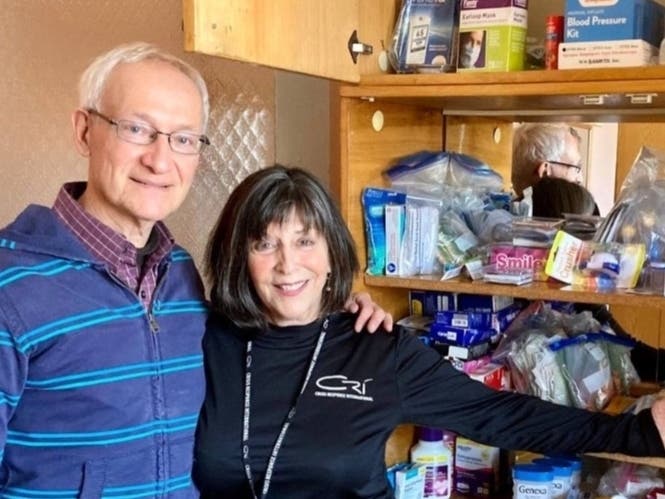
NORTH FORK, NY — When beloved Mattituck pediatrician Dr. Thomas Mercier and his wife Barbara, a nurse, announced his retirement in 2017 after 40 years, the community, while saddened at the thought of saying good-bye, wished them many years of love and happiness.
But, while many may have just seen retirement as a time to kick up their heels and relax, maybe taking trips to see family or to pursue new hobbies, Dr. Mercier and Barbara followed their hearts and faith toward a mission that had long been important to them both — helping the people of Ukraine.
The pair returned Friday from a trip to Ukraine where they lived in a building with refugees — and this week, both spoke with Patch about their journey.
Find out what's happening in North Forkfor free with the latest updates from Patch.
Barbara said they knew they had to go, had to do all they could to help. "Everyone is watching what is going on in Ukraine and we're all horrified," she said. "Our hearts are broken."
The Merciers have deep ties with Ukraine, having volunteered on at least seven mission trips there since their first in 1995, when they went as a family.
Find out what's happening in North Forkfor free with the latest updates from Patch.
Imbued with deep faith, the Merciers said they wanted to teach their children about the importance of giving back. "We live in a lovely community," Barbara said. "Life is good. We are blessed. We'd go to Disney World, and do fun things — but we'd begun to feel that it was important, that you have to give, too."
The trips include a group of "like-minded, similar-hearted people who throw everything aside" and just focus on the work at hand, Barbara said.
They became involved with the Arise! Ukraine ministry; both now serve on the organization's board of directors.
"We fell in love with the Ukrainian people, the culture, the richness, the legacy," Barbara said.
Over the years, Barbara said, she and her husband have seen the shift in the Ukraine sensibilities. Communism had just collapsed and the people felt as though no one should be or act better than anyone else. "There was a feeling of, 'A blade of grass that sticks up higher is going to be cut off,'" she said. "There was an atmosphere of fear — not to do anything to stand out."
In the 27 years since, Barbara said they have seen culture shift, with young people emerging as strong entrepreneurs and business people — adventuresome young adults who are free thinkers.
But when Russia invaded Ukraine, with bombs destroying cities and lives, the people of Ukraine were experiencing something unlike anything they'd seen before.
And Dr. and Barbara Mercier knew they had to go. "We felt we really wanted to do something," Dr. Mercier said. "We felt as though the world was watching, and no one was doing anything."
Both Dr. Mercier and his wife had also become involved in Crisis Response International, a Christian organization, and decided to reach out and see if they could help Ukraine refugees in Poland.
"They started sending groups in waves," Barbara said. Part of the fourth wave, the original plan was that the couple would go to Poland. "By the time we got there, they felt the best thing we could do to really help was to go into Ukraine and be present — working and living at the refugee center," she said. "It was a bit of a surprise."
Added Dr. Mercier: "I was very apprehensive. I didn't feel like it was safe. It wasn't safe. It's a country at war."
Barbara, he said, wasn't deterred. "Barbara is very adventure-oriented," Dr. Mercier said.
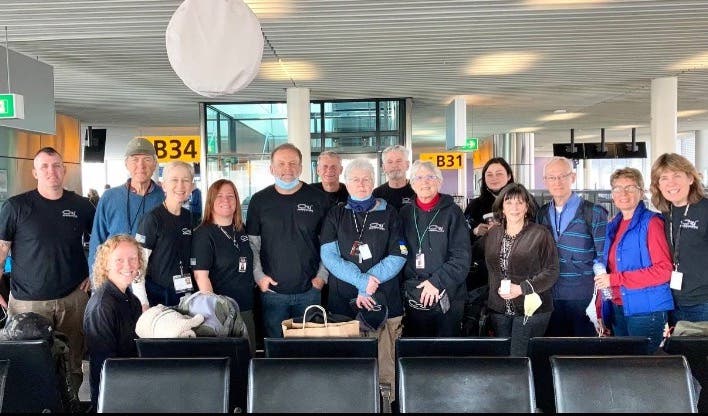
The couple flew into Poland, then were brought by chartered bus to Stryi, a city in Ukraine. They were members of a team of 18, volunteers from all across the United States, all of whom came "loaded down" with donations, including medical supplies.
The team left Poland, where their passports were checked. After a half hour of passing through an area Dr. Mercier described as "no man's land," they reached Ukraine, where they experienced a "very quiet border crossing, but very official," and their passports were checked again, Dr. Mercier said.
They drove for about two hours into Ukraine, where they pulled up to "this old, Soviet-style building, a little bit crumbly and dilapidated, in disrepair," Barbara said.
"It was pretty dismal," Dr. Mercier said.
Of the five-story hospital building, only one floor was being used as a medical facility; the rest of the building still had running water and flushing toilets, so local officials decided to open the building as a haven for refugees from Kiev and other places — those fleeing the war who did not want to leave the country, Dr. Mercier said.
The town officials had posted on Facebook about the refuge, and soon, people, some of whom come in their own cars and others, via public transportation, began knocking on the door, desperate for safe haven.
Families, some with three, others with up to seven, were placed in rooms about 10-feet by 10-feet wide, he said. Some families had bathrooms; others shared a bathroom in the hallway.
They were not the typical refugees, Dr. Mercier said. "You could tell, by looking at them, that these were people who were not used to living five in a room. These were people who were educated, successful."
One young man, 21, was there with his parents, his grandfather, and their dog; he told them that his father was retired. He'd had a very successful business and had been able to retire while still young.
"We're not talking about people who are destitute, who don't have a comfortable lifestyle," Dr. Mercier said.
"They're just like you and me, and all of sudden, someone drives them out of their lives with bombs," Barbara said.
All, Dr. Mercier said, were traumatized, serious, sober, and confused. "They didn't know if they'd ever be able to get back to their towns, or if they'd have to leave Ukraine. They all had an attitude of, 'Why is this happening to us? We didn't do anything to confront or antagonize anyone.'"
The refugees also wanted to know why more wasn't being done, Dr. Mercier said. "Their feeling was, 'Why is the world letting this happen?' 'Why isn't our government sending planes and troops? This is something like World War II, where the Nazis killed 6 million Jews, and everyone is just watching,'" he said.
Barbara said she and her husband arrived in Ukraine, like the rest of the world, they'd been seeing the scenes of horror unfold on television. Because they'd been in Ukraine many times before, they were in direct communication with friends, in real time.
And while, as a couple from the United States, they couldn't do anything about airspace or missiles, they could join other volunteers, packing up their bags with supplies and boarding a plane in solidarity.
"We were there to look in their eyes, to hug them and say, 'We love you. We care. God cares. We don't have much to hand to you, but we came from America, to your nation, to tell you that you're worth it," Barbara said.
And, she said, as they held the refugees' hands and looked into their eyes, "We saw them grow tender, and cry, as they told their stories."
The Bible, she said, teaches lessons on loving God and one another. "And we got to do that for them, during this time in history," she said.
The stories will resonate forever, both said — moments of grace that shone through the darkness.
There were the washing machines that they were able to have delivered to the building, that were installed. There was the little boy, a talented guitarist, who'd had to leave his guitar behind.
"We purchased a guitar for him," Barbara said.
For their translator, an educated woman who wrote poetry, they were able to procure a laptop.
All the refugees, no matter their station in life, worked together, mopping floors, cleaning, cooking, sorting clothing — creating a sense of normalcy in a time of the unthinkable.
And yet, Dr. Mercier said, the refugees had been blindsided by the invasion. "There was an older lady who left in such a hurry, she had no teeth — she'd forgotten her dentures," he said. "That gives you an idea of the chaos, the kind of fear and pandemonium when they were leaving, that someone would forget their dentures."
One 22-year-old told Dr. Mercier that he was from eastern Ukraine; he'd already lived through two wars and didn't want to live through another and was planning a life in Australia or America.
Their days in Ukraine were spent dispensing medication to many who'd rushed out of their homes with not enough insulin, or blood pressure medicine, or other critical supplies. Most of the refugees they met were the elderly, the women and children — the men had stayed behind to fight.
Although the area where they were staying had seen no war damage, they were able, Dr. Mercier said, to get trauma kits sent out to people on the front lines, including bandages and tourniquets.
They were also able to help a family, including a husband, wife, their children, and their newborn, out of Ukraine and into Poland; the baby was born before they left.
"To see a new life, it was great — and her name was Barbara," Barbara said. "That was joy, in the midst," she said.
The days were long, and many just stayed in their rooms, private with their thoughts. But Barbara said there were some gatherings, where the group sang and worshiped the Lord. One night, the refugees invited the Merciers to enjoy a night of Ukrainian songs, music, and poetry.
Above all, the refugees they met were glad to be alive and grateful for safe shelter, Dr. Mercier said. "They were able to assess the situation and say, 'We've lost our homes, we've lost our entire city, but we are alive and here — so we are grateful for that."
Despite the fact that they didn't see any war damage, there were ominous reminders. "Every night, we'd hear the air raid sirens," Dr. Mercier said. "Just like what you hear in the old movies."
They huddled in a hallway, not sure of where the bomb shelter was, when the air raids sounded, Barbara said.
There were voices on loudspeakers, making announcements in a language they didn't understand, also disconcerting, Barbara said.
And there was the group of 24 orphans who were expected at the shelter, who'd been living in a basement for weeks — a stark reminder of what the people of Ukraine were enduring. "We prepared a place for them, we made decorations," Barbara said. "There were lots of devastating stories."
But there were also life-affirming moments, such as when a woman who worked in the kitchen shared her experience of hearing the gospel in 1995 and receiving Jesus as her savior, Barbara said.
The experience was deeply fulfilling, Barbara said. "To watch the atmosphere in a room, and in a person's eyes, shift from terror and fear to a sense of connectedness and hope — I felt that," she said. "There was a sense of hope being imparted."
Many of those in Ukraine didn't want to leave their country, Barbara said. "We got to live with people who have a heart, who were truly courageous," she said.
Barbara said when it was time to head back to the United States, they weren't ready to leave; Dr. Mercier agreed they will go back one day.
In the meantime, he urged people to contact their elected officials. "Tell them to please do everything possible to help the Ukrainian people," he said. "Close the airspace, send munitions, tanks troops — do everything you can to stop this barbaric nightmare."
Barbara said the community has been generous with sending supplies and that giving is needed and should continue. She also urged others who find themselves with the calling to go in person to help in Ukraine, to find their way.
"I would encourage them not to be afraid, if you have a heart to go," she said. "He's 70. I'm 68. I think we were made for this."
Get more local news delivered straight to your inbox. Sign up for free Patch newsletters and alerts.