Politics & Government
Hashamomuck Cove Residents After Storm: 'Who's Going To Help Us?'
"The Hashamomuck Cove discussion has gone on long enough. The board needs to make a decision." — Scott Russell.


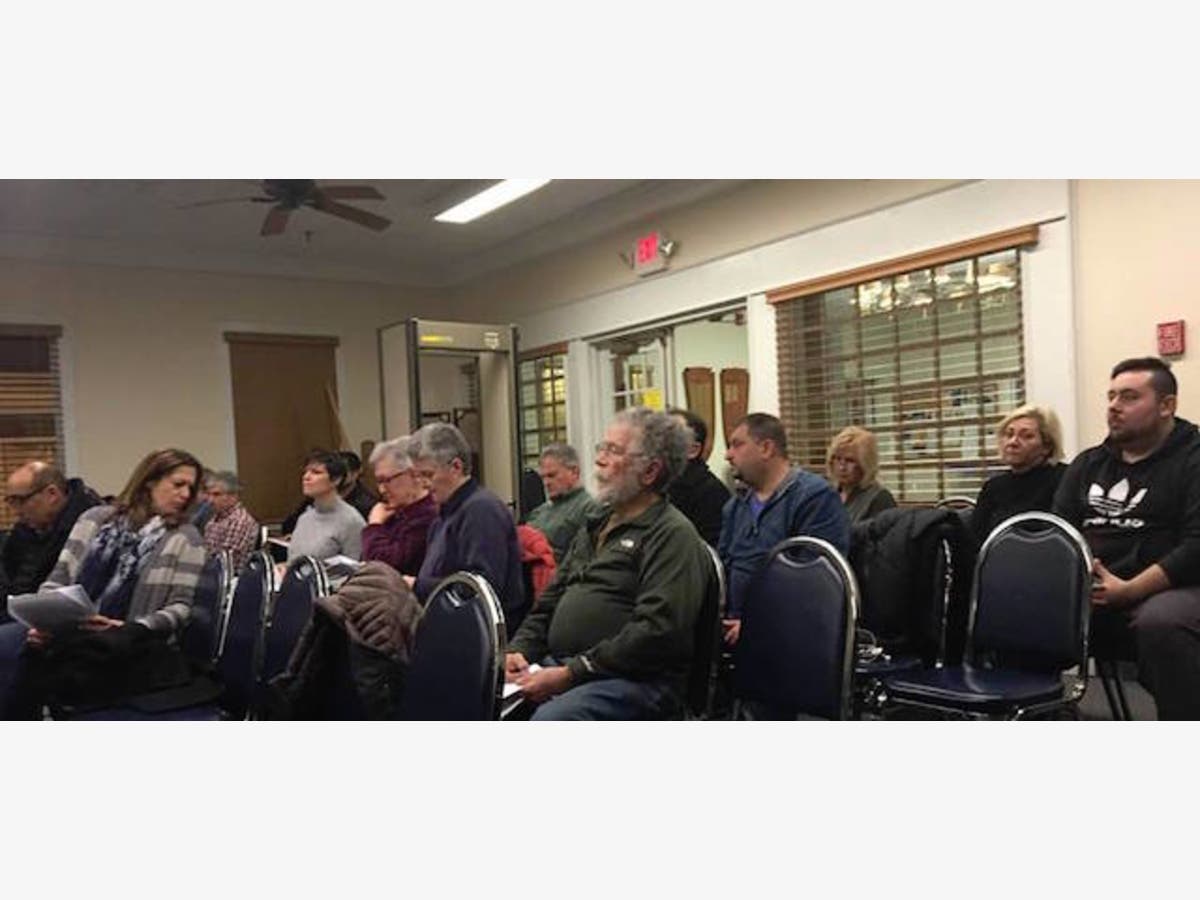
SOUTHOLD, NY— A group of residents implored the Southold town board to help them find a solution to a desperate situation at Hashamomuck Cove that they say could mean devastating impacts sooner than later, should another major storm batter their homes and breach County Road 48.
After the recent "bomb cyclone" slammed the North Fork, a fishing shack that has stood since the 1920s at Hashamomuck Cove was smashed, battered and completely washed away. Bulkheads were destroyed, homes severely damaged.
And homeowners were left surveying the damage — angry, they said, that their cries for help have gone unheard for years.
Find out what's happening in North Forkfor free with the latest updates from Patch.
"It's a war zone," resident Lynn Laskos said.
However, she said, the damage was not unexpected. For years, Laskos and neighbors have been imploring government officials for help; their homes, they said, stand as a buffer between the raging Long Island Sound and County Road 48 and during a storm event, rushing waters threaten to breach County Road 48, a vital evacuation route in the event of a hurricane or emergency.
Find out what's happening in North Forkfor free with the latest updates from Patch.
After the most recent storm, Laskos said, "We always said we're the buffer to County Road 48. Now, our houses are so damaged that even if we wanted to be that buffer, we couldn't be. Now it's time for the county and town to step it up."
At Tuesday's Southold town board work session, Councilman Jim Dinizio said he was hoping for a discussion on what decisions have and haven't been made; since the storm, he's been asking questions and has called the United States Army Corp of Engineers and speaking to residents, he said.
He said based on numbers he had been given by Southold Town Engineer Michael Collins, who got that information from the ACOE, the cost for a plan to shore up and renourish the beach at Hashamomuck Cove could cost Southold Town $488,855 per year for the full 50 year project.
"I'm not going to go for that," Dinizio said.
He added, though, that something needed to be done.
"This isn't going to get better. It's only going to get worse," he said. "We need to make some decision for these people."
Dinizio said he just wanted the correct and accurate information out there for the public.
At Tuesday night's town board meeting, Laskos said that numbers disseminated at the morning's meeting were incorrect.
"The numbers that were shared were, unfortunately, inaccurate," she said. The ACOE sent her the correct numbers earlier, she said; she said she'd sent those numbers to the board before the meeting. "I'm confused why inaccurate information" was put out for the public, she said.
Dinizio posted the inaccurate numbers on Facebook, Laskos said. "It ended up being a lot of controversy with a lot of people having some really bad information," she said.
According to the new numbers, Laskos said the portion for a local sponsor — which could be the town, county, Water Authority, or another party — would be a $1.5 million initial cost, with 50 percent of that, the town's share, or approximately $764,500.
Renourishment every 5 years would be $273,000 every 5 years, or $54,600, for the town's share, she said.
"How much does the town spend a year for the band aid approach?" she asked. Under the proposed plan, a solid beach of at least 25-feet out with 6-foot elevation, would be created.
Dinizio pointed out that the numbers he initially posted were the numbers most recently available.
At the work session, Southold Town Supervisor Scott Russell said questions needed to be answered, such as what the town's portion would be if a nor-easter hit the area hard. He added that the numbers presented by town engineer Michael Collins were the numbers he'd been given by the ACOE.
Laskos, at the meeting, said the ACOE had told her in certain situations, if the storm wipes out a "significant" area of the town, it would fund 100 percent of the repairs.
Russell said he'd like the terms defined under which the feds would pay 100 percent and said not all areas were clearly delineated, or defined — and were, instead, "subjective" — and other costs needed to be specifically outlined, such as mobilization costs, maintenance, town costs, and other issues.
Also, he said, the state has not officially signed on for its portion of the plan.
Laskos said she'd spoken with New York State Senator Ken LaValle and was speaking to U.S. Senator Chuck Schumer.
Dinizio said he didn't look at the issue from the broader perspective of global warming. "I see it as a narrow 5 or 6 month decision," he said. "We need to make up our minds if we want to fund it one way or another," Dinizio said, adding that he wanted a letter from the county stating their position. County Road 48 is a county road and the county road has responsibility, he said.
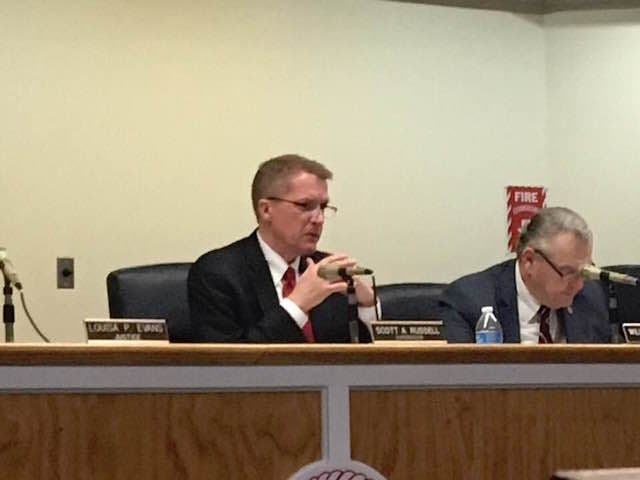
In an email after the work session Russell responded to a question about next steps for Hashamomuck Cove: "The Hashamomuck Cove discussion has gone on long enough. This board needs to make a decision. Yes, we will be a local sponsor, or no, we won't. The board should be more than familiar enough with the facts and the costs to say yes or no at this point in 2 weeks."
He added that he wanted the full board present for the decision; Councilwoman Jill Doherty was away and not present Tuesday. Russell said the board could make its own decision without waiting for the county or state to render its decision.
At the meeting, Russell reminded that County Road 48 is not a town road, and the town "has taken no action to cause this." Residents, he said, pay county taxes.
Even if a taxing district was established, as has been suggested by Russell — residents have said now that they understand the concept, it's an idea they would be willing to pursue — there would be other costs to the town, the supervisor said, in the event of major storm damage.
Calling for a roundtable discussion
After the work session, Laskos said, "My takeaway is there is a lot of misinformation and inaccurate facts floating around. The homeowners would welcome a roundtable with elected officials, the ACOE, and the New York State Department of Environmental Conservation," she said. "We'd like to sit down and figure out a solution that will make everyone comfortable."
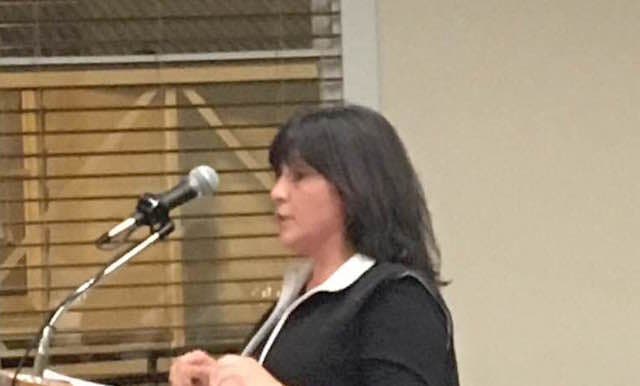
At the town board meeting, Laskos said she's a registered voter, with her home on County Road 48. The issue, she said, is not about the homes, but the fact that County Road 48 is a major artery in danger should a storm breach that roadway again.
And, she said, a groin built in Southold Town in the 1960s was the reason for the erosion that has wiped away the beach at Hashamomuck Cove. "Where were the town trustees then? Why did they allow that groin to be built?" she asked.
Residents on Bayberry Way and Ruch Lane could find themselves trapped on virtual islands, should Country Road 48 become impassable in a storm, she said.
If the road breached again, emergency responders could find it impossible to reach residents in a crisis, she said.
"This is scary," Laskos said.
She added, "Our homes can no longer be the buffer," to County Road 48. The most recent storm shattered bulkheads and compromised all 3 coves, she said, including the town beach cove, the cove near residents' homes, and the cove near the Soundview.
Laskos urged the town board to organize a roundtable with all representatives on all levels of government, as well as homeowners, at the table. "We want skin in the game," she said. "We're not asking for freebies. We want to understand how to help."
She said she'd been speaking not only to the ACOE but to Schumer's office and New York State Governor Andrew Cuomo's office. "We're not leaving it lie," she said, adding that the ACOE would be coming to Hashamomuck Cove Thursday for a site walk.
Russell said he wanted to meet with all involved to get the accurate information. "I want them all in one room and I want the numbers in black ink, for a change," he said.
To suggest the town, as a local sponsor, would only have to do "modest maintenance, is irresponsible," Russell said.
An emergency plan, previously suggested, to put sheathing on the road, Laskos said, could damage the houses, but even if residents were reimbursed for that damage, the issue remains that it's still a band aid approach.
"This is a serious problem," she said.
As for the town beach, Russell said the town hasn't spent money on the beach when it couldn't absorb the costs and even a band aid approach costs less than the annual costs of maintaining some town recreational facilities. The most recent sand brought to the beach was donated by the Cross Sound Ferry, Councilman Bob Ghosio reminded.
Residents implored the board to help.
Kathleen Phelan, who lives in Hashamomuck Cove, said while she understands the financial component for the town is difficult, she was asking the town to help residents find a means of financial support, whether through infrastructure or commercial entities. Forming a tax district, she said, is something residents would consider. Once residents understood the meaning of easements, she added, they were not against them.
Russell said it wasn't just about the cost: "It's a fundamental, underlying philosophical issue of whether the town wants to be in the business of restoring private property. This isn't all about protecting County Road 48."
Laskos said if County Road 48 weren't a concern, residents wouldn't have received the attention they've garnered to the current day.
Residents' homes, she said, are protecting the county's road. "We're getting beaten. We're all running out of money. We can't fix our houses," she said.
Southold's Doug Hardy, a retired oceanographer, spoke about the "elephant in the room," which was sea level rise.
By 2100, the sea level could rise between 19 and 59 inches, he said. "The most recent forecast is 6 to 7 feet," he said.
"The solution is going to be unfavorable and this could cause some resentment. You're not going to like what's going to happen. But it appears poor real estate decisions have been made," Hardy said.
Solutions should focus on preserving and saving County Road 48 and New York State Road 25, as well as the Long Island Rail Road for at least 100 years, he said. Decisions need to be made for strategic fortification of those roadways and the railroad, he said.
"What you should be looking at is not to be held hostage by people who have made poor real estate decisions but the most cost efficient engineering to protect County Road 48 for the next 50 to 100 years," Hardy said.
Route 48 could be moved landward, he said.
Dinizio reiterated that for him, the issue was not about climate change. "The taxpayers of our town deserve an answer that comes sooner rather than later," he said.
Laskos countered Hardy's statements: "Our houses were not poor choices," she said. The homes are older, standing since 1908; her family's home was built in 1918. When those homes were built, there was 200 feet of beach before them, she said, and about 160 feet when her family purchased the home.
It was a groin approved by the Town of Southold trustees that caused the severe erosion, she said.
Harry Bashian said his house sits 2 houses west of the Soundview. "High tide hits my house," he said.
During the last devastating storm, his bulkheads and deck collapsed. "If another wave comes by we're going to lose the whole property," he said.
Once the houses are swept away, or if owners can't afford to fix them, "the bigger issue" will be that County Road 48 will no longer have a buffer, he said. "I'm worried in a month, my house won't be there anymore. We as a community need to rise up and put this above every thing else," he said. "What is going to happen in a few months when I don't have a house. Who's going to help me?"
While there's much talk, nothing is being done, he said.
"Our houses should not be protecting Route 48. It's not fair. Who's going to help us?" he asked. "We need to stand up as a town and as a county, get together and put this at the top of the agenda. We need to fix this problem. It won't go away on its own."
John Katsigeorgis agreed, and said County Road 48 is needed by all. "When our houses are gone, someone will have to pay for that road. The town has a vested interest in saving that road, and if it's not a town road — be on our side. Help us to get the people that the road belongs to, to get them to step up and help us to save that road."
Joseph Yenna said, of the beach, "This is accelerated erosion," brought about by the groin. In other communities, such as the Jersey Shore and the Hamptons, eroded beaches have been re-nourished, while Hashamomuck Cove residents wait. "We're still sitting here waiting to solve a problem we really need to get behind," he said.
Robert Dunn thanked the town for its work near his Peconic community and said if County Road 48 breaches, damage would impact the entire town.
Russell said the notion that the town hasn't been behind the issue "isn't fair." The town, Russell said, has attended many meetings; he has walked the site with county reps. "The town hasn't been sitting idly by," he said. "We've been discussing it to death like every other agency. That's why this board will say yes or no" to being a local sponsor, "and I would like to say that we will do that in 2 weeks."
After the recent storm, Southold Town Police Chief Martin Flatley said a portion of Route 48 between Boisseau Ave. in Southold and Chapel Lane in Greenport was closed due to flooding at Hashamomuck Cove. There was flooding and water damage by Albertson Lane in Greenport, Flatley said.
Laskos said much of that debris might have come from bulkheads that were battered and destroyed; the beach was littered with fields of broken and splintered wood and shattered remains of bulkheads.
Homes sustained water and structural damage, Laskos said.
Laskos said her heart broke when she had to call her longtime friend and neighbor David Corwin and tell him that his family's shack, which had stood for generations, had been wiped away.
"It is only a matter of time and the right storm and the bulkheads and houses that are protecting County Road 48 are going the way of the shack in a storm. Then County Road 48 will be out of service for days or weeks rather than 2 hours," Corwin said.
As far back as 2006, then Congressman Tim Bishop said the situation at Hashamomuck Cove was desperate, with a badly eroded shoreline, homes threatened, and a major roadway, gas main and power lines at risk. At the time, he first called upon on the United States Army Corp. of Engineers to conduct the study.
Laskos said for all the money spent since on studies, a solution could have been rendered.
In August, 2016, with erosion still an issue, a press conference was held at the site, with Rep. Lee Zeldin and local elected officials gathered.
On August 12, 2016, Zeldin said, the U.S. Army of Corps of Engineers released the Draft Integrated Feasibility Report & Environmental Assessment, which outlined the proposed coastal storm risk management project for Hashamomuck Cove.
The proposed project, which was estimated to cost $17,749,000, would encompass 1.5 miles of developed coast on the Long Island Sound, including 58 residential structures and two commercial properties.
Zeldin highlighted the details of the project, announcing that the proposed project, which is broken down into three parts: the West Cove, Central Cove, and East Cove, includes plans to build a 25-foot berm in the West Cove, a variable-width berm between 25 to 75 feet in the Central Cove, and a 25-foot berm in the East Cove.
Overall, 160,000 cubic yards of sand would be needed to enhance the coastline, including 34,000 cubic yards in the West Cove, 56,000 cubic yards in the Central Cove, and 70,000 cubic yards in the East Cove.
The initial planning and engineering costs will be covered 100 percent by the federal government, Zeldin said.
The initial construction cost share would be covered 65 percent with federal funding — with 35 percent still needed to be provided by a non-federal partner at the town, county and or state level, Zeldin said.
The cost of re-nourishment over the long term, 50 year life of the project will be shared 50/50 by the federal government and a non-federal source.
When asked if a public private partnership or corporate sponsorship was a possibility, to generate between $6 and $7 million in funding for the remaining 35 percent needed, Zeldin said he'd go back to the ACOE to find answers.
When asked about the issue after the storm, Suffolk County Legislator Al Krupski said, "Certainly, the county will take care of the road and make sure the road is secure." The county and town would not be able to address issues on private property, he said.
"Mother Nature calls the shots. That's the reality. Mother Nature is calling the shots here, not her, and not me," Krupski said.
He added that he has a long history of addressing the issues at Hashamomuck Cove, beginning when he was a trustee and through devastating storms over the years. "It's Mother Nature," he said.
Zeldin spoke out on Hashamomuck Cove after the recent storm damage: ""The Hashamomuck Cove project is important to protect local homes, businesses, and infrastructure, including County Route 48, which is a critical roadway for transportation, first responders, and the sole evacuation route in case of an emergency," he said.
"Local businesses, residents, and first responders cannot afford to wait as their properties and access to Route 48 continues to be threatened. I will continue to work closely with the Army Corps and local officials to ensure this pivotal project continues to move forward," Zeldin said.
Patch photos by Lisa Finn.
Get more local news delivered straight to your inbox. Sign up for free Patch newsletters and alerts.