Community Corner
Kayaker Rescued In Long Island Sound 'Eternally Grateful'
"In those moments I felt an overwhelming sadness in thinking I might not see my children, wife, and family again."


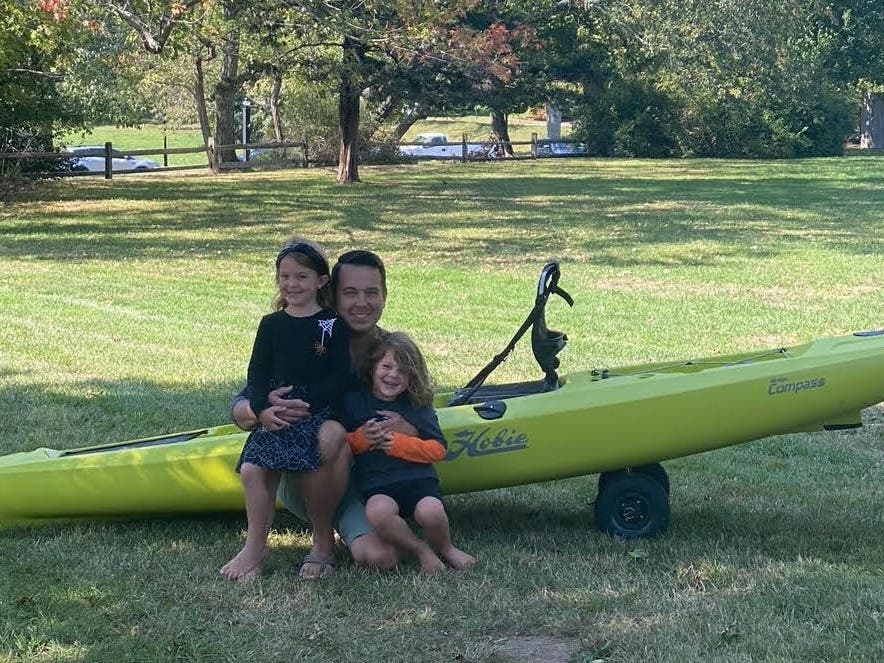
SOUTHOLD, NY — A Cutchogue man who was rescued after his kayak capsized in the Long Island Sound on Saturday is grateful to be alive.
Jesse Downing, 35, told Patch that he wanted to share his story not only to thank those who brought him to safety — but also, to outline his experience so that others realize how critical it is to be prepared, and to embrace safety measures, on the water.
The preparations he made before setting out undoubtedly helped to keep him alive during his frightening time in the Sound. To that end, he outlined the steps he took with Patch, with an eye toward raising awareness and preventing tragedy.
Find out what's happening in North Forkfor free with the latest updates from Patch.
"If this could save even one person's life, it's worth sharing," Downing said.
According to Southold Town Police, the incident took place at 8:42 a.m. Saturday just north of McCabe's Beach on North Sea Drive. A mayday call came in on VHF 16 that Downing, of Cutchogue, was in a yellow kayak that capsized, police said.
Find out what's happening in North Forkfor free with the latest updates from Patch.
Southold Town Police marine units located him grabbing his kayak a half-mile away from shore, police said. The Southold Fire Department launched a small boat at the beach to retrieve Downing and his kayak, police said.
Downing was transported to Stony Brook Eastern Long Island Hospital as a precaution, police said.
Memories of the morning are vivid, Downing said. "I planned to launch from McCabe Beach in Southold around low tide with the intent of fishing the incoming tide for a few hours," he said.
An avid, lifelong angler, the location is one he has frequented both from the surf, as well as inshore via kayak, Downing said. His float plan, he said, involved following some previous routes and fishing several waypoints he had marked on h GPS unit.
In addition, Downing said he had been following the weather and tide forecasts for several days prior, which indicated generally favorable water conditions during the planned time frame.
"Upon arriving at the beach there was a slight wind of 5 to 10 miles per hour and I confirmed visually that the water was calm for some time before launching," Downing said. "It really looked like a great day to be on the water."
And then, what began as a normal Saturday, fishing on the Sound, turned into a life-or-death situation.
Once launched, Downing said he spent some time fishing shallow water waypoints he had marked around the Horton Point vicinity — and the water remained cooperative.
"Around an hour into the trip I noticed a massive gathering of birds around the water surface approximately a half mile north of my location," he said. "This is usually an indication that large predatory fish like striped bass or bluefish are feeding aggressively and in large numbers on smaller baitfish near the surface."
Downing made the decision at that point to navigate closer to the spot "with the intent of fishing around the blitz that was unfolding," he said. " While I was traveling north, the water quickly became choppy, and I was hit from the left by a large wave that swelled perpendicular to the general tidal flow and broke to the east. It seemed to rise up randomly from underneath the boat — and I didn’t see it coming. There was no time to edge the kayak into the oncoming wave, or to shift my center of gravity. The kayak capsized immediately."
Growing up around the water, Downing said he understands and respects that waters can be unpredictable, "particularly the Long Island Sound, which can have very strong currents and underwater structure that creates unpredictable water behavior."
His normal safety routine was key in keeping Downing alive during the most critical of moments, he said.
"When kayaking I always wear a personal flotation device, without exception, and I always carry a waterproof marine VHF radio tethered to the PFD," he said. "I’ve also practiced self-rescue and re-entering the kayak from a submerged position, although admittedly I have only done this under more serene conditions in the bay."
Upon capsizing, Downing said he immediately swam toward, and grabbed onto, the kayak, which was floating upside down. Downing has a 12-foot sit-on-top kayak, which weighs around 90 lbs. when empty, he said.
From that moment on, Downing said he was contending with a strong current running against the incoming tide, which was essentially pulling him under the boat, with waves breaking over his head.
His goal initially was to secure the vessel — the foam inserts in its bulkhead provided life-raft like features — then to flip it right side up and re-enter to execute a self-rescue.
Downing said he felt that attempting to flip the boat by lifting it from below would risk his losing his grip on the vessel — he didn’t have a great grip on it, he said – and possibly losing it in the current.
"I continued to hold onto the underside of the kayak while attempting to align my body to be more parallel with the water line," he said. "This would put me in position to jettison myself over the hull, by swimming forward and pulling the boat under me, and grab the far side of the boat. The resulting position would provide the necessary leverage where I could fall backward into the water while holding the far side of the kayak, simultaneously flipping the kayak right side up," he said.
Finally, Downing said, he was able to move into position and propel and pull his body over the hull of the kayak, grab onto the far side of the hull, and fall back toward the water, which successfully flipped the boat right-side up.
"Adrenaline was overpowering my senses but I did feel some relief that I would be able to re-enter the kayak and get myself back to shore safely," he said.
The next step would be to perform the same maneuver, he said — to jettison over the body of the boat, re-enter and rotate himself into a position where he could regain control.
"However, at this point, I was feeling the effects of fighting the current and tides, and the water temp, in the mid 50s, was taking a toll," he said. "I was having great difficulty regaining a more parallel position with the water line; fighting the current and tides was rapidly reducing my energy and making this maneuver very difficult."
At one point, Downing said, he got into position and attempted to re-enter the now right-sized boat, but he wasn’t able to securely grab structure on the kayak — and he fell back to the water.
That's when the outlook began to look grim, Downing said.
"Concern was turning to fear. Realizing how fatigued I was and that time was of the essence I decided to pivot from attempting self-rescue to calling for help," he said. "I grabbed onto the seat of the kayak, which has an exposed bar that provided a secure point for me to hold on to. In retrospect, right-sizing the boat and exposing this bar were critical. Toward the end I barely had any strength left and the kayak, was it in its previously capsized state, would not offer a very secure point to hold. I believe without flipping the kayak back to its normal position there is a high probability I would have ultimately lost my grip."
Thankfully, when kayaking, Downing always keeps a waterproof, handheld marine VHF radio clipped to his PFD, which is also secured to the vest with a tether. On Saturday, the radio had actually become unclipped from the PFD but was still secured to his PFD via the tether.
Downing was able to retrieve the radio by reeling in the tether with one hand while holding the kayak with my other hand.
The radio was already set to Channel 16, the U.S. Coast Guard emergency frequency, he said.
Downing placed a mayday call on the channel, providing his vessel description, describing his situation and his approximate location to the best of his ability, he said.
The Coast Guard responded immediately and Downing remained in contact with them throughout the rest of his time in the Sound. The Coast Guard, he said, was able to connect with Southold Town Police and the Southold Fire Department, "who had eyes on me from the beach and ultimately dispatched a small rescue boat," he said.
Emergency personnel were at the beach when Downing was brought to shore and he was taken to the hospital for evaluation, he said.
When asked what emotions had run through his mind after he capsized, Downing said: "The time frame between when I hailed the Coast Guard and when they arrived felt like eternity. I was a bit disoriented and am still unsure how long I was in the water in total, although if I had to guess it was probably somewhere between 45 to 60 minutes. Even with the Coast Guard dispatching help, I felt my situation was precarious at best."
Given the amount of fatigue he was feeling, Downing said it took everything he had to hold on to the kayak while continuing to tread water, and to keep his head above water while being carried offshore by the current.
"In those moments I felt an overwhelming sadness in thinking I might not see my children, wife and family again," he said. "Thankfully, help arrived and I was eventually able to go home. The event took a toll on my body and I spent several days in and out of the hospital dealing with the aftermath. That said, the outcome of my experience was positive, in that I am alive."
And, he said, he is thankful to those who saved him. "I am eternally grateful to all those who played a part in this outcome. I just want to reiterate how grateful my family and I are to the U.S. Coast Guard, Southold police and fire departments, and the first responders at the scene who helped me. I’d also like to thank the healthcare professionals at Stony Brook Eastern Long Island Hospital in Greenport who helped with my recovery. They are all heroes who do incredible things day in and day out."
His story, Downing said, should serve as a cautionary tale.
"While you can never be completely prepared for every situation I think there are a few takeaways from my experience which may be helpful for other water sports enthusiasts to better prepare and be safer on the water," he said. "I recognize that I didn’t do everything right and my self-rescue was unsuccessful. But I believe some combination of the below put me in a position where I did not lose my life."
There are tips water enthusiasts should follow, Downing said, including:
Always wear a PFD: "If you capsize, please recognize that you won’t have time to put it on and you will likely be struggling against the water trying to keep yourself afloat," he said.
Practice self-rescue (ideally with a trained professional) in the conditions you are likely to experience while kayaking: Practicing self-rescue, Downing said, can better prepare individuals so they don’t panic and make bad decisions in the moment.
"And even if unsuccessful, it may put you in a better position to stay alive — as I believe it did for me," he said.
Consider carrying a marine VHF radio tethered to your PFD: "If self-rescue doesn’t work, this may be your only realistic chance for a timely rescue," Downing said. "In my case, the radio, in all likelihood, saved my life."
Tether any and all items necessary for self-rescue or survival to yourself or the kayak: That, Downing said, includes the paddle, first aid kit, and marine VHF radio.
Consider going out with a kayaking “buddy”: While it may not always be possible, doing so provides a safety net if something goes wrong, he said.
"Finally, I encourage everyone to prepare in advance but expect the unexpected," Downing said. "Clearly you should not launch if you know ahead of time that the weather and tides are unfavorable. Check forecasts from multiple sources and confirm visually prior to launch. However, know that conditions can change quickly — Mother Nature is unpredictable — and you can never be 100 percent certain of what you will encounter on the water."
Get more local news delivered straight to your inbox. Sign up for free Patch newsletters and alerts.