Community Corner
New Domestic Violence Help On LI: 'I Thought I Was Going To Die'
One woman said she was strangled more than once by her ex-husband. "I thought several times that I was going to die at his hands."


NORTH FORK, NY — October marks Domestic Violence Awareness Month and on Long Island, a new organization seeks to help those struggling in abusive situations find new beginnings — and hope.
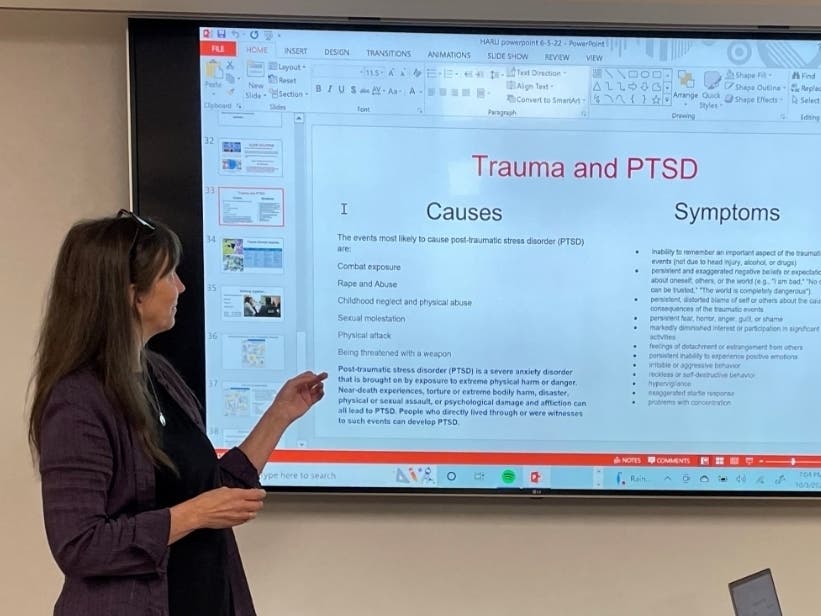
Hope and Resilience Long Island, or HARLI, was formed by Pamela Greinke of Southampton. On Monday, Greinke hosted a program at the Mattituck-Laurel Library on how to recognize the signs of domestic abuse and offer support to loved ones experiencing abuse at home.
One woman spoke anonymously with Patch about her experience after the presentation.
Find out what's happening in North Forkfor free with the latest updates from Patch.
She was in an abusive marriage for 12 years, having married at only 18, she said. Her husband cut her off from family and friends, strangled her more than once, and was physically, verbally and emotionally abusive throughout their marriage. She eventually left him, and they established a somewhat amicable relationship for the sake of their child, the woman said.
Then one day, 10 years after separating, during a heated discussion over child support, her ex-husband went into a rage and attacked her, the woman told Patch. That was the first time she ever called the police. Years ago, she explained, services were not available for women in her position, adding that she was very happy that now there are more and more agencies that support survivors of domestic abuse.
Find out what's happening in North Forkfor free with the latest updates from Patch.
"While I was in that relationship, I felt trapped," she said. "I had moved far away from family and my husband wouldn't let me socialize outside of work, so I had no friends."
She spoke about the times her husband had tried to strangle her.
"I thought several times that I was going to die at his hands," she said. "One time, I lost consciousness."
She added: "I was only able to keep looking for a way out for my child's sake. Finally, I had an opportunity to move to a small apartment, just me and my son — and that is when I started to feel hopeful for a better life."
The woman told Patch that her experience happened years ago, and she finds it easier to talk now about what she endured. Her goal, she said, was to learn about available resources and possibly one day help a friend in need.
Greinke discussed how to recognize the signs of domestic abuse. According to the National Coalition Against Domestic Violence, 1 in 4 women and 1 in 7 men have been victims of severe physical violence — beating, burning, strangling — by an intimate partner in their lifetimes. More than 10 million experience domestic violence every year. Also, half of female murder victims and 1 in 13 male murder victims are killed by intimate partners, according to the coalition.
"Many don't know what services are available or are afraid of what might happen if they reach out for help," Greinke said. "It is not uncommon for an abusive partner to threaten that if the person being abused should leave the relationship, the abuser will hurt them more, or worse, kill them."
Greinke, who has more than 13 years of experience in the field of domestic violence services, shared what some of the signs of an abusive relationship can be and explained that domestic abuse is not always physical. It can include financial and psychological abuse, as well.
According to thehotline.org, signs of those suffering domestic abuse at home include:
- Telling a person that they never do anything right.
- Showing extreme jealousy of friends or time spent away from them.
- Preventing or discouraging someone from spending time with friends, family members, or peers.
- Insulting, demeaning, or shaming a person, especially in front of other people.
- Preventing a person from making their own decisions, including about working or attending school.
- Controlling finances in the household without discussion, including taking a person's money or refusing to provide money for necessary expenses.
- Pressuring someone to have sex or perform sexual acts they are not comfortable with.
- Pressuring someone to use drugs or alcohol.
- Intimidating someone through threatening looks or actions.
- Insulting a person's parenting or threatening to harm or take away children or pets.
- Intimidating a person with weapons such as guns, knives, bats, or mace.
- Destroying a person's belongings or home.
According to Greinke, "Domestic abuse, also known as intimate partner violence or IPV, can also have a profoundly negative effect on children who witness it or intervene to try to rescue the parent being harmed."
Women do not always immediately call police, Greine said.
According to the Emory University School of Medicine, women are 5 to 8 times more likely than men to be victimized by an intimate partner and most IPV incidents are not reported to the police, with only 20 percent of rapes/sexual assaults, 25 percent of physical assaults, and 50 percent of stalking toward women reported.
However, that research also indicated that, despite "severe under-reporting" of IPV, calls related to IPV make up about half of all violent crime calls to police departments.
Greinke explained why women do not always immediately reach out for help or try to leave abusive situations.
"The reasons for this vary widely and can include fear that their children will be taken from them, fear of eviction, or fear that they will be arrested because the abusive partner said they would lie to the police and say the victim was the instigator," she said.
Hope and Resilience Long Island, Inc. was established in early 2022 to meet the need of a rapidly growing community, Greinke explained. The five East End towns saw a population increase between 2010 and 2020 of approximately 27 percent, she said.
"In the two years since, the population has continued to grow and statistically, that means more people in need of services. HARLI currently offers legal advocacy and case management services. While all services are currently provided by volunteers on a part-time basis, the goal is to raise funds to hire full-time staff to fill the demand," she said.
According to the Substance Abuse and Mental Health Services Administration, domestic violence incidents spiked during the coronavirus pandemic, with social distancing and stay-at-home orders, as well as limited resources, leading to few avenues for escape. Abusers were not able to leave for work in the mornings — leaving their victims literally trapped.
HARLI is the newest domestic violence support agency on the East End, joining The Retreat in East Hampton.
Anyone who needs help leaving an abusive situation, or who needs help navigating life after leaving, can call HARLI at 631-408-6751 or email info@harliinc.org, Greinke said.
All communication is confidential. Spanish speaking service providers are available, as well.
Get more local news delivered straight to your inbox. Sign up for free Patch newsletters and alerts.