Politics & Government
Residents 'Under Siege' Pack Deer Forum; Future Cull Possible
There's no immediate plan for a new deer cull in Southold, but possibly long-term, officials say. Residents want help now: 'This is insane."


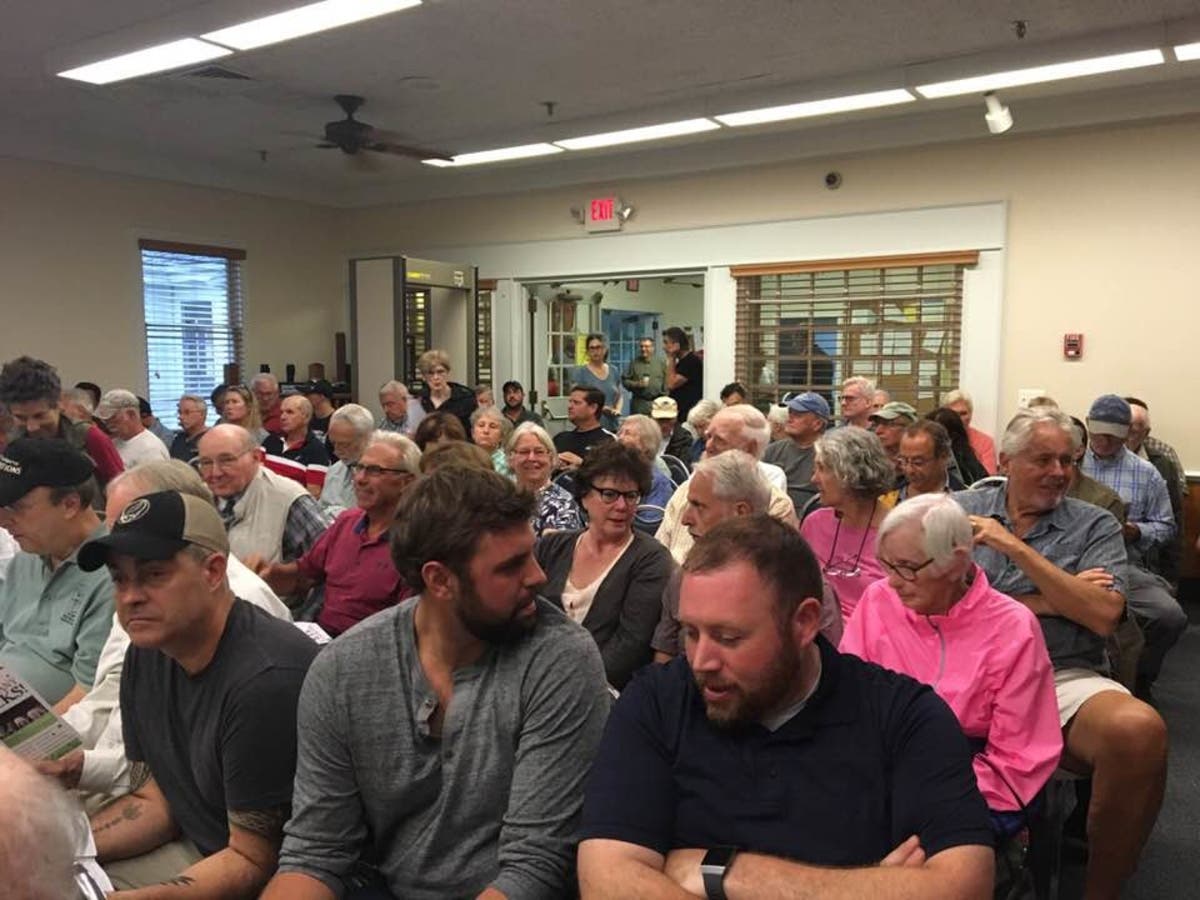


SOUTHOLD, NY — Frustrated and angry over a lack of solutions, a crowd packed the Southold Town meeting room Wednesday night, spilling out into the hallway as they turned out for a deer forum organized to address a problem they say has sparked health, environmental and quality of life concerns for years.
According to the town's wildlife manager Craig Jobes, the goal of the forum was to address and educate the public on issues sparked by the overabundance of deer found locally.
"We feel that the acceptance of the deer problem and the willingness to do something about it has been growing around the town and we would like to help further these efforts by hopefully reaching out and touching more residents who may still be unsure," Jobes said.
Find out what's happening in North Forkfor free with the latest updates from Patch.
Deer management in a location such as Southold Town can be difficult, due to the fact that a very large percentage of the town is privately owned, making it difficult to conduct deer management efforts, he said.
But irate residents want answers now: "This is insane," one woman said."You have . . . people saying you cannot get enough deer by hunting. We need money from the town — and political action — to get the laws changed. I can't tell you how many people I know who've had Lyme disease, car accidents, property destroyed. We cannot do it this way. This is a useless project."
Find out what's happening in North Forkfor free with the latest updates from Patch.
Another man, while commending the town's efforts, asked if those efforts were enough to make a tangible difference and achieve goals.
"Hunting on its own, no," Jobes said. "I think we need to combine hunting with a cull in the future — but the issue is, where it can take place. It's something we'd like to look into doing in the future, but it's a matter of efficiency and cost."
"I have to express to you, the frustration," the resident added. "We keep having meetings, with experts, but things keep getting worse. There is no improvement. If you don't have culls, and there are no town and county executives behind you, it's not going to happen. We're going to have another meeting in four years and it's just going to get worse." While he said he realizes the town was doing its best, "dramatic action" was needed.
A controversial 2014 deer cull in Southold led to legal action by a group of animal rights advocates on the South Fork; that case was eventually dismissed and the cull ended after use of allocated funding.
When asked about the possibility of a future cull, Southold Town Supervisor Scott Russell responded via email. Jobes; comments, he said, "were referencing long-term goals.There is no immediate plan to have one. Any future cull would have to be limited in scope because, we can't, and won't, hunt on property we weren't given permission to. Our more immediate goal is reaching out and trying to get permission from private landowners to permit hunting on their property."
The forum included statistics and information about the town's hunting program. Guest speakers included Sue Booth-Binczik, a wildlife biologist with the New York State Department of Environmental Conservation's division of fish and wildlife, who discussed the impacts of an overabundance of deer on the environment, as well as management options.
Allen Gosser, Wildlife Services State Director, United States Department of Agriculture Animal and Plant Health Inspection Service, gave a presentation on the USDA's approach to deer damage management across the state of New York, as well as current legislation in place that constrict types deer management.
Thomas Rawinski, a botanist with the United States Forest Service, discussed the negative effects that deer have on the surrounding ecosystem and plant life. For years, Rawinski has been presenting his studies and findings all around the northeast; he is currently working on a study in Southold Town with Jobes.
Although the forum did not focus on ticks, that will be the subject of a future meeting, Jobes said.
Booth-Binczik said deer are best at eating and reproducing; one doe, beginning at a year old, can produce two fawns per year and live up to 20 years. "They can crank out a lot of babies in a lifetime," she said.
The deer population, she added, can double every two years.
Deer, she said, evolve despite their high mortality rate as a prey species. While historically, deer predators were wolves and mountain lions, those were eliminated long ago and even current predators, including bobcats and coyote, do not exist on Long Island.
"Predators really aren't able to control the deep population in New York anymore. We rely on hunting but in the more developed areas, there's not a lot of hunting," Booth-Binczik said.
The principle source of deer mortality is car strikes, with more than 70,000 deer/vehicle collisions in New York each year. "Compared to the number of deer, it's not that significant. As a result, the deer population continues to grow," she said. "Deer just do really well, living with us."
"People feel they are under siege"
Deer, Booth Binczik said, find food and their preferred forest edge habitats in North Fork neighborhoods. "Their unnaturally high survival rate, combined with naturally high reproductive rates, lead to a phenomenally high deer population. People feel they are under siege."
Negative impacts, she said, include collisions, damage to agriculture, degraded forests and natural resources, and public health impacts.
Municipal, controlled hunts have been a very successful model in some communities, she said. "However, hunting isn't enough," she said, adding that a combination of approaches — including surgical sterilization; and catching but not killing — might be used. "The next step is culling, shooting deer outside of the hunting context, which requires a permit" from the New York State Department of Environmental Conservation, she said.
Limited access in Suffolk County severely hinders efforts to control the burgeoning deer population, Booth-Binczik said, with cooperation and collaboration needed from private landowners. "If you don't have access you won't be able to reduce the population."
Restrictions in Suffolk County, such as the inability to hunt with crossbows, makes the task even more difficult, she said.
While deer fencing for farms might be effective, it's impossible to erect deer fence around an entire community and one person doing so sends the deer out into the community, raising problems for others, she said.
One resident said stronger words need to be used in language to discuss the problem. "It's a menace," she said. "You use words like 'sustainable.' It's not sustainable for human life, ultimately," the woman said.
Gosser discussed deer damage management and wildlife damage, with impacts on agriculture, property, natural resources and human health and safety. "In a community like Southold, the deer touch all of those rails," he said. "It's a herculean task," with a goal of integrating as many solutions as possible, he said.
In the last five years, "our work has exploded here in New York," Gosser said. "There's been a decrease in mortality and an increase in food."
For example, he said, from 2009 to 2013, three tons of venison, or 25,000 meals, were donated; from 2014 to 2018, that number spiked to 32 tons or 250,000 meals. "It's exploded tenfold."
In 2017, Gosser said the DEC did an internal review on issuing deer damage permits and said certain restrictions, such as not shooting within 500 ft. of a building, or bait within 300 ft. of a roadway, and the ability to use rifles on Long Island, needed to be revisited. "These tools allow the community to have effective deer culling," he said.
However, the DEC does not have the ability to change laws; changes need to go through the Senate and Assembly and this year, while new legislation to update hunting laws was passed by the Senate, the bill got rewritten on the Assembly level and died, Gosser said. The hope is to revive the bill in coming months, he added.
"The level of deer damage I see in this community is the worst I have seen in all of New York."
Addressing the frustrated crowd, Gosser empathized: "The level of deer damage I see in this community is the worst I have seen in all of New York."
One woman asked if birth control had been explored as an option and said it should be considered.
Discussing deer fencing, one resident said: "People are trying to find some way to protect themselves in their own yards. This is a major problem and we need to do something now."
The crowd applauded.
Rawinski discussed the devastation to the natural environment. He added when he sees hunters marching with animal rights activists to oppose sharp shooting of deer, "I see them as siding with the pestilence."
Alicia, a woman who lives in Westhampton and works on a produce farm also advocated for birth control options for deer. "I was looking forward to hearing all the options today," she said, adding that birth control was not brought up, "and that bothers me. I've been to Billings, Montana and studied birth control. I'm not the enemy. I'm trying to solve the problem. We keep hunting and it's not making a difference."
Gosser said one problem is that when a deer is given a dose of the birth control, it has to be captured with immobilization drugs, then, that same deer has to be located and given another dose, difficult in a town as large as Southold.
Kenneth Degan suggested possibly legislation to open up Long Island year round for hunters.
"No one wants to shoot a mother doe with fawns," Gosser said.
But, he added, "We don't have to think outside the box — we have to think outside the box store."
Jobes then discussed Southold Town's deer management program which, as of 2017, spans 28 parcels of land, or 733 acres, with 915 acres of government owned property.
Back in 2008 when the program kicked off, there were 50 hunters and seven deer harvested; in 2017, there were 292 deer harvested, "a record high;" the last record high was 288 in 2014. To date, 1,900 deer have been harvested, with 45,000 lbs. of venison donated to food pantries, Jobes said.
Goals are to reduce the deer herd to eight to 10 per square mile; at the time of the last forum, that number was 65 deer per square mile, Jobes said.
Critical, he added, is increasing public education efforts to facilitate hunting on private land and lobbying the NYS DEC to allow cross bow hunting in Suffolk County.
"Our goal is not to eliminate all deer, it's to obtain a healthier ecosystem for humans and animals," Jobes said.
After the forum, Southold Town Councilman Bob Ghosio, liaison to the town's deer committee, said the committee's goals are aimed at helping to develop deer management programs and strategies, to work on providing education on deer related issues, to vet any ideas, and work on programs with the county and state. And, since the town hired Jobes, the committee works with him on developing or implementing programs.
The forum, Ghosio said, was well-attended. "I walked away feeling the message is finally starting to resonate. We need more people to lobby the state elected officials to help create laws that would allow us to do more to curb the deer population. Pressure from the town board is fine, but the state needs to get the message from the grassroots. That carries much more weight, in my opinion," he said.
Patch photos by Lisa Finn.
Get more local news delivered straight to your inbox. Sign up for free Patch newsletters and alerts.